
Circle of Fifths Quiz
How the Scales are Structured
Who Usually Takes This Test?
See How You Compare
Below is a preview of how scores are typically distributed across each scale.
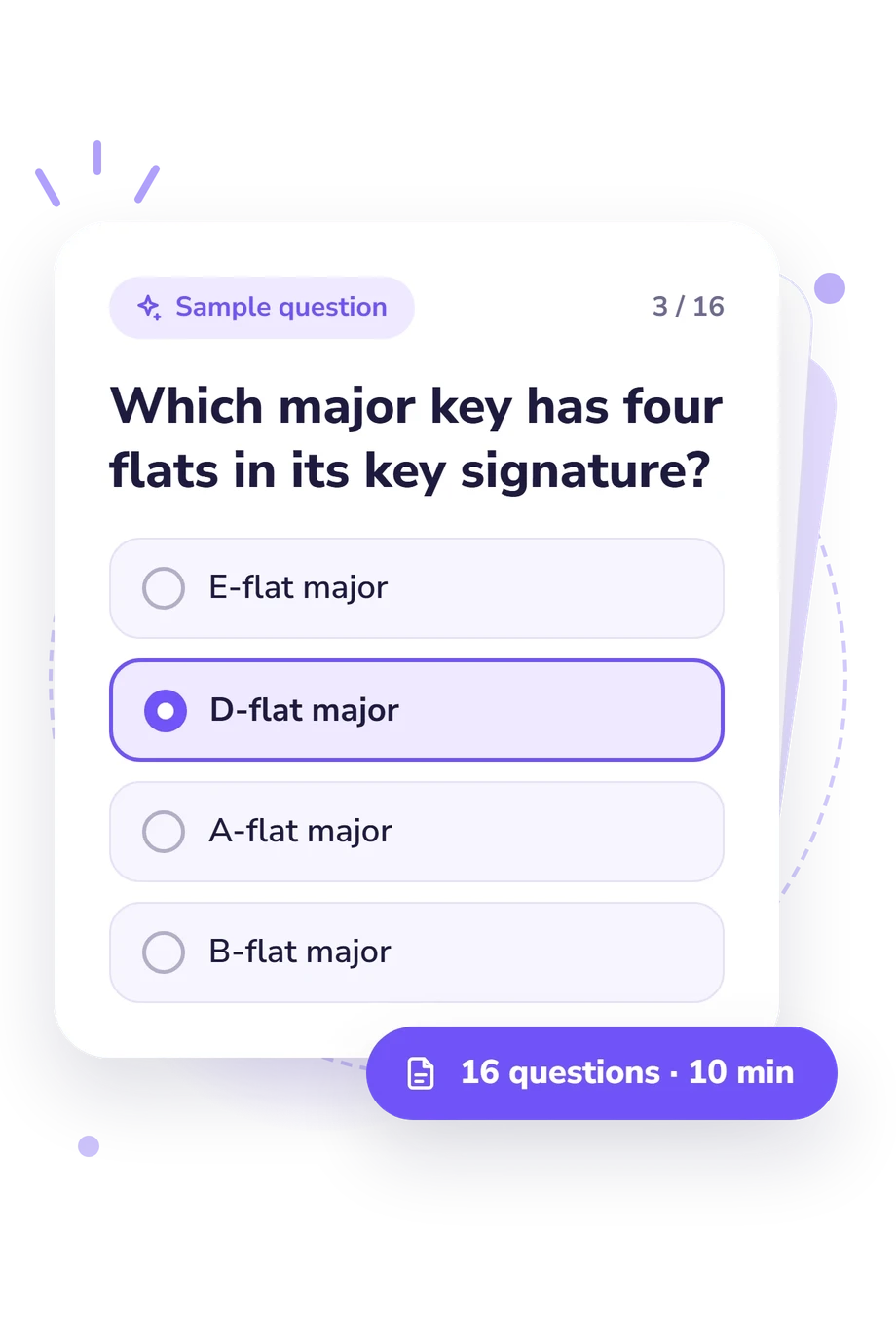
Example Questions From the Test
- C-sharp minor
- F-sharp minor
- G-sharp minor
- E minor
- B-flat major
- E-flat major
- F major
- D minor
- E-flat major
- D-flat major
- A-flat major
- B-flat major
Circle of Fifths Quiz - Description and methodology of the test
Musicians who want to check their grasp of tonal relationships can use the circle of fifths quiz as a focused self-check. It suits learners revising theory, teachers seeking a discussion prompt, and players who want to locate gaps before practice. As a key signature test, it connects notation knowledge with practical navigation of nearby keys and familiar harmonic routes without requiring a written explanation from the respondent.
What This Assessment Measures
The questionnaire examines whether a learner can read the circle as a map of major keys, signatures, relative minors, and harmonic destinations. For theory students, teachers, and players, this circle of 5ths quiz gives a picture of current fluency.
Its item themes fall into three groups:
- Key signatures show whether you can match sharps or flats with the correct major key.
- Directional movement shows whether you can follow fifths and construct sharp- or flat-side sequences.
- Relative minors and enharmonic relationships show whether you can connect shared signatures with equivalent spellings.
The result is Circle of Fifths Knowledge, ranging from 0-16. Foundations to build (0-6) indicates that core ideas need reconstruction; Developing fluency (7-12) reflects understanding with some relationships needing practice; Strong command (13-16) indicates navigation across keys, relative minors, and harmonic relationships.
Methodology and Scientific Basis
Each item uses four-option multiple choice. Prompts ask the respondent to identify key signatures, continue sharp or flat sequences, move around the circle, match relative minors, or interpret a progression. The format tests recognition and practical application rather than a written derivation.
The result is reported on one displayed scale. This music theory quiz gives a snapshot of fluency: it can show whether the learner needs to rebuild the layout, practise familiar applications, or navigate related keys accurately.
Circle of Fifths (Ewell and Schmidt-Jones, 2013) supplies the framework for fifth-related keys, key signatures, and relative minors; the questionnaire is conceptually consistent with it, not a reproduction of the source. The tested applications include identifying major keys from one to four sharps or flats, tracking clockwise and counterclockwise moves, and pairing major keys with relative minors.
Interpretation is educational: the displayed bands are descriptive categories, not population norms. Guessing, recent study, and familiarity with notation can affect performance, so a lower band identifies review topics rather than defining musical ability.
- Ewell, Terry B., and Catherine Schmidt-Jones. “1.11: The Circle of Fifths.” In Music Fundamentals 1: Pitch and Major Scales and Keys. OpenStax CNX, 2013.
- Maske, Dan. Circle of Fifths Explained: Understanding the Basics of Harmonic Organization. Hal Leonard, 2020. ISBN 9781540069481.
- Benward, Bruce, and Marilyn Saker. Music in Theory and Practice, Volume 1, 10th ed. McGraw-Hill Education, 2021. ISBN 9781260493450.
- Telesco, Paula J. “Teaching Secondary Dominant Triads and 7ths through the Circle of 5ths.” Journal of Music Theory Pedagogy, vol. 35, article 13, 2021. DOI 10.71156/2994-7073.1374
Updated: