
Russian Quiz
How the Scales are Structured
Who Usually Takes This Test?
See How You Compare
Below is a preview of how scores are typically distributed across each scale.
Example Questions From the Test
- Oleg arrived after his train departed.
- Oleg’s train departed at 8:15.
- Oleg arrived fifteen minutes before departure.
- Oleg spent thirty minutes traveling to the station.
- ходили (khodili)
- идём вчера (idyom vchera)
- пойдём (poydyom)
- пошли бы вчера (poshli by vchera)
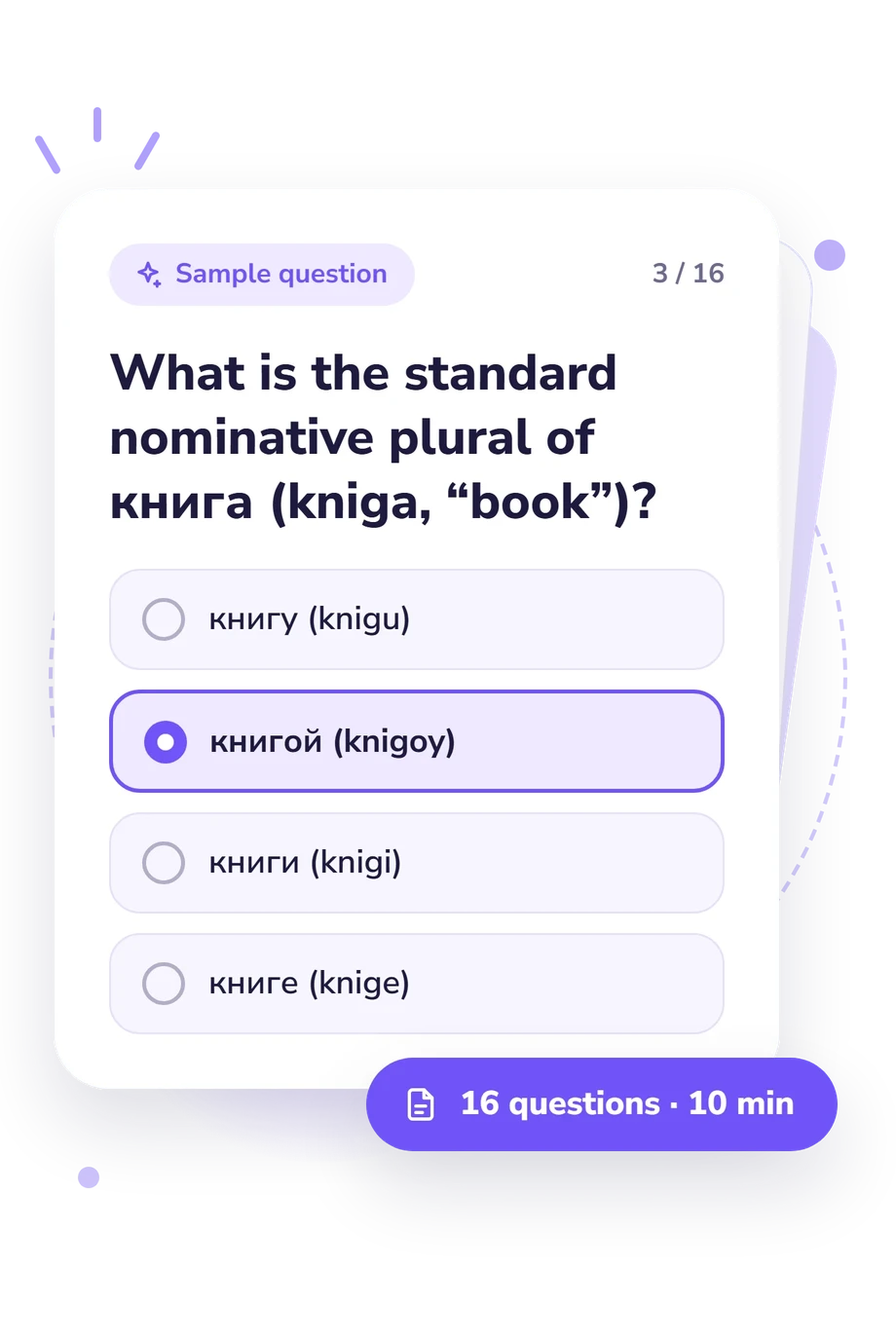
- книгу (knigu)
- книгой (knigoy)
- книги (knigi)
- книге (knige)
Russian Quiz - Description and methodology of the test
For learners who want to check practical Russian before choosing what to study, this Russian Quiz offers a focused self-check. It suits beginners and early learners who recognise familiar words but want a clearer picture of everyday comprehension. This practical russian language quiz links individual answers with concrete priorities for vocabulary, grammar, and reading practice.
What This Assessment Measures
This assessment checks practical comprehension of beginner Russian rather than speaking, pronunciation, or extended writing. It suits visitors who want to see how they handle familiar words, simple sentence patterns, short notices, and everyday situations.
The russian language quiz questions cover four connected areas:
- Everyday vocabulary shows whether common words and polite expressions are understood in context.
- Grammar and agreement show control of endings, cases, gender, number, and verb forms.
- Short reading comprehension shows whether brief sentences, signs, and notices yield the intended meaning.
- Functional language shows whether greetings, requests, replies, and location questions are understood.
The single scale, Russian Knowledge (0-16), summarises these areas. Foundations to build (0-6) signals essential review; Developing command (7-12) reflects usable forms with gaps; Strong quiz performance (13-16) reflects solid performance on the sampled skills.
Methodology and Scientific Basis
Each item has four answer choices; the raw score gives one point per correct answer. Tasks require inference, correct-form selection, case or agreement recognition, or choice of a natural everyday expression. This is an objective multiple-choice knowledge check, not a self-rating of confidence.
Its item themes overlap conceptually with the RFL A2 subtests described by Markina et al. (2022), which treat vocabulary, grammar, and reading as related areas. They also overlap with the reading-and-language-use emphasis discussed by Erofeeva and Popova (2021). Those studies do not provide validation, norms, or scoring for this online questionnaire; its displayed result is an informal knowledge result, not a certified proficiency level.
For learners tracking progress, this russian language test gives a snapshot of the skills represented by its items. The CEFR Companion Volume offers broader learning context, but this score does not establish an official CEFR level or placement decision. Attention, prior study, and current context can affect responses; missed vocabulary, grammar, or reading items can show where targeted review may be most useful, while the total remains an informal indicator.
- Markina, P. V., Voronets, M. V., & Avvakumova, E. A. (2022). The Issue of Developing Subtests to Determine the Basic Level of Russian as a Foreign Language Proficiency (A2) (Vocabulary. Grammar. Reading. Listening). Pedagogy. Theory & Practice, 7(11), 1176-1185. 10.30853/ped20220204
- Erofeeva, I. N., & Popova, T. I. (2021). Modern principles of developing the subtest “Reading and Use of Language” of the TORFL-II. Russian Language Studies, 19(2), 207-221. 10.22363/2618-8163-2021-19-2-207-221
- Council of Europe. (2020). Common European Framework of Reference for Languages: Learning, Teaching, Assessment - Companion Volume. Council of Europe Publishing, Strasbourg. ISBN 978-92-871-8621-8
Updated: