
Am I in the Friend Zone Quiz
How the Scales are Structured
Who Usually Takes This Test?
See How You Compare
Below is a preview of how scores are typically distributed across each scale.
Example Questions From the Test
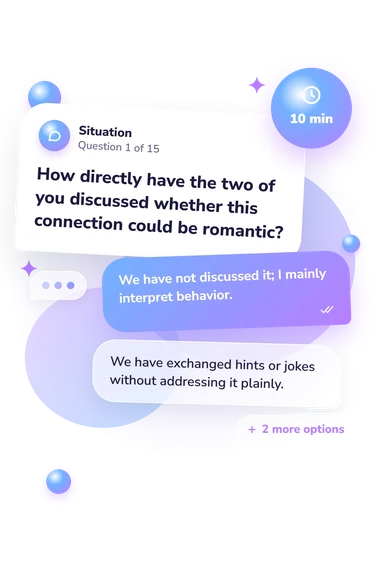
- We have not discussed it; I mainly interpret behavior.
- We have exchanged hints or jokes without addressing it plainly.
- At least one of us has shared feelings, but we have not fully compared intentions.
- We have had a direct, two-way conversation about feelings and what we want.
- There have been no direct statements to compare with behavior.
- Comments and actions send noticeably mixed messages.
- They mostly align, though the relationship itself remains partly undefined.
- Clear statements, boundaries, and repeated actions consistently point to the same understanding.
- They ask whether the two of us might be compatible.
- They joke about us but leave the meaning open.
- They mention other crushes while seeming attentive to my reaction.
- They consistently seek my advice about pursuing other people and frame me as a trusted friend.
Am I in the Friend Zone Quiz - Description and methodology of the test
People who feel caught between friendship and possible attraction can use the Am I in the Friend Zone Quiz to organize what they have observed before deciding whether to ask a clearer question. For readers asking whether they are friendzoned, this am i friendzoned quiz keeps the focus on communication, boundaries, and reciprocal behavior rather than one memorable interaction. The result helps a person name the pattern they currently perceive.
What This Assessment Explores
This assessment examines whether the relationship is understood clearly, framed as friendship, or showing mutual romantic interest. In this friend zone quiz, the distinction is between observable interaction patterns and guesses about private feelings. Items address dating conversations, labels, boundaries, follow-up, one-on-one plans, flirtation, and reactions to dating elsewhere.
These are the three result dimensions:
- Mutual Clarity (0-15) shows how directly feelings, intentions, and boundaries are discussed: Mostly inferred 0-5, Partly discussed 6-10, or Directly understood 11-15; it describes clarity, not the connection's romantic or platonic status.
- Platonic Framing (0-15) measures friendship framing: Little platonic framing 0-5, Blurred framing 6-10, or Strong platonic framing 11-15; these are evidence, not certainty about private feelings.
- Romantic Reciprocity (0-15) reflects observable signs that interest may be mutual: Limited reciprocity 0-5, Mixed signals 6-10, or Strong reciprocity 11-15; it does not prove another person's feelings.
Methodology and Evidence Base
Each item presents a relationship situation with four response options. Choose the description that best matches what you know, observe, or would expect in the situation presented, rather than one hopeful or disappointing moment. Responses become three displayed scores, but no point value is stated for each option; the displayed bands are the available interpretation categories.
Conceptually, the structure is consistent with Guerrero and Chavez (2005), who examined relational maintenance in cross-sex friendships with different romantic intentions. Malachowski and Dillow (2011) connect relational uncertainty, romantic intent, attraction, and communication. Reeder (2000) frames attraction that coexists with friendship, while Koenig, Kirkpatrick, and Ketelaar (2007) address possible misperception of romantic interest.
In practice, this friendzone quiz draws attention to communication and observable behavior. It displays three descriptive score bands, but provides no documented point mapping or validation claim for the online questionnaire. Current emotions, selective memory, and self-awareness can shape self-report, so the result describes the pattern you perceive rather than proving private feelings.
- Guerrero, Laura, & Chavez, Alana M. (2005). Relational maintenance in cross-sex friendships characterized by different types of romantic intent: An exploratory study. Western Journal of Communication, 69(4), 339-358. 10.1080/10570310500305471
- Malachowski, Colleen C., & Dillow, Megan R. (2011). An examination of relational uncertainty, romantic intent, and attraction on communicative and relational outcomes in cross-sex friendships. Communication Research Reports, 28(4), 356-368. 10.1080/08824096.2011.616245
- Reeder, Heidi M. (2000). 'I Like you... as a Friend': The Role of Attraction in Cross-Sex Friendship. Journal of Social and Personal Relationships, 17(3), 329-348. 10.1177/0265407500173002
- Koenig, Bryan L., Kirkpatrick, Lee A., & Ketelaar, Timothy. (2007). Misperception of sexual and romantic interests in opposite-sex friendships: Four hypotheses. Personal Relationships, 14(3), 411-429. 10.1111/j.1475-6811.2007.00163.x