
Cooking Quiz
How the Scales are Structured
Who Usually Takes This Test?
See How You Compare
Below is a preview of how scores are typically distributed across each scale.
Example Questions From the Test
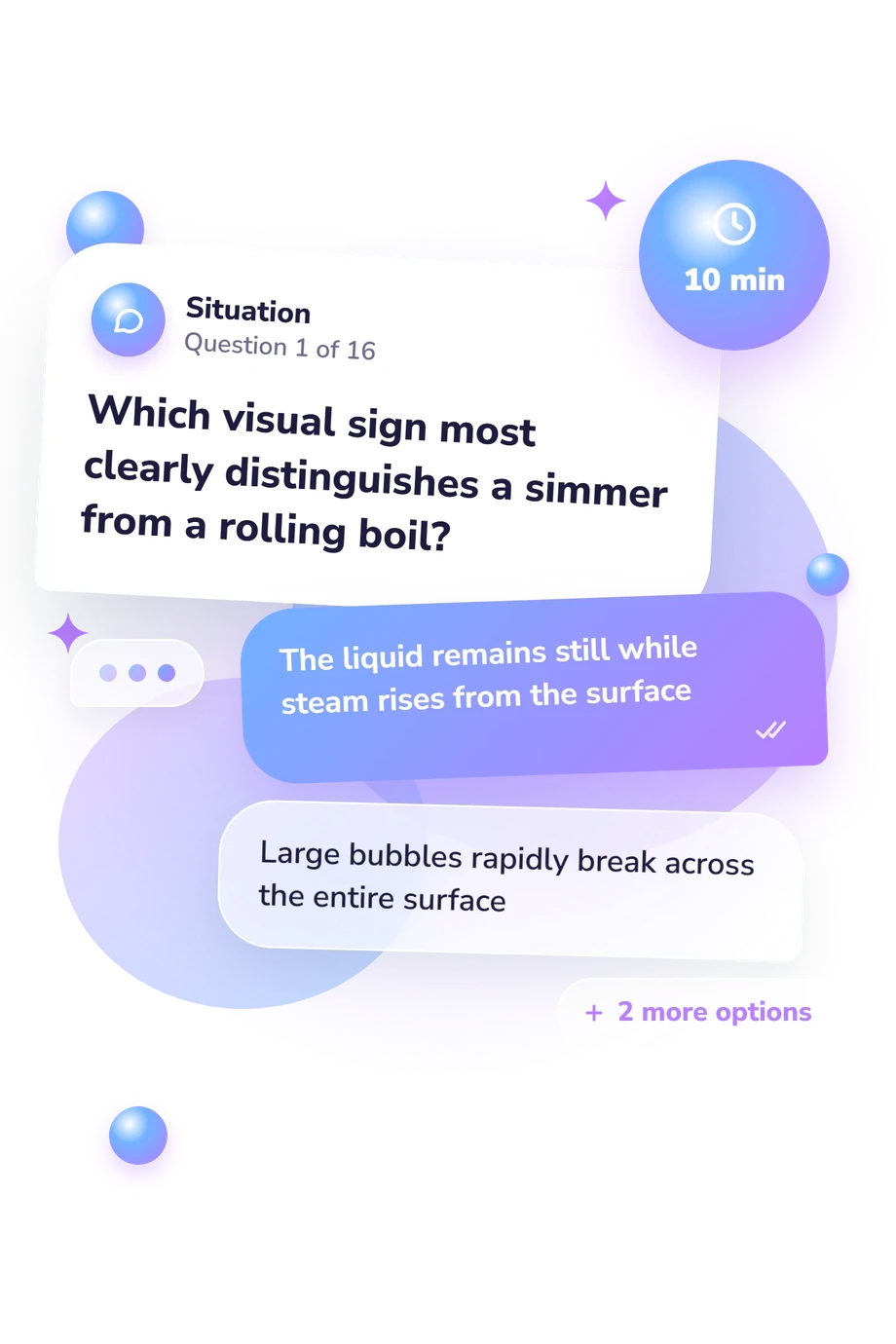
- The liquid remains still while steam rises from the surface
- Large bubbles rapidly break across the entire surface
- Small bubbles rise intermittently with gentle surface movement
- A ring of foam forms around the edge without any bubbles rising
- Folding the wet and dry ingredients together too briefly
- Filling the muffin cups to slightly different levels
- Letting the baked muffins cool on a rack
- Mixing the batter too vigorously or for too long
- Caramelization of concentrated table sugar
- Gelatinization of starch granules
- The Maillard reaction between amino compounds and sugars
- Emulsification of fat and water
Cooking Quiz - Description and methodology of the test
People who want to check their everyday kitchen knowledge can use this cooking quiz to see how well they understand technique, ingredient behavior, preparation choices, and safety-related decisions. It suits learners, home cooks, and anyone planning focused practice. Taking this cookery quiz can help you notice gaps before they become repeated recipe mistakes.
What This Assessment Explores
The items focus on practical decisions rather than personal taste or cooking identity. Presented as a practical cooking-knowledge assessment, it asks you to recognize visual cues, choose safer handling steps, explain texture and browning, and select adjustments for common kitchen problems.
The main themes are:
- Technique recognition shows whether you can distinguish simmering, deglazing, emulsifying, and carryover cooking.
- Ingredient behavior explains how heat, moisture, acidity, starch, proteins, and sugars affect results.
- Preparation judgment reflects choices involving measuring, pan spacing, batter mixing, and gentle custard cooking.
- Kitchen safety checks whether you recognize protective knife handling and steps that prevent cross-contamination after raw poultry.
The result is reported on the Cooking Knowledge scale, ranging from 0-16: Foundation Building (0-6), Developing Cook (7-12), or Strong Command (13-16). These bands describe the knowledge demonstrated in the scenarios, with higher results indicating more consistent understanding of cooking principles.
Methodology and Scientific Basis
Each item presents one cooking scenario and four answer choices, with one best response expected. The format tests recognition and application rather than confidence or frequency ratings. This cooking knowledge test awards one point for each correct answer, producing the total score; its bands provide descriptive educational feedback rather than norms from a comparison population.
Its closest conceptual reference is the Knowledge of Cooking Terms and Techniques Evaluation. The present questionnaire is conceptually consistent with that work, but it is not an adaptation of the published evaluation. The cooking and healthful-eating scales reported by Condrasky and colleagues address related cooking and healthful-eating outcomes but do not validate this knowledge score. Work by Byrd-Bredbenner and colleagues shows how structured knowledge questions can address food-safety topics.
This online questionnaire is not a standardised instrument with established norms or a published reliability estimate. Results show how many scenarios were answered correctly at completion. Performance can vary with memory, wording, prior experience, and current attention, so the score helps direct study but does not certify culinary skill or safe food handling.
- Michaud, Patricia. Development and Evaluation of Instruments to Measure the Effectiveness of a Culinary and Nutrition Education Program. Master’s thesis, Clemson University, 2007.
- Condrasky, Margaret D., Joel E. Williams, Patricia Michaud Catalano, and Sara F. Griffin. “Development of Psychosocial Scales for Evaluating the Impact of a Culinary Nutrition Education Program on Cooking and Healthful Eating.” Journal of Nutrition Education and Behavior, 43(6), 511-516, 2011. 10.1016/j.jneb.2010.09.013
- Byrd-Bredbenner, Carol, Virginia Wheatley, Donald Schaffner, Christine Bruhn, Lydia Blalock, and Jaclyn Maurer. “Development and Implementation of a Food Safety Knowledge Instrument.” Journal of Food Science Education, 6(3), 46-55, 2007. 10.1111/j.1541-4329.2007.00029.x
Updated: