
I Said This You Heard That Quiz
How the Scales are Structured
Who Usually Takes This Test?
See How You Compare
Below is a preview of how scores are typically distributed across each scale.
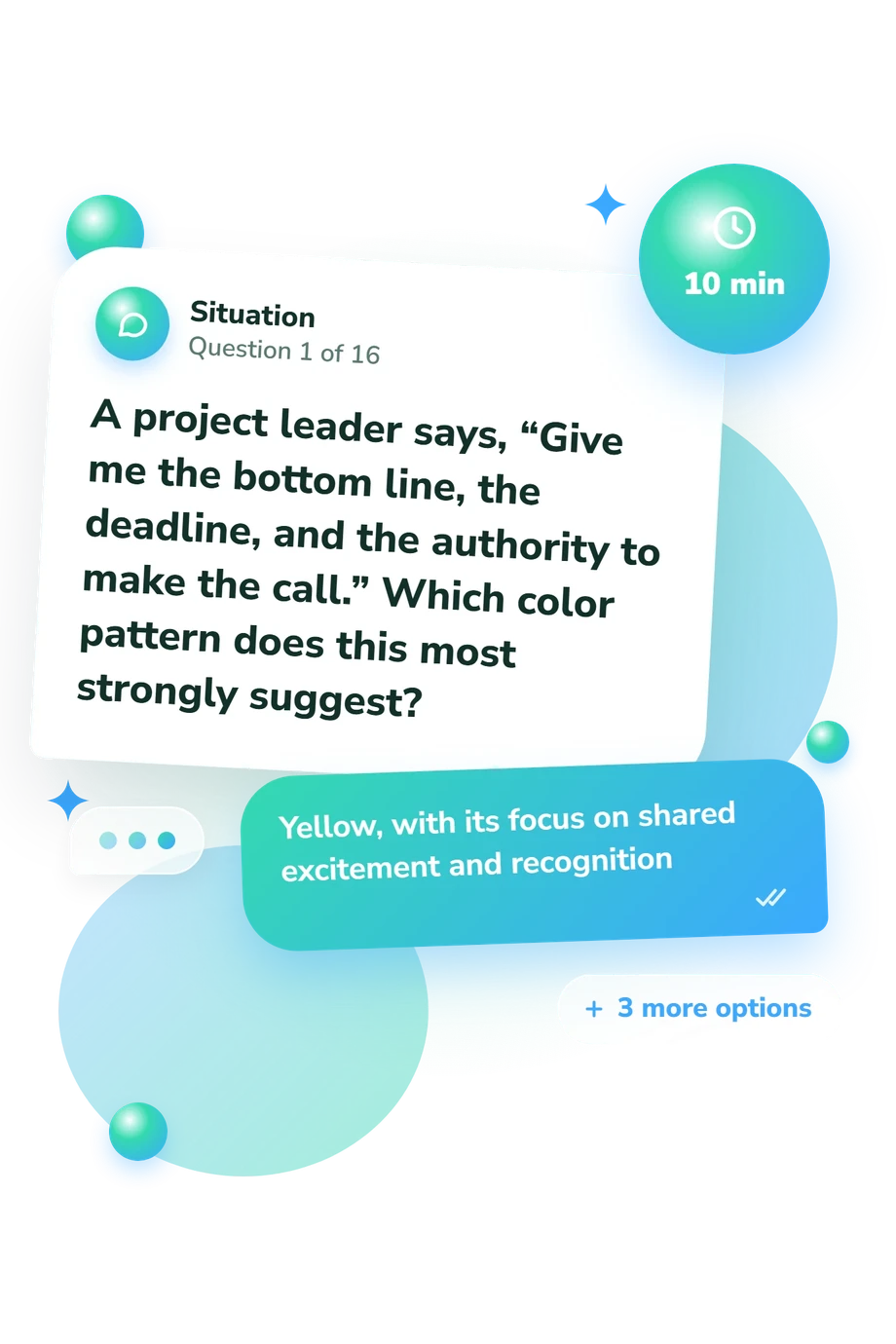
Example Questions From the Test
- A preference for excitement, visibility, and improvisation
- An emphasis on accuracy, order, preparation, and high standards
- A desire to preserve a comfortable, unhurried atmosphere
- A drive to take charge and produce immediate progress
- Six
- Five
- Four
- Nine
- Gaining control and moving decisively toward results
- Receiving social approval through lively connection
- Maintaining peace through patience and accommodation
- Reaching exacting standards through careful analysis
I Said This You Heard That Quiz - Description and methodology of the test
Readers seeking a practical way to interpret everyday misunderstandings can use this questionnaire to see what kind of framework knowledge they can apply in common conversations. The I Said This You Heard That Quiz gives a knowledge result based on recognizing four color-coded communication patterns and matching them to everyday situations. The four-color communication model adds context for considering how wording, pace, and pressure can shape conversations.
What This Assessment Explores
The questionnaire measures knowledge of a four-color communication framework, not personal temperament. Scenarios cover disagreement, change, decisions, feedback, detail, energy, pace, and when a label would be premature.
Many readers use the free quiz on I Said This, You Heard That to see how communication needs differ without making colors permanent identities. The framework’s four patterns are concepts respondents are asked to recognize, not separate personality scales:
- Red signals control, speed, direct goals, and decisive results.
- Yellow signals social energy, novelty, visibility, and spontaneity.
- Green signals steadiness, harmony, patience, and lower pressure.
- Blue signals accuracy, preparation, structure, evidence, and high standards.
Results appear on I Said This You Heard That Knowledge (0-16): Starting Point (0-6), Developing Knowledge (7-12), or Strong Knowledge (13-16). The bands describe framework knowledge, not personal temperament. The exercise suits anyone reflecting on everyday conversations.
Methodology and Evidence Base
Each item presents a short situation and four answer choices. The four-choice knowledge items lead to one displayed result for framework knowledge rather than a personal color profile. Several items also ask whether wording, pace, detail, or pressure should be adapted to another person.
The I Said This, You Heard That framework has a later second edition with a related formulation. Its four-temperament structure is conceptually consistent with the four-factor approach examined by Cruise, Blitchington, and Futcher, but this online questionnaire is not presented as that published inventory or as a validated adaptation of it.
As a communication style knowledge test, it is an educational measure of framework knowledge. The displayed result is an independent educational result, not an official certification or personality assessment. Results may vary with prior familiarity, attention, and interpretation of a scenario at the time of answering, so the bands indicate current knowledge within this model rather than a stable psychological classification.
- Edelman, Kathleen. I Said This, You Heard That Workbook. North Point Resources, 2019. ISBN 9781943535415.
- Edelman, Kathleen, and The ColorWorks Group, editor. I Said This, You Heard That - Second Edition. The ColorWorks Group, 2023. ISBN 9798218213077.
- Cruise, Robert J., W. Peter Blitchington, and W.G.A. Futcher. "Temperament Inventory: an Instrument To Empirically Verify the Four-Factor Hypothesis." Educational and Psychological Measurement 40, no. 4 (1980): 943-954. DOI 10.1177/001316448004000418
Updated: