
Advanced English Grammar Quiz
How the Scales are Structured
Who Usually Takes This Test?
See How You Compare
Below is a preview of how scores are typically distributed across each scale.
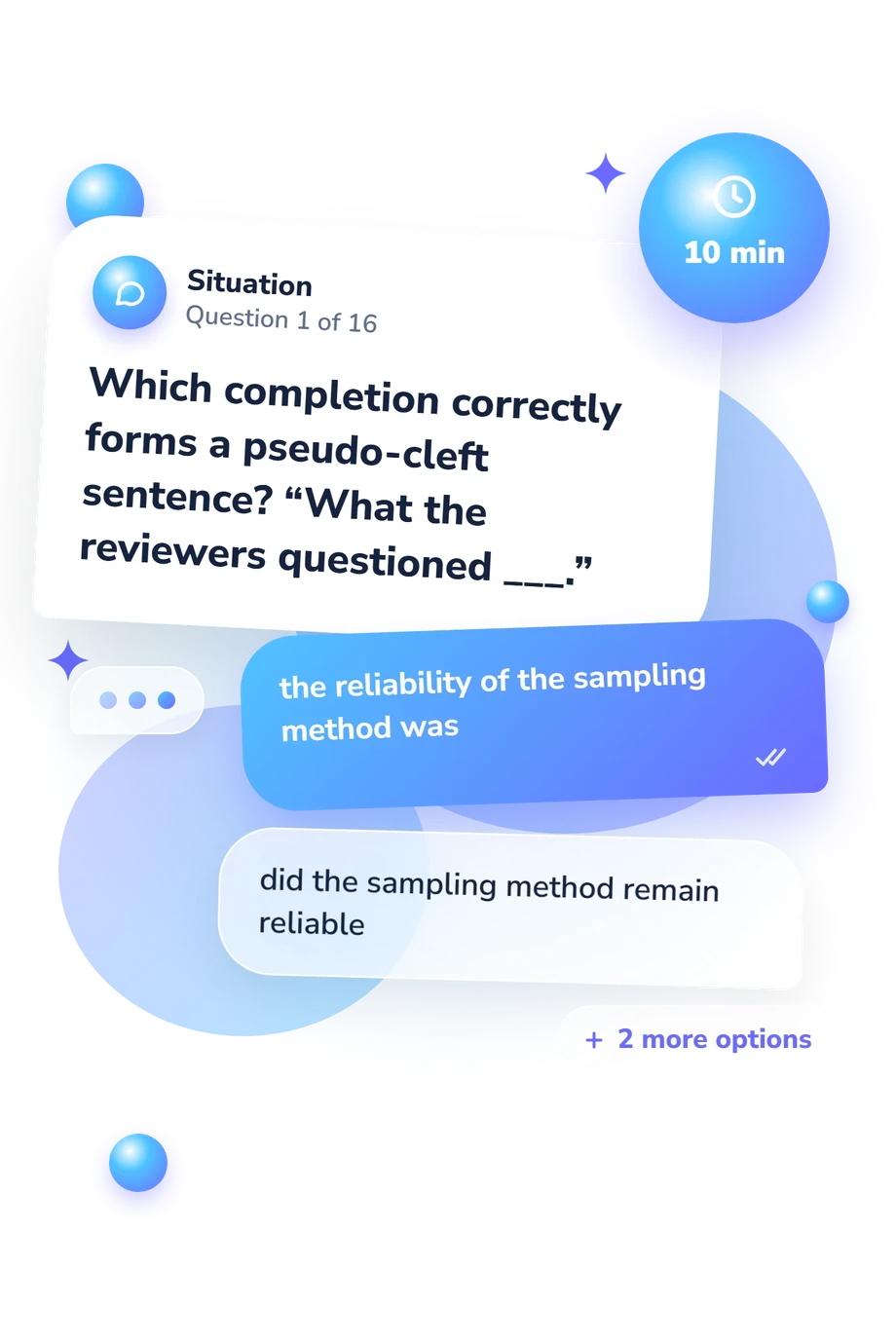
Example Questions From the Test
- the reliability of the sampling method was
- did the sampling method remain reliable
- was the reliability of the sampling method
- that the sampling method was reliable
- was
- were
- have been
- be
- Exhausted although she was, she completed the final inspection.
- Exhausted though she was, she completed the final inspection.
- Though was she exhausted, she completed the final inspection.
- Exhausted despite she was, she completed the final inspection.
Advanced English Grammar Quiz - Description and methodology of the test
When advanced structures interact, even learners who know the rules can hesitate over word order, tense, agreement, or meaning. This advanced english grammar quiz presents those choices in formal contexts. As an advanced grammar quiz, it examines complex usage rather than reviewing basic rules, making it relevant to readers refining academic writing or preparing for advanced study. Small grammatical decisions can change emphasis and precision in both settings.
What This Assessment Measures
The questions place advanced forms inside sentences rather than testing isolated labels. They ask you to judge how structure affects meaning, emphasis, relationships, and formal style. Its focus makes it a difficult english grammar quiz for learners who know rules and want precision in demanding contexts.
The assessment reports one scale, Advanced English Grammar Knowledge, from 0 to 16. Foundation-building (0-6) signals recognition of some advanced forms; Developing command (7-12) reflects many correct complex constructions with nuanced gaps; Strong command (13-16) indicates accurate application across varied contexts.
The main thematic groups are:
- Clause structure, inversion, and relative clauses show whether you can manage pseudo-clefts, emphatic word order, clause reduction, and restrictive versus nonrestrictive information.
- Agreement, complementation, and noun usage examine subject-verb agreement, verb patterns, and countability.
- Tense, conditionals, modality, and parallelism indicate control of time, deduction, hypothetical meaning, and balanced coordination.
Methodology and Evidence Base
Each item presents a sentence or context with four answer choices. You select the completion that best fits the grammatical relationship, construction, or meaning; scoring condenses performance into one scale rather than separate topic subscores.
The English Grammar Profile (O'Keeffe & Mark, 2017) is the closest evidence base for learners' competence. This questionnaire is conceptually consistent with that work, not a reproduction or validated adaptation. Huddleston and Pullum provide an account of English grammar supporting distinctions including inversion, clause reduction, complementation, and nonrestrictive modification.
The contexts require attention to relationships that are easy to miss when a sentence carries several signals. They include academic and professional situations, so choosing an answer depends on grammatical form and intended meaning.
For interpretation, this questionnaire reports one score through the command bands; it does not state population norms, reliability estimates, or diagnostic cutoffs. As an advanced English grammar test, it describes performance on selected constructions, while recent exposure, attention, guessing, and familiarity with test conventions or item wording can affect results. It is better read as a structured performance check than as formal placement.
- O'Keeffe, Anne, and Geraldine Mark. "The English Grammar Profile of learner competence: Methodology and key findings." International Journal of Corpus Linguistics, vol. 22, no. 4, 2017, pp. 457-489. 10.1075/ijcl.14086.oke
- Huddleston, Rodney D., and Geoffrey K. Pullum. The Cambridge Grammar of the English Language. Cambridge University Press, 2002. 10.1017/9781316423530
- Saville, Nick, and Roger Hawkey. "The English Profile Programme - the first three years." English Profile Journal, vol. 1, no. 1, 2010, e7. 10.1017/S2041536210000061
Updated: