
Pronoun Agreement Quiz
How the Scales are Structured
Who Usually Takes This Test?
See How You Compare
Below is a preview of how scores are typically distributed across each scale.
Example Questions From the Test
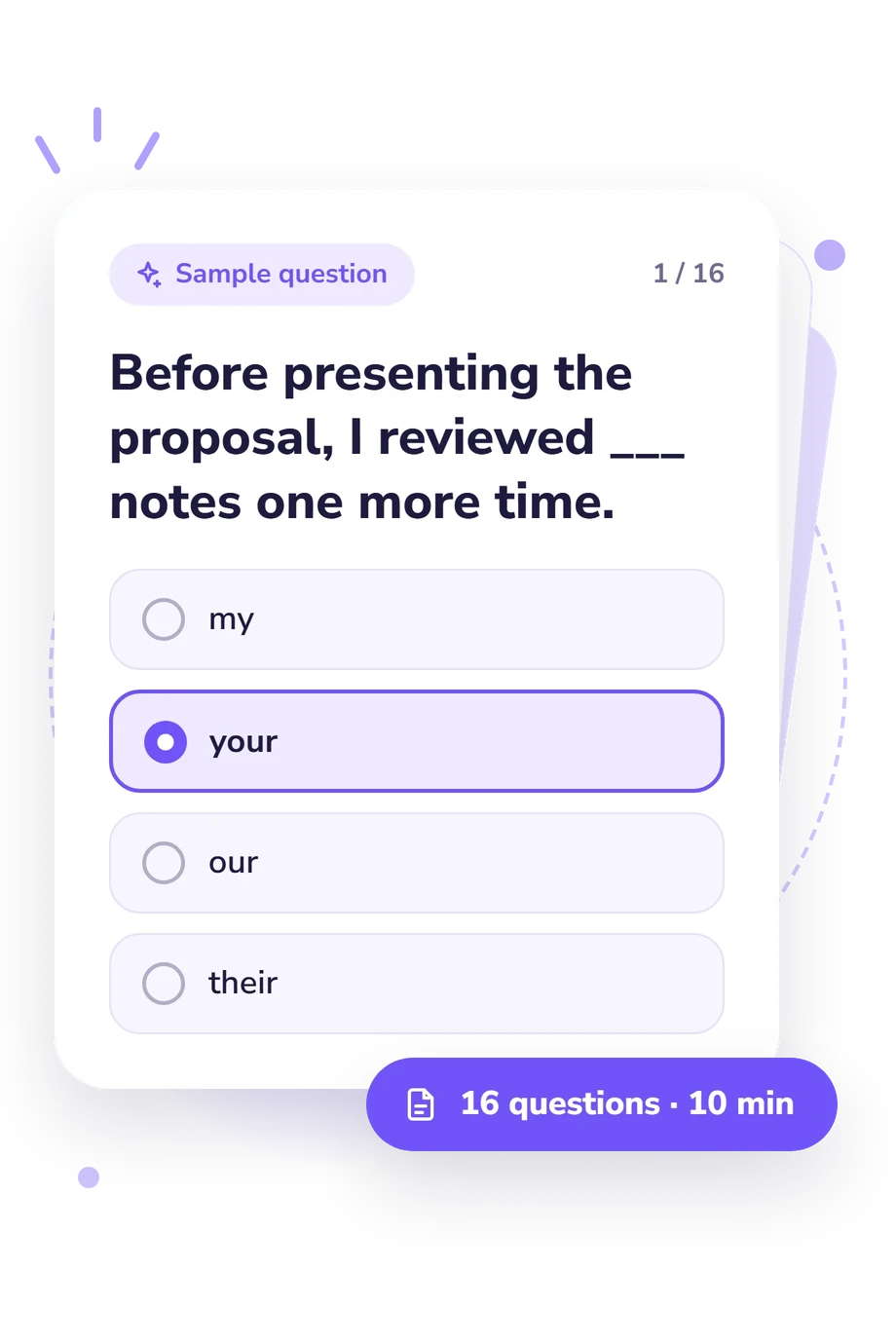
- my
- your
- our
- their
- their
- its
- our
- her
- their
- its
- his
- our
Pronoun Agreement Quiz - Description and methodology of the test
For students, writers, and learners who want to check a specific grammar skill, the pronoun agreement quiz offers a focused way to examine whether pronouns clearly match the nouns or noun phrases they refer to. It is useful when reviewing sentence construction, editing drafts, or identifying rules that deserve further practice. As a pronoun antecedent agreement quiz, it gives a concise learning profile rather than overall ability.
What This Assessment Measures
Agreement between an antecedent and its pronoun is the central skill. Items test number and person in possessive, personal, and reflexive forms, including coordinated, collective, paired, and separated nouns. The result shows how reliably respondents apply pronoun agreement rules in sentence editing. The format isolates agreement before a longer piece of writing is revised.
These areas explain what the result captures:
- Number agreement shows whether a pronoun matches a singular or plural antecedent.
- Person agreement shows whether forms such as I, you, and they fit the subject.
- Complex patterns show whether agreement holds across coordinated, collective, or separated nouns.
- Pronoun Agreement Knowledge (0-16) reports Foundations (0-6) when basic matching needs review, Developing (7-12) when common examples are handled but compound, collective, or interrupted cases need practice, and Strong (13-16) when agreement is applied consistently in simpler and complex sentences.
Methodology and Evidence Base
Items combine sentence completion and sentence-selection tasks. Each item offers four choices; some require a pronoun selection, while others require a sentence or revision selection. In this pronoun antecedent agreement online quiz, each target remains visible in context. The four answer choices make the alternatives explicit, while the result summarizes performance rather than explaining every choice.
No separate weighting rule is defined for the questionnaire; the result is reported on the single displayed scale. This pronoun agreement assessment is not standardized and has no established reliability or independent validity evidence, so scores describe performance on these items rather than general language proficiency and may vary with prior instruction, guessing, and attention.
The questionnaire is conceptually consistent with Bautista and colleagues’ 2026 intervention, which treats pronoun-antecedent agreement as a teachable grammar skill. It is not an adaptation of that study. Li and Akram (2024) document related ESL writing errors, while Huddleston and Pullum (2002) supply the grammatical framework.
- Bautista, Joana Rose S., Venus Avelour F. Felicio, Deveyvon L. Espinosa, Jonelson C. Escandallo, Regine L. Generalao, Kristy Jane R. Muegna, and Conie B. Cerna. "Improving Mastery of Pronoun-Antecedent Agreement in Grade 9 Students Through Game Intervention: Gamified Activities for Mastery Enhancement." International Journal of Multidisciplinary Educational Research and Innovation, vol. 4, no. 2, 2026, pp. 31-47. 10.64637/632384.
- Li, Shengji, and Huma Akram. "Navigating Pronoun-Antecedent Challenges: A Study of ESL Academic Writing Errors." SAGE Open, vol. 14, no. 4, 2024, pp. 1-11. 10.1177/21582440241296607.
- Huddleston, Rodney, and Geoffrey K. Pullum. The Cambridge Grammar of the English Language. Cambridge University Press, 2002. 10.1017/9781316423530.
Updated: