
Bass Clef Quiz
How the Scales are Structured
Who Usually Takes This Test?
See How You Compare
Below is a preview of how scores are typically distributed across each scale.
Example Questions From the Test
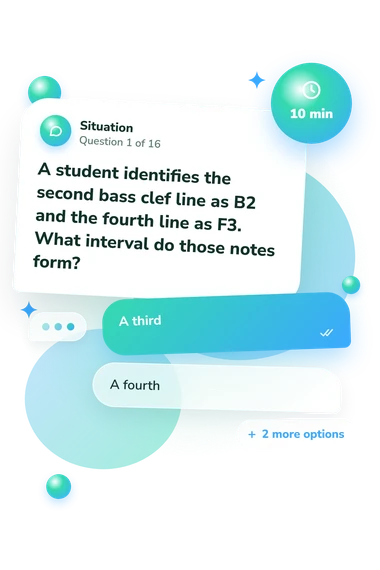
- A third
- A fourth
- A sixth
- A fifth
- F–A–C
- A–C–E
- G–B–D
- C–E–G
- They are the same sounding pitch
- They are a sixth apart
- They are a seventh apart
- They are one octave apart
Bass Clef Quiz - Description and methodology of the test
Designed for learners, students, performers, and others reviewing bass-clef notation, this assessment checks whether staff positions translate into accurate pitch names and relationships. The bass clef quiz gives a focused checkpoint for anyone reviewing notation or preparing for more demanding reading. As a bass clef reading test, it shows which recognition skills are secure and which deserve deliberate practice.
What This Assessment Measures
Questions focus on recognition rather than performance technique. They connect staff location with note names, trace adjacent positions, identify the F-clef landmark, and read pitches above or below the staff. Other items test intervals and triads, so the result reflects relationships among notes as well as isolated naming.
Used as a bass clef notes quiz, it suits developing readers, music students, performers, and anyone revisiting notation. It describes sampled recognition, not general musicianship.
The assessment uses one displayed scale, Bass Clef Knowledge, ranging from 0 to 16. Its result bands are:
- Foundations to Build (0-6) indicates that core line, space, and landmark recognition needs further practice.
- Developing Recognition (7-12) shows workable command of common positions with room to strengthen ledger-line and applied reading skills.
- Strong Recognition (13-16) reflects accurate interpretation of most standard positions and pitch relationships sampled here.
Methodology and Evidence Base
Each item presents a notation problem or short musical situation with four answer choices. The respondent selects a note, interval, triad, sequence, or clef term, and responses are aggregated into the displayed scale. No detailed weighting rule or norm sample is specified for this online questionnaire; the displayed result is a task-specific recognition snapshot.
The items are conceptually consistent with notation concepts also explained by Gotham and colleagues (2023) and by Benward and Saker. Benward and Saker provide a complementary account of notation principles, while Stewart’s 2005 study offers context on coordinated visual and pitch processing in music reading. These sources do not establish this questionnaire’s provenance, validation, or standardization.
For a learner, the result functions as a bass clef practice test and offers a focused snapshot of note recognition. Prior instruction, recent practice, familiarity with scientific pitch notation, and guessing can affect performance. The limited item set cannot represent every reading situation, so the displayed bands describe recognition demonstrated on these tasks rather than complete musicianship.
- Gotham, Mark, Kyle Gullings, Chelsey Hamm, Bryn Hughes, Brian Jarvis, Megan Lavengood, and John Peterson. Open Music Theory 2e. VIVA Open Publishing, 2023. Chapter 1, “Notation of Notes, Clefs, and Ledger Lines.”
- Benward, Bruce, and Marilyn Nadine Saker. Music in Theory and Practice, 9th ed., vol. 1. McGraw-Hill, 2014. ISBN 9780077493325.
- Stewart, Lauren. “A Neurocognitive Approach to Music Reading.” Annals of the New York Academy of Sciences, vol. 1060, no. 1, 2005, pp. 377-386. 10.1196/annals.1360.032.