
Fantasy Quiz
How the Scales are Structured
Who Usually Takes This Test?
See How You Compare
Below is a preview of how scores are typically distributed across each scale.
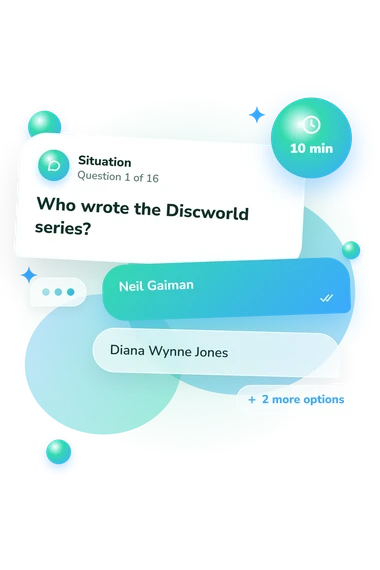
Example Questions From the Test
- Neil Gaiman
- Diana Wynne Jones
- Douglas Adams
- Terry Pratchett
- Grendel
- Fenrir
- Fafnir
- A dragon
- A silver mirror
- A painted ship
- A garden gate
- A wardrobe
Fantasy Quiz - Description and methodology of the test
Readers who want to check their command of fantasy literature can use this fantasy quiz to see how well they recognize conventions, works, and terminology. It suits newcomers, experienced readers, students, and writers seeking a content score showing which concepts they recognize readily and which areas deserve attention. Questions about conventions, works, and terminology make this fantasy genre quiz a focused test of genre knowledge, not literary taste.
What This Assessment Explores
The items sample recognition in fantasy literacy: landmark authors and works, mythology, narrative terminology, subgenre labels, point of view, and magical systems. Someone may know a famous title yet still be learning dramatic irony, the MacGuffin, secondary worlds, or unreliable narration. By asking readers to identify ideas in context rather than merely recall names, the assessment serves as a fantasy knowledge test.
The result appears on Fantasy Knowledge (0-16) with three displayed bands:
- Emerging Explorer (0-6) indicates recognition of some touchstones while leaving genre vocabulary and classic worlds to discover.
- Developing Scholar (7-12) indicates a solid foundation across fantasy canon, subgenres, and storytelling devices, with some distinctions still unfamiliar.
- Accomplished Sage (13-16) indicates wide-ranging knowledge and the ability to apply concepts as well as recall them.
These labels describe performance on this question set, not taste or creativity.
Methodology and Evidence Base
Each item uses four-option multiple choice. The set combines factual recall with short interpretive scenarios: questions address authors and mythological figures, narrators, plot devices, settings, and magic systems. The result is reported on one scale with descriptive bands, so it reflects the full mix rather than separate topic scores.
Factual recall and applied interpretation both matter in this fantasy trivia quiz, which covers authors, mythology, narrative technique, settings, and magic systems. It is conceptually consistent with James and Mendlesohn (2012), whose work surveys fantasy traditions and forms. Attebery supports the focus on genre conventions and imaginative alternatives, while Prince supplies terminology for viewpoint and narrative function. These books provide subject-matter context; they do not establish validity for this questionnaire.
Interpret the result as a snapshot of recognition on selected content. The displayed bands are descriptive summaries; they do not establish population percentiles or mastery of every fantasy tradition. They cover recognition of authors, works, mythology, narrative technique, subgenres, and magic systems. Canon familiarity, language, education, and current recall can influence performance; lower results can guide further reading rather than define a fixed limit.
- James, Edward, and Farah Mendlesohn, eds. The Cambridge Companion to Fantasy Literature. Cambridge: Cambridge University Press, 2012. 10.1017/CCOL9780521429597
- Attebery, Brian. Strategies of Fantasy. Bloomington: Indiana University Press, 1992.
- Prince, Gerald. A Dictionary of Narratology. Revised ed. Lincoln: University of Nebraska Press, 2003.