
Independent vs Dependent Variable Quiz
How the Scales are Structured
Who Usually Takes This Test?
See How You Compare
Below is a preview of how scores are typically distributed across each scale.
Example Questions From the Test
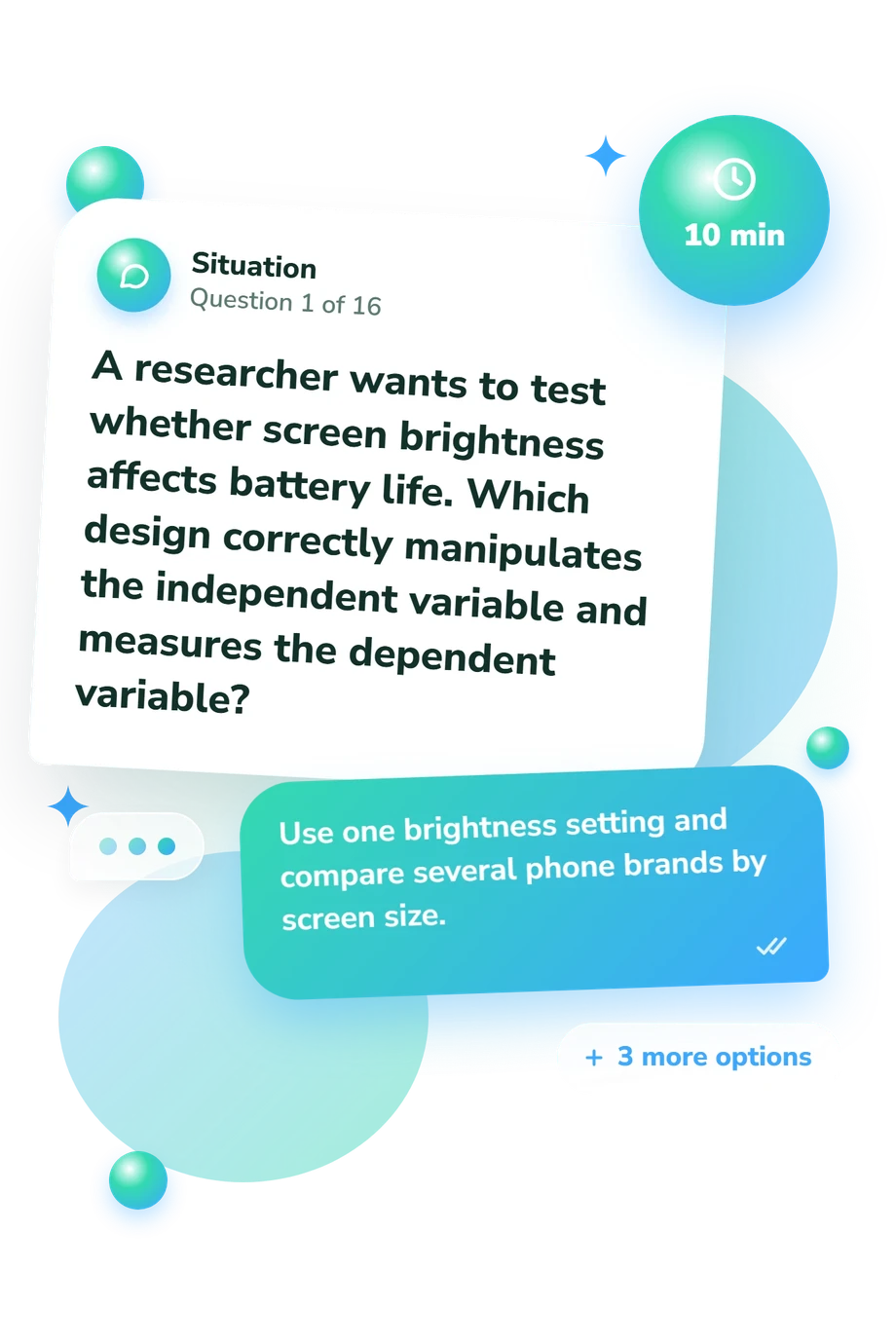
- Use one brightness setting and compare several phone brands by screen size.
- Set phones to different brightness levels and record how long each battery lasts.
- Change battery capacity and record the brightness selected by each user.
- Measure users’ preferred brightness and hold battery duration constant.
- As hours of tutoring increase, students’ test scores will change.
- Tutoring quality will stay constant because test performance controls it.
- Students with different test scores will be assigned different amounts of tutoring.
- Hours of tutoring and test scores will both be held constant.
- Four measurements of the dependent variable
- Four control variables used to standardize the task
- Four levels of the independent variable
- Four possible confounders in the study
Independent vs Dependent Variable Quiz - Description and methodology of the test
Students, beginning researchers, and anyone reviewing basic research methods may use this quiz on variables before interpreting a study, choosing measures, or planning a simple investigation. The independent vs dependent variable quiz helps them decide whether to proceed independently or pause for targeted practice. Its result offers a focused starting point for that decision.
What This Assessment Explores
Variable roles depend on the research question. An independent variable is changed, assigned, compared, or treated as a predictor; a dependent variable is the measured outcome. The items also address controls, operational definitions, graph axes, confounding, and hypotheses, so learners must apply terms to study designs rather than recall definitions. The quiz about variable roles suits introductory research review.
The result reflects three abilities:
- Identifying the independent role shows whether you can locate the changed or predictive factor.
- Identifying the dependent role shows whether you can find the measured outcome.
- Applying both roles shows whether you can interpret controls, confounds, and research questions.
The displayed scale, Independent vs Dependent Variable Knowledge (0-16), measures accurate distinction and application across research scenarios. Its bands are Foundational review (0-6), Developing knowledge (7-12), and Strong knowledge (13-16).
Methodology and Scientific Basis
Each item presents an experiment, observational question, definition, graphing problem, or design scenario with four answer choices. Selecting one option tests whether you can assign a role, identify an operational level, recognize a control or confound, or interpret a predictor-outcome relationship. The four-choice questions about independent and dependent variables measure recognition and application across contexts.
The result is reported on the displayed knowledge scale and interpreted using the catalogue's displayed learning bands. No population norms or validation statistics are established for this questionnaire; it is best read as a learning signal rather than a clinical cutoff.
The questionnaire is conceptually consistent with Campbell and Stanley (1963) on experimental and quasi-experimental variables and outcomes. Brown and Melamed (1990) support operational definitions, controls, and confounding, while Illowsky and Dean (2023) provide context for predictors, outcomes, and graphs. It is not a direct adaptation of any of these works.
Guessing, prior coursework, and familiarity with examples can affect the result, while a single score samples only part of methodological knowledge. Review missed concepts and apply them to research problems.
- Campbell, Donald T., and Julian C. Stanley. Experimental and Quasi-Experimental Designs for Research. Rand McNally, 1963.
- Brown, Steven R., and Lawrence E. Melamed. Experimental Design and Analysis. Quantitative Applications in the Social Sciences, no. 74. SAGE Publications, 1990. 10.4135/9781412984218
- Illowsky, Barbara, and Susan Dean. Introductory Statistics 2e. OpenStax, 2023.
Updated: