
Yoga Quiz
How the Scales are Structured
Who Usually Takes This Test?
See How You Compare
Below is a preview of how scores are typically distributed across each scale.
Example Questions From the Test
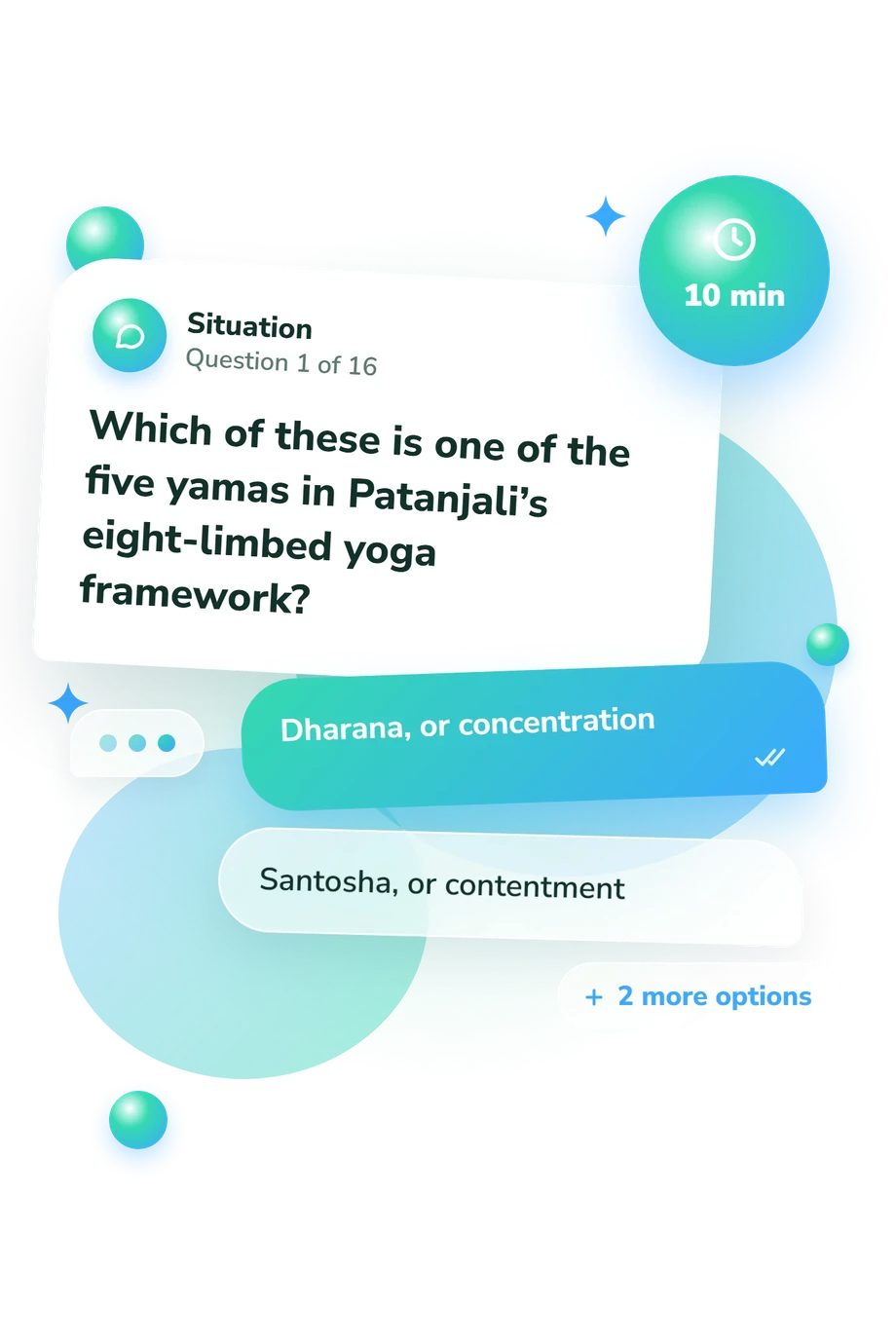
- Dharana, or concentration
- Santosha, or contentment
- Asana, or posture
- Satya, or truthfulness
- Holding your breath until the pose feels steady
- Closing your eyes and lifting your chin
- Resting your gaze on one stable point
- Turning your standing foot outward repeatedly
- Contentment with present circumstances
- Focused study of the self
- Withdrawal from sensory distractions
- Non-harming in thought and action
Yoga Quiz - Description and methodology of the test
For learners who want to understand yoga beyond memorizing pose names, this yoga quiz checks how confidently they connect philosophy, movement, breath, meditation, and safe practice. It can serve as a yoga knowledge test for curious practitioners, students, and people reviewing classroom fundamentals. The result gives a focused snapshot of familiarity, helping you choose useful areas for further study while keeping the emphasis on learning rather than judgment.
What This Assessment Explores
This assessment focuses on foundational recognition and practical judgment rather than athletic performance. The questions about yoga cover philosophy, Sanskrit terms, postures, breath regulation, meditation, class styles, sequencing, props, and responses to discomfort. Together, they show whether a learner can identify core concepts and choose a sensible action in a familiar situation.
The result is organized as one scale:
- Philosophy and ethics shows understanding of principles such as ahimsa.
- Postures and alignment shows whether common shapes, names, and adjustments are understood.
- Breathing and meditation reflects knowledge of pranayama and returning attention.
- Practice principles and safety captures choices about preparation, props, adaptation, and pain.
Yoga Knowledge ranges from 0-16: Foundation to Build (0-6), Developing Knowledge (7-12), and Strong Knowledge (13-16). These labels describe foundational familiarity, not physical ability or personal worth.
Methodology and Evidence Base
Each item offers four answer choices. Some prompts test recognition; others describe a practice situation and ask for the safest or most appropriate response. The displayed result reflects performance across the questionnaire, but no separate weighting rule is stated, so the range cannot show how many points any answer adds.
Its approach is educational and concept-based. Yamas, niyamas, asana, pranayama, and attention practices are consistent with Patanjali’s Yoga Sutras as translated and commented on by Edwin F. Bryant. Postural, breathing, sequencing, prop, and pain-response themes also align with Iyengar’s Light on Yoga. Alam et al. (2024) studies yoga teachers’ understanding and practice of the eight limbs; this questionnaire is conceptually consistent with that work, not an adaptation of it.
As an online yoga assessment, the result is a descriptive indication of knowledge at the time of answering. The result is descriptive rather than norm-referenced and has no clinical thresholds. Prior instruction, terminology, attention, and guessing can affect performance; selected answers cannot show physical execution or teaching skill. It is an educational result, not a medical assessment.
- Kaushal Kumar Alam, Nonita Gangwani, and Mamta Mohan. Perception and practice of the eight limbs of yoga in yoga teachers: A cross-sectional descriptive study. Journal of Family Medicine and Primary Care. 2024;13(4):1500-1506. 10.4103/jfmpc.jfmpc_1711_23
- Patanjali. The Yoga Sutras of Patanjali: A New Edition, Translation, and Commentary with Insights from the Traditional Commentators. Translated and commented by Edwin F. Bryant. New York: North Point Press, 2009. ISBN 978-0-86547-736-0
- B. K. S. Iyengar. Light on Yoga: Yoga Dipika. New York: Schocken Books, 1966.
Updated: