
Is My Girlfriend Gay Quiz
How the Scales are Structured
Who Usually Takes This Test?
See How You Compare
Below is a preview of how scores are typically distributed across each scale.
Example Questions From the Test
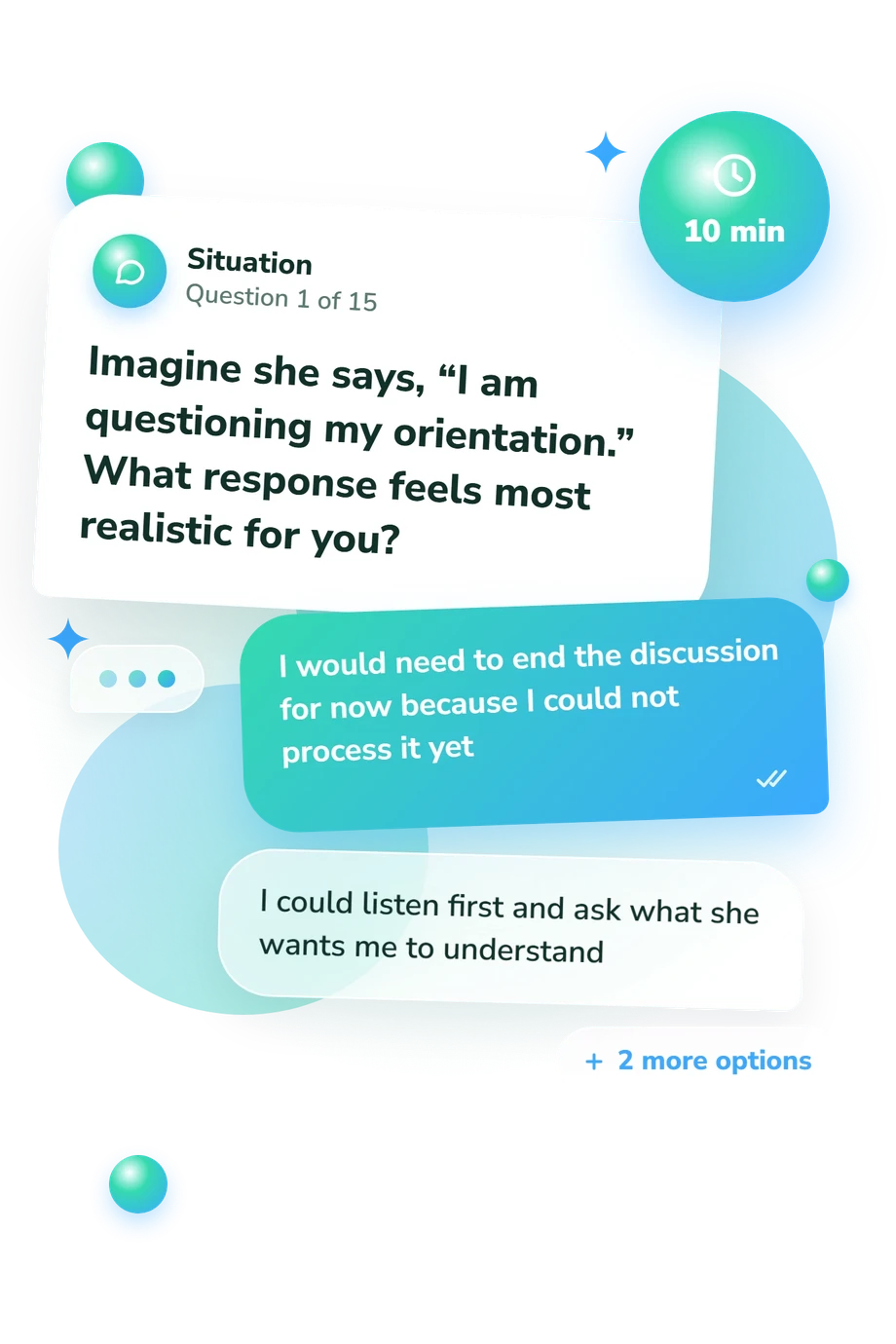
- I would need to end the discussion for now because I could not process it yet
- I could listen first and ask what she wants me to understand
- I would ask for a pause so I could settle my emotions before continuing
- I could listen, though I would soon need to ask what it means for our relationship
- I am not ready to hear an answer that could change the relationship
- I would be overwhelmed initially and would need to continue on another day
- I could remain respectful, though I might need clear limits and outside emotional support afterward
- I could listen without debating her identity and then discuss what each of us wants next
- I could focus on what each of us wants from the relationship right now
- I could allow time, provided we agreed to revisit our relationship needs
- I would probably need some distance before deciding what I can accept
- I would feel unable to have a useful conversation until she was certain
Is My Girlfriend Gay Quiz - Description and methodology of the test
For a respondent wondering about her partner’s orientation, this assessment addresses the concern that prompts an is she gay quiz without deciding the partner’s identity. The useful starting point is what has been said, what has changed, and what remains unknown. The Is My Girlfriend Gay Quiz supports relationship self-reflection and helps a respondent prepare for an honest conversation while respecting the partner’s right to define her own identity.
What This Assessment Explores
Appearance, friendships, and mannerisms are not proof; the assessment frames concern as a relationship and communication question. Items address firsthand statements, affection, future plans, emotional inclusion, sexual connection, and respectful uncertainty. They separate the respondent’s firsthand observations from relationship interpretations, so this relationship evidence quiz organizes her evidence; even direct information does not prove an orientation, and only your girlfriend can identify herself.
The profile contains three dimensions:
- Direct Information vs. Assumptions (0-15) reflects the basis of concern: Mostly indirect (0-5), Some direct material (6-10), or More direct information (11-15).
- Relationship Connection (0-15) reflects unresolved disconnection, not orientation: Connection largely present (0-5), Mixed connection (6-10), or Marked disconnection (11-15).
- Respectful Conversation Readiness (0-15) reflects listening and discussing needs: Not ready yet (0-5), Partly ready (6-10), or Conversation-ready (11-15).
Together, they show what needs attention next, not who the partner is.
Methodology and Evidence Base
Each prompt presents a relationship situation with four response options. Options distinguish direct evidence, connection, emotional regulation, listening, and willingness to discuss needs; they do not label orientation. The result reports three scales within the displayed bands. Because the item-to-point formula is unstated, read results through those bands rather than infer individual weights.
The evidence base is conceptual; this questionnaire does not reproduce a published instrument. Li and Samp (2021) is the closest match for disclosure in heterosexual partnerships involving LGB people. Li and Samp (2019), McNair, Hegarty, and Taft (2012), and Beals and Peplau (2001) add perspectives on coming-out communication, disclosure, and relationship quality. It is conceptually consistent with these studies, not adapted from them. The questionnaire’s scope is organizing the respondent’s concern, relationship context, and readiness for conversation, making it a relationship conversation quiz rather than an evaluation of her sexuality.
The questionnaire has no stated standardized norms, reliability estimates, or clinical cutoffs, and self-report may be shaped by current conflict, selective memory, fear, or limited self-awareness; interpret the profile alongside the conversation and broader relationship context.
- Li, Yachao, and Jennifer A. Samp. (2021). Predictors and outcomes of LGB individuals’ sexual orientation disclosure to heterosexual romantic partners. Journal of Applied Communication Research, 49(1), 24-43. 10.1080/00909882.2020.1849769
- Li, Yachao, and Jennifer A. Samp. (2019). Predictors and outcomes of initial coming out messages: Testing the theory of coming out message production. Journal of Applied Communication Research, 47(1), 69-89. 10.1080/00909882.2019.1566631
- McNair, Ruth, Kelsey Hegarty, and Angela Taft. (2012). From silence to sensitivity: A new Identity Disclosure model to facilitate disclosure for same-sex attracted women in general practice consultations. Social Science & Medicine, 75(1), 208-216. 10.1016/j.socscimed.2012.02.037
- Beals, Kristin P., and Letitia Anne Peplau. (2001). Social involvement, disclosure of sexual orientation, and the quality of lesbian relationships. Psychology of Women Quarterly, 25(1), 10-19. 10.1111/1471-6402.00002
Updated: