
Triangle Congruence Quiz
How the Scales are Structured
Who Usually Takes This Test?
See How You Compare
Below is a preview of how scores are typically distributed across each scale.
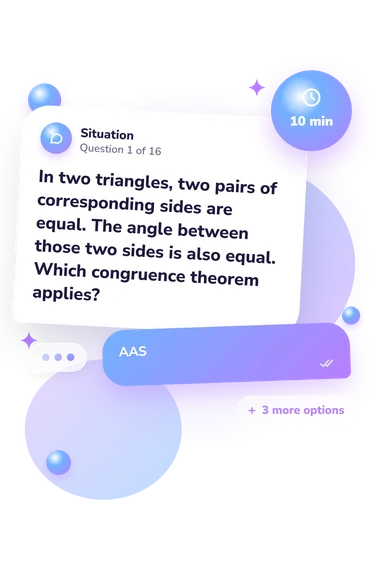
Example Questions From the Test
- ∠B = ∠E
- ∠C = ∠F
- ∠A = ∠D
- ∠B = ∠F
- Dilation, translation, and reflection
- Dilation, horizontal stretch, and reflection
- Horizontal stretch, rotation, and translation
- Rotation, reflection, and translation
- They are congruent by ASA.
- They are congruent by AAA.
- They are similar by AAA, but congruence is not guaranteed.
- They cannot be similar because no sides are known.
Triangle Congruence Quiz - Description and methodology of the test
Students checking their grasp of triangle congruence can use this assessment to organize study, while teachers or tutors may use it as a focused review prompt. The Triangle Congruence Quiz asks whether you recognize sufficient geometric information, track corresponding parts, and justify conclusions rather than rely on visual appearance. This congruent triangles quiz is most useful when each choice leads back to the theorem behind it.
What This Assessment Measures
Questions connect geometric definitions with decisions about sufficient evidence. They use side lengths, angles, midpoints, transformations, coordinates, correspondence, and proof conclusions. The assessment suits learners reviewing elementary geometry and those preparing for formal proof work.
The main thematic groups are:
- Congruence criteria show whether you can select SSS, SAS, ASA, AAS, or HL.
- Correspondence shows whether you match vertices, sides, angles, and CPCTC conclusions.
- Transformations show whether rigid motions preserve measurements and establish a match.
- Proof sufficiency shows why SSA or AAA may be inadequate.
The displayed scale, Triangle Congruence Knowledge (0-16), gives one point per correct answer: Foundations to build (0-6), Developing command (7-12), and Strong command (13-16). Reviewing your answers in this assessment can guide targeted triangle congruence practice toward the theorem or proof step you missed.
Methodology and Evidence Base
Each item gives a geometry prompt with answer choices. You select the theorem, transformation, correspondence, or conclusion that fits the facts. Some questions test SSS, SAS, ASA, AAS, or HL directly; others involve a shared side, vertical angles, a coordinate translation, or the difference between congruence and similarity. It combines recall with proof reasoning and distinguishes sufficient evidence from tempting but incomplete patterns such as SSA and AAA.
Scoring is direct: each correct response adds one point to the scale, and the bands describe command within this questionnaire. As a triangle congruence test, it is a focused learning check: scores reflect performance on these items and should guide review rather than represent overall mathematical ability.
The questionnaire is conceptually consistent with Jacobs’s (2003) theorem-focused treatment and is not an adaptation of it. Lo, Zhou, and Liu (2024) provide instructional context rather than a scoring or validation basis.
- Jacobs, Harold R. Geometry: Seeing, Doing, Understanding. 3rd ed., W. H. Freeman and Company, 2003.
- Lo, Jane-Jane, Lili Zhou, and Jinqing Liu. “A comparative analysis of congruent triangle units in textbooks from China and the United States.” Asian Journal for Mathematics Education, vol. 3, no. 3, 2024, pp. 312-327. 10.1177/27527263241266666.
- Euclid. The Thirteen Books of Euclid’s Elements: Translated from the Text of Heiberg, with Introduction and Commentary, by Sir Thomas L. Heath. 2nd ed., vol. 1, Cambridge University Press, 1925.