
Starseed Quiz
How the Scales are Structured
Who Usually Takes This Test?
See How You Compare
Below is a preview of how scores are typically distributed across each scale.
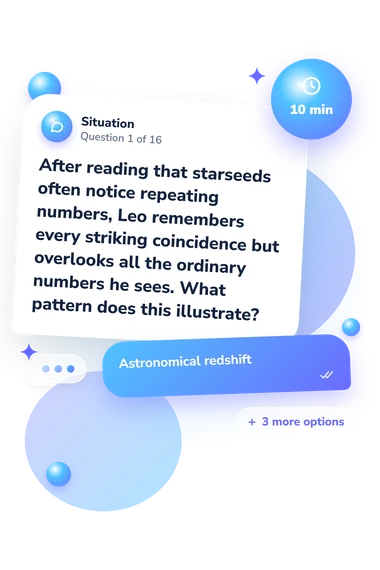
Example Questions From the Test
- Astronomical redshift
- Confirmation bias
- Peer review
- Random sampling
- They are confirmed whenever several quizzes produce the same result
- They are spiritual claims without an accepted empirical method of verification
- They can be verified by comparing personality traits with a birth chart
- They are accepted astronomical facts but remain medically untested
- Classical astronomy as taught through laboratory measurement
- Contemporary New Age spirituality and metaphysical belief
- A single organized religion with universally binding doctrine
- Clinical personality assessment based on validated traits
Starseed Quiz - Description and methodology of the test
People curious about starseed beliefs can use this starseed quiz to test how they distinguish spiritual language from astronomy and evidence. It is designed for readers who want a careful knowledge check rather than a verdict about cosmic identity. Someone approaching it as a quiz asking whether they are a starseed can treat the result as a prompt to examine definitions, reasoning errors, and the limits of spiritual-origin claims.
What This Assessment Explores
The questions test conceptual literacy rather than identity assignment. They cover starseed, lightworker, indigo children, awakening, and named identities such as Arcturian or Sirian. Other items ask whether readers can separate a physical object from a metaphysical interpretation and recognize confirmation bias, the Barnum effect, or unsupported agreement. The Arcturian example turns this into a quiz about Arcturian starseed identity without treating Arcturus itself as evidence for a spiritual label.
The displayed scale is Starseed Knowledge, with a 0-16 range. Its bands describe understanding and interpretation:
- Foundations to Build (0-6) indicates that clearer distinctions among lore, astronomy, and evidence may help.
- Developing Knowledge (7-12) shows familiarity with common concepts and thoughtful evaluation of claims.
- Strong Knowledge (13-16) reflects broad familiarity and critical interpretation, not proof of a starseed origin.
Methodology and Evidence Base
Each item presents a scenario or definition with four answer choices. The respondent selects the option that best separates spiritual language, astronomical fact, and reasoning principles. Responses produce the displayed score and band; they do not assign a personality type or establish a soul’s origin. As a starseed test quiz, this is structured self-reflection rather than cosmic classification.
Crockford (2021) provides the closest subject-specific framework, placing starseeds within contemporary UFO and New Age culture. The questionnaire is conceptually consistent with it, not a reproduction or adaptation. Barberia and colleagues (2018) support its attention to causal illusions and paranormal belief; Forer explains why broad descriptions feel exact, and Nickerson (1998) supports its focus on confirmation bias.
If someone expects a what starseed am i quiz, the result should be read differently: it measures knowledge, not a named type. Prior familiarity, attention, self-awareness, and confirmation habits can affect performance. The questionnaire is not presented as standardized and has no stated norms or clinical threshold; a stronger band indicates better handling of the material, not proof of spiritual origin.
- Crockford, Susannah. “Starseeds.” In Handbook of UFO Religions, edited by Benjamin E. Zeller, 403-422. Brill, 2021. DOI 10.1163/9789004435537_021.
- Barberia, Itxaso, Elisabet Tubau, Helena Matute, and Javier Rodríguez-Ferreiro. “A short educational intervention diminishes causal illusions and specific paranormal beliefs in undergraduates.” PLOS ONE 13, no. 1 (2018): e0191907. DOI 10.1371/journal.pone.0191907.
- Forer, Bertram R. “The fallacy of personal validation: A classroom demonstration of gullibility.” Journal of Abnormal and Social Psychology 44, no. 1 (1949): 118-123. DOI 10.1037/h0059240.
- Nickerson, Raymond S. “Confirmation bias: A ubiquitous phenomenon in many guises.” Review of General Psychology 2, no. 2 (1998): 175-220. DOI 10.1037/1089-2680.2.2.175.
Updated: