
Spelling Quiz
How the Scales are Structured
Who Usually Takes This Test?
See How You Compare
Below is a preview of how scores are typically distributed across each scale.
Example Questions From the Test
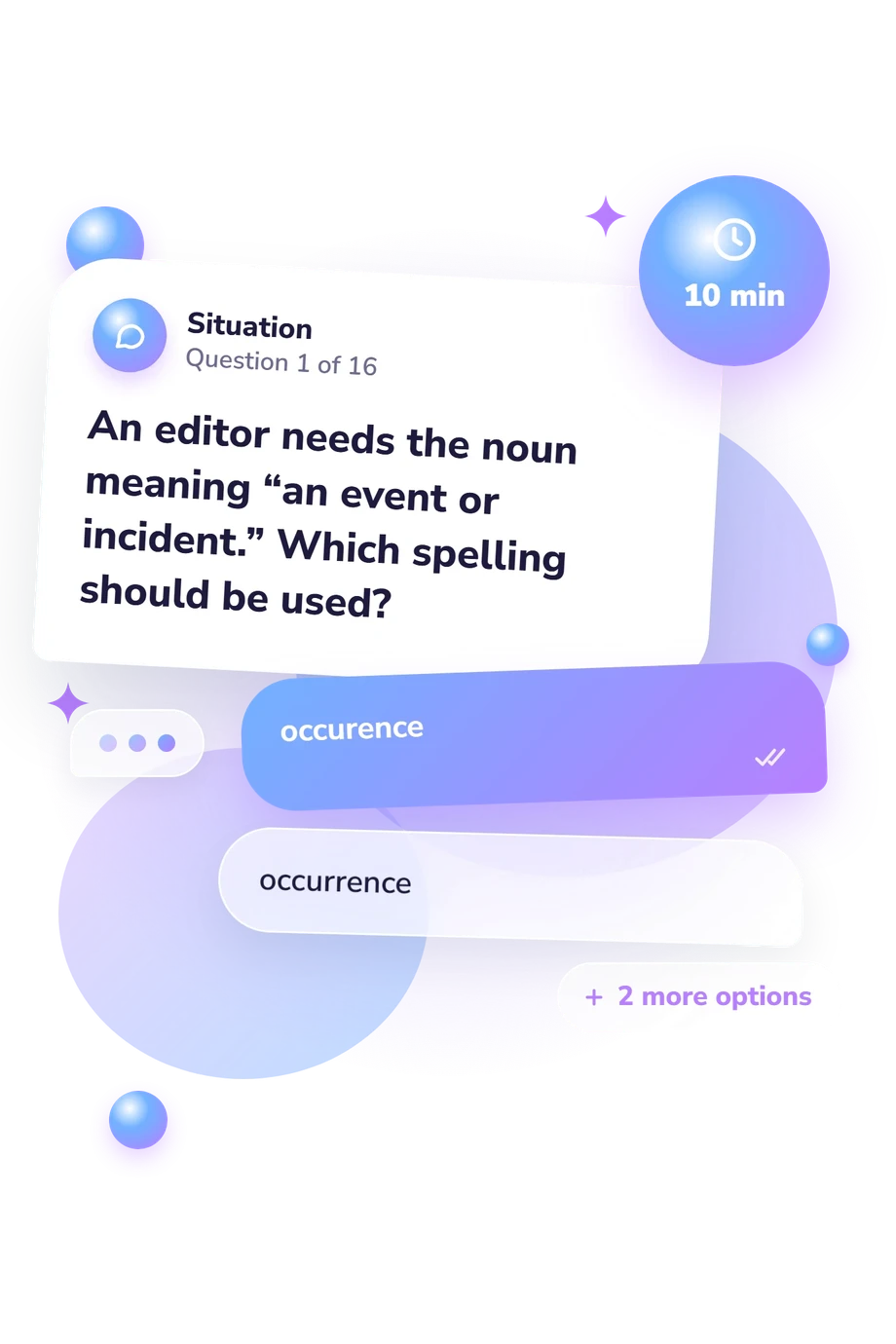
- occurence
- occurrence
- occurrance
- ocurrance
- accommodate
- accomodate
- acommodate
- accommoddate
- supercede
- superscede
- superseede
- supersede
Spelling Quiz - Description and methodology of the test
People who want a clear snapshot of written-word accuracy can use this assessment to examine how reliably they recognize conventional American English spellings. The spelling quiz suits learners, editors, students, and anyone reviewing personal strengths. It also helps readers identify the letter pattern behind an uncertain spelling, which can guide focused spelling pattern practice.
What This Assessment Explores
The items test correctly spelled words in workplace, academic, and everyday sentences. They sample doubled consonants, vowel sequences, unexpected letters, suffixes, and confused letter orders. Context makes the task one of recognizing a conventional written form, not explaining a rule.
Answer choices make unfamiliar spellings easier to examine: each alternative exposes a different letter pattern, so the assessment functions as a spelling knowledge test rather than a lesson in reciting rules. The following themes describe what the items represent, not separately scored dimensions:
- Familiar sequences are represented by items testing common consonant and vowel patterns.
- Tricky word forms are represented by plausible misspellings that must be rejected.
- Spelling Knowledge (0-16) totals correct answers: Foundation to build (0-6) indicates practice needs; Developing accuracy (7-12) reflects many recognized forms; Strong command (13-16) indicates consistently accurate advanced spelling.
Methodology and Evidence Base
Each item is a self-administered, four-option question. One option is conventionally spelled; the sentence supplies meaning. Each correct response contributes one point, and displayed bands interpret the total rather than an undisclosed formula.
In practical terms, this spelling assessment measures orthographic recognition in context, not handwriting, composition, pronunciation, or extended editing. Attention, American English exposure, word familiarity, and the testing situation can affect performance.
Brunswick and colleagues' study provides the closest published comparison because it examines self-administered spelling of difficult words. This questionnaire is conceptually consistent with that work, not an adaptation of it. McManus and colleagues' work on copying accuracy, visual memory, and dyslexia-related performance limits what can be inferred from a spelling result, while Treiman and Kessler's account of written-word learning clarifies the role of recurring orthographic patterns.
The score is a snapshot of performance on the selected spellings, not a measure that can be generalized to overall spelling ability. It does not establish a diagnosis, and an incorrect answer alone cannot distinguish unfamiliarity with a word from inattention, limited exposure, or another cause of the error.
- Brunswick, Nicola, I. Christopher McManus, Rebecca Chamberlain, Howard Riley, and Qona Rankin. (2011). "Imediately, sincerly, choclate": Findings from a new self-administered spelling test for dyslexia. Paper presented at the British Dyslexia Association's 8th International Conference, Harrogate, UK. 10.13140/2.1.2066.6566
- McManus, I. Christopher, Rebecca Chamberlain, Phik-Wern Loo, Qona Rankin, Howard Riley, and Nicola Brunswick. (2010). Art students who cannot draw: Exploring the relations between drawing ability, visual memory, accuracy of copying, and dyslexia. Psychology of Aesthetics, Creativity, and the Arts, 4(1), 18-30. 10.1037/a0017335
- Treiman, Rebecca, and Brett Kessler. (2014). How Children Learn to Write Words. Oxford University Press. 10.1093/acprof:oso/9780199907977.001.0001
Updated: