
Spanish Numbers 1-20 Quiz
How the Scales are Structured
Who Usually Takes This Test?
See How You Compare
Below is a preview of how scores are typically distributed across each scale.
Example Questions From the Test
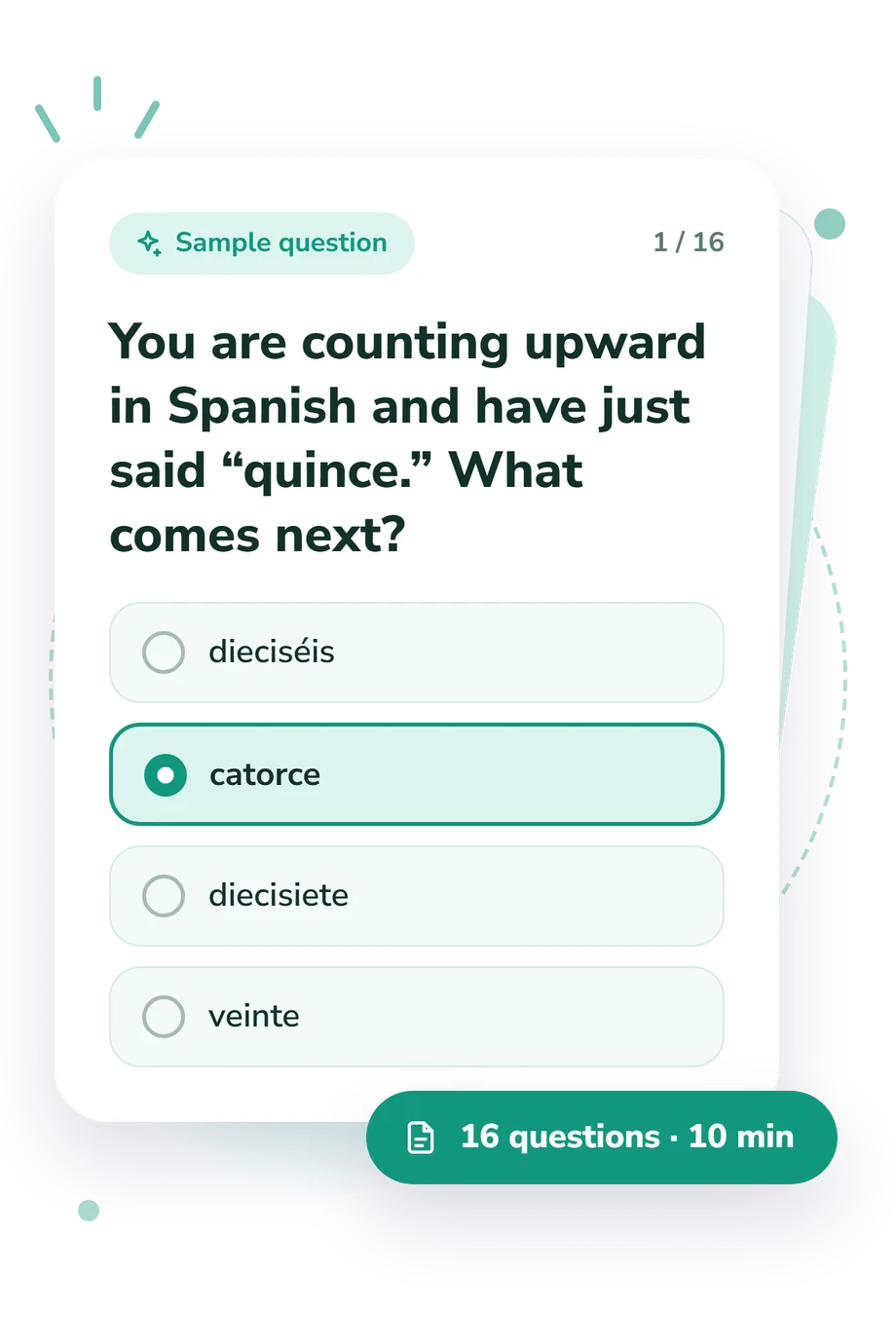
- dieciséis
- catorce
- diecisiete
- veinte
- cuatro
- cinco
- quince
- seis
- once
- nueve
- diez
- trece
Spanish Numbers 1-20 Quiz - Description and methodology of the test
For independent learners, tutors, and teachers choosing where to focus, the Spanish 1 20 Quiz offers a practical way to check number knowledge. It provides a clear picture of how confidently someone recognizes and uses forms from uno through veinte. Spanish number practice can then target the words or relationships that need attention.
What This Assessment Measures
It checks whether learners connect Spanish number words with meanings, numerals, order, and quantities. It includes practical-use questions about counting, prices, labels, tickets, food, sequences, comparisons, and small additions, keeping the focus on forms from one through twenty rather than broad Spanish vocabulary.
The single result is reported as Spanish Numbers One to Twenty Knowledge (0-16), placing performance in Foundations (0-6), Developing (7-12), or Strong (13-16). These bands describe this questionnaire, not overall Spanish proficiency.
As a quiz about Spanish numbers from 1 to 20, it shows the item themes contributing to that overall score:
- Recognition and translation show whether number forms match meanings or numerals.
- Sequencing shows whether number words occupy the correct order.
- Quantity use shows whether words connect with practical amounts.
- Comparison shows whether nearby values are understood.
- Addition shows whether simple totals are understood.
Methodology and Evidence Base
Each item offers four answer choices and asks the learner to select the word, numeral, or quantity that completes a prompt. This selected-response knowledge check combines recognition, translation, matching, sequencing, comparison, and everyday application. The displayed result summarizes performance across these tasks rather than general Spanish ability.
Methodologically, its form-meaning recognition tasks have a limited conceptual overlap with the vocabulary-testing method discussed by Laufer and Goldstein (2004); that study does not validate this questionnaire. Butt et al. (2019) is used only as a content reference for Spanish forms and usage conventions.
These contexts test Spanish number knowledge in everyday amounts rather than recall isolated word lists. The questionnaire reports one overall score rather than separate subscores, and it has no reported standardization, population norms, or reliability estimate.
Interpretation is straightforward: a stronger result suggests more dependable performance across these forms, while a lower result identifies review targets. Attention, guessing, recent practice, and familiarity with written wording can influence performance. It works best as an instructional indicator alongside practice and broader language activities.
- Laufer, Batia, and Zahava Goldstein. “Testing Vocabulary Knowledge: Size, Strength, and Computer Adaptiveness.” Language Learning 54, no. 3 (2004): 399-436. 10.1111/j.0023-8333.2004.00260.x
- Butt, John, Carmen Benjamin, and Antonia Moreira Rodríguez. A New Reference Grammar of Modern Spanish. 6th ed. Routledge, 2019.
- Council of Europe. Common European Framework of Reference for Languages: Learning, Teaching, Assessment - Companion Volume. Council of Europe Publishing, Strasbourg, 2020.
Updated: