
Spanish Months Quiz
How the Scales are Structured
Who Usually Takes This Test?
See How You Compare
Below is a preview of how scores are typically distributed across each scale.
Example Questions From the Test
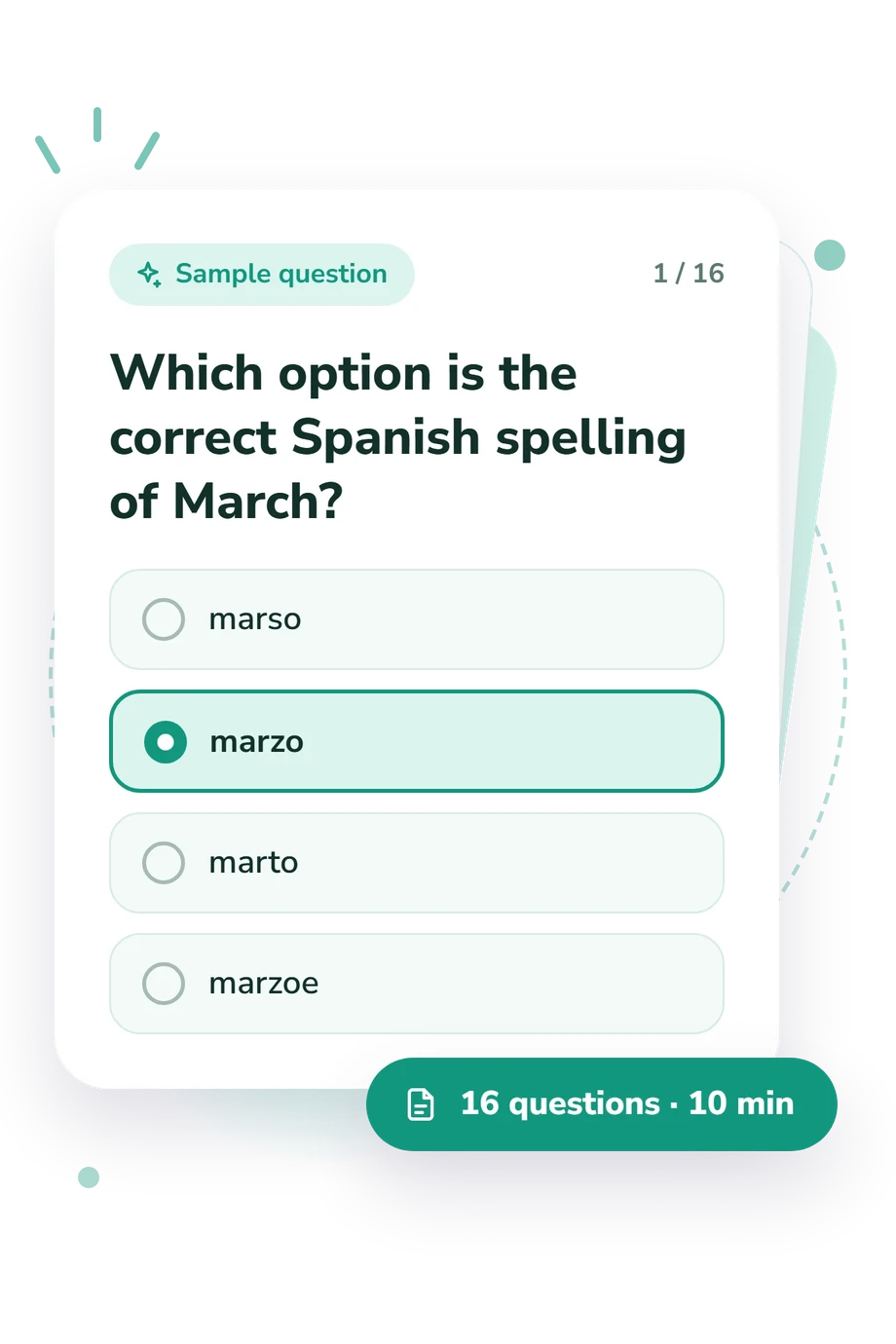
- marso
- marzo
- marto
- marzoe
- June
- March
- May
- August
- mayo
- abril
- febrero
- junio
Spanish Months Quiz - Description and methodology of the test
People who want to check their readiness for basic Spanish calendar vocabulary can use the Spanish Months Quiz to plan a focused review. It suits beginners, learners revisiting foundational material, and anyone organising targeted practice around dates. As a Spanish months of the year quiz focused on one vocabulary set, the questionnaire keeps the result narrow enough to guide study without representing overall Spanish ability.
What This Assessment Measures
The questions cover a compact lexical field: the twelve Spanish month names and relationships that make them useful in dates. They test correct spelling, English-Spanish meaning, chronological order, the month before or after another, and short expressions such as “en abril.” Because this Spanish month names quiz focuses on one lexical field, it provides a focused vocabulary check rather than a broad assessment of grammar or fluency.
One reported scale, Spanish Months Knowledge (0-16), groups performance as Foundational (0-6), Developing (7-12), or Strong (13-16). The question themes fall into three practical groups:
- Recognition and spelling show whether learners can identify month forms without confusing similar-looking options.
- Translation and meaning indicate how reliably learners connect Spanish names with English equivalents.
- Calendar order and contextual use reveal whether learners can place months in sequence and select them in simple date expressions.
Methodology and Evidence Base
Each item uses four-choice multiple-choice format. Some prompts ask for recall, while others place a month inside a date, translation, sequence, or short sentence. The alternatives distinguish spelling, meaning, order, or contextual errors, so this Spanish calendar vocabulary test checks applied recognition as well as recall.
The displayed scoring method awards one point for every correct answer. The bands organise performance across the score range. Prior exposure, guessing among the options, or a familiar study context can affect performance. A strong result indicates command of these items; it does not measure pronunciation, listening, spontaneous speaking, writing, or wider Spanish proficiency.
Conceptually, the questionnaire is consistent with vocabulary-assessment work by Khong and Kabilan, which treats knowledge as form, meaning, and use rather than memorized labels. The Instituto Cervantes framework offers a reference for viewing lexical knowledge within communicative language use, while Read and Chapelle link task design and score interpretation to the construct assessed. These publications provide conceptual and methodological context, not evidence establishing standardization for this questionnaire. The bands describe performance on this focused question set.
- Khong, Hou Keat, and Muhammad Kamarul Kabilan. "Development of an instrument for measuring Spanish vocabulary knowledge." Porta Linguarum: An International Journal of Foreign Language Teaching and Learning, no. 41 (2024): 79-95. 10.30827/portalin.vi41.25406
- Instituto Cervantes. (2006). Curricular Plan of Instituto Cervantes: Reference Levels for Spanish. Madrid: Biblioteca Nueva. 3 vols.
- Read, John, and Carol A. Chapelle. "A framework for second language vocabulary assessment." Language Testing, 18(1) (2001): 1-32. 10.1177/026553220101800101
Updated: