
Smoking Quiz
How the Scales are Structured
Who Usually Takes This Test?
See How You Compare
Below is a preview of how scores are typically distributed across each scale.
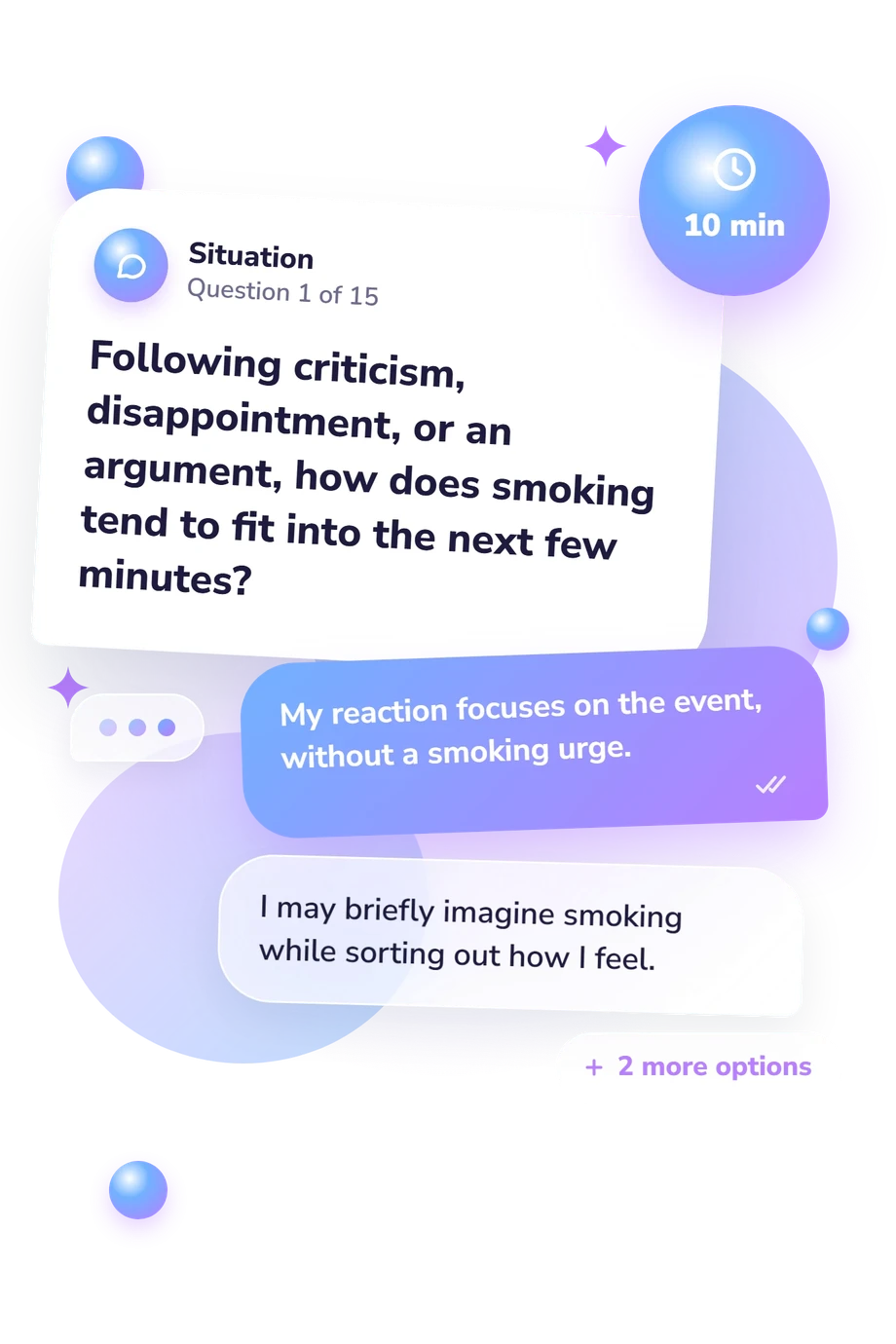
Example Questions From the Test
- I switch tasks or pause without thinking about smoking.
- I sometimes remember smoking because a break has opened up.
- I commonly weigh whether to use the break for a cigarette.
- A task break feels incomplete or difficult without smoking.
- Smoking usually does not enter my mind because of the tension.
- A brief thought of smoking may appear, then fade.
- I repeatedly consider smoking while I try to unwind.
- I feel a strong urge to smoke or quickly reach for a cigarette.
- Being there does not meaningfully bring smoking to mind.
- I briefly remember smoking there without much pull.
- The surroundings repeatedly make me consider smoking.
- The setting itself produces a strong or immediate urge to smoke.
Smoking Quiz - Description and methodology of the test
People who notice that cigarettes become appealing in particular moments can use this quiz about smoking to organize those experiences before deciding what to examine more closely. The smoking quiz questions move through routines, feelings, social encounters, places, and sensory cues, so the result identifies the strongest trigger pattern, or a blended pattern when the leading scores are within one point.
What This Assessment Explores
This questionnaire examines how strongly three kinds of situations cue smoking, revealing smoking trigger patterns across routines, feelings, and social or environmental settings. It is for people reflecting on smoking patterns; it does not establish dependence or health impact.
The result compares three trigger affinities:
- Daily Routine Triggers (0-15) shows how strongly repeated activities, timing, and transitions cue smoking: Occasional signal (0-5), Noticeable pattern (6-10), or Strong affinity (11-15).
- Emotional-State Triggers (0-15) shows how strongly uncomfortable or positive feelings may cue smoking: Occasional signal (0-5), Noticeable pattern (6-10), or Strong affinity (11-15).
- Social and Setting Triggers (0-15) shows how strongly people, offers, places, and visible smoking cues influence urges: Occasional signal (0-5), Noticeable pattern (6-10), or Strong affinity (11-15).
The highest profile marks the strongest connection between that type of situation and smoking thoughts or urges.
Methodology and Evidence Base
Each item offers four ordered positions: no meaningful smoking link, a passing thought, active consideration, and a strong or automatic urge in situations involving routines, feelings, people, places, and smoking cues.
Methodologically, the questionnaire produces a separate score for each smoking trigger profile. The highest score is the strongest affinity; scores within one point of it appear as a blended result. Bands are reflection categories, not clinical cutoffs.
Zhou and colleagues' 2021 study describes an ecological model of smoking cues whose themes are conceptually consistent with this questionnaire, distributing cues across routines, emotions, people, places, and contexts. The content is also conceptually consistent with the Glover-Nilsson smoking behavioral questionnaire and Shiffman and colleagues' 2013 study on cue reactivity, craving, and smoking behavior. The questionnaire is not an adaptation of those instruments, and the cited studies do not validate its scores.
The result is an unvalidated self-reflection score, not a measure of dependence or health impact. Stress, recent smoking, memory, and self-awareness can influence answers, so use the strongest profile to track situations and guide reflection rather than quantify smoking risk.
- Zhou S, Levinson AH, Zhang X, Portz JD, Moore SL, Gore MO, Ford KL, Li Q, Bull S. A pilot study and ecological model of smoking cues to inform mobile health strategies for quitting among low-income smokers. Health Promotion Practice. 2021;22(6):850-862. 10.1177/1524839920942214
- Glover ED, Nilsson F, Westin A, Glover PN, Laflin MT, Persson B. Developmental history of the Glover-Nilsson smoking behavioral questionnaire. American Journal of Health Behavior. 2005;29(5):443-455. 10.5993/AJHB.29.5.7
- Shiffman S, Dunbar M, Kirchner T, Li X, Tindle H, Anderson S, Scholl S. Smoker reactivity to cues: effects on craving and on smoking behavior. Journal of Abnormal Psychology. 2013;122(1):264-280. 10.1037/a0028339
Updated: