
Skin Cancer Quiz
How the Scales are Structured
Who Usually Takes This Test?
See How You Compare
Below is a preview of how scores are typically distributed across each scale.
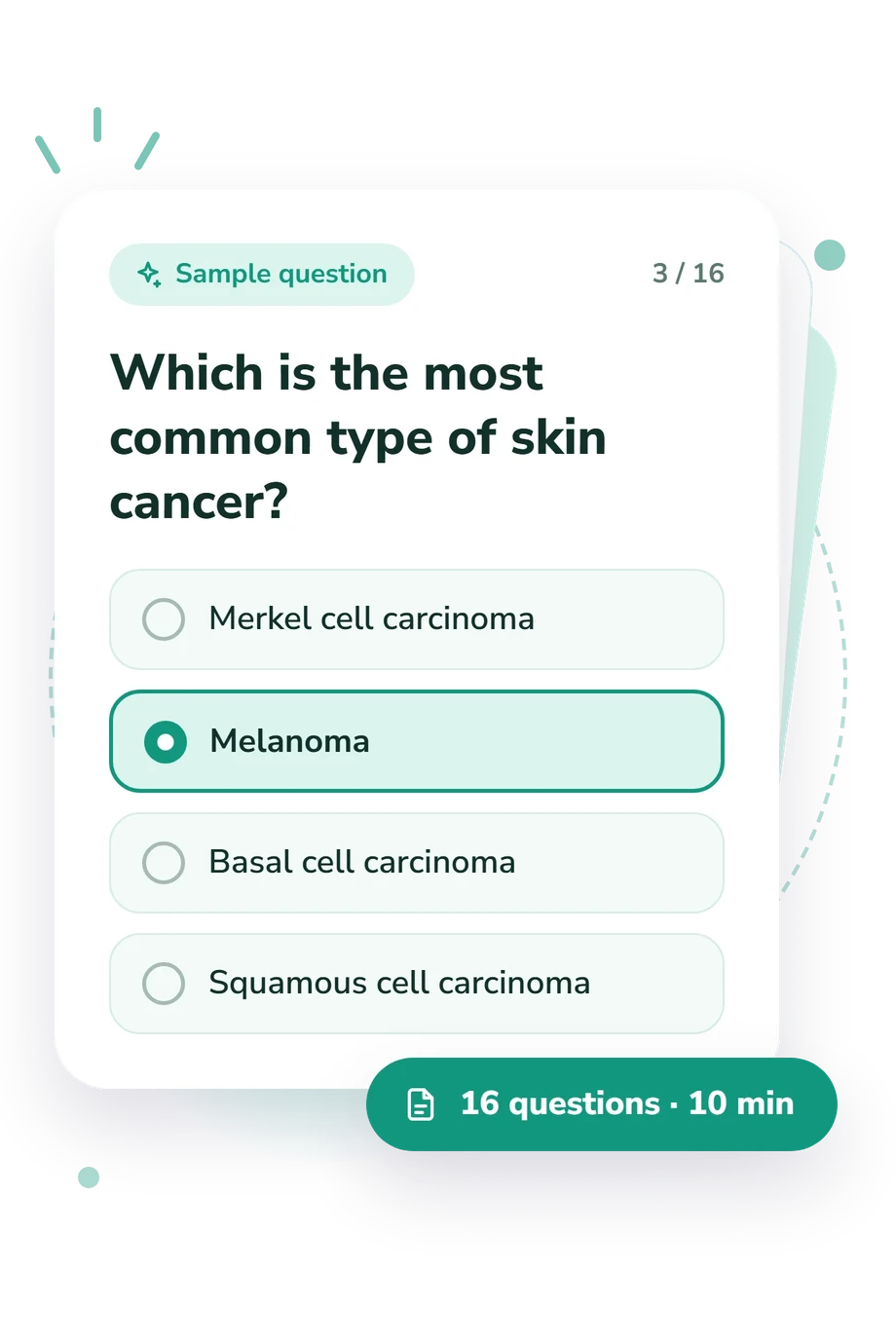
Example Questions From the Test
- Photograph it and wait until it becomes painful
- Arrange an evaluation with a dermatologist or qualified clinician
- Treat it with an over-the-counter wart remover
- Assume it is harmless if it is smaller than a pencil eraser
- Merkel cell carcinoma
- Melanoma
- Basal cell carcinoma
- Squamous cell carcinoma
- It remains effective for an entire day
- It is suitable for every skin condition
- It protects against both UVA and UVB radiation
- It blocks all visible and ultraviolet light
Skin Cancer Quiz - Description and methodology of the test
For people who want to understand suspicious skin changes and everyday prevention, this skin cancer quiz offers a focused knowledge check. It is useful for readers who want to recognise warning signs, understand UV protection, and refresh basic terminology. The result gives people using this do-I-have-skin-cancer quiz a summary of how well they recognise common warning signs, prevention principles, and key terms.
What This Assessment Explores
The questionnaire checks whether you can recognise warning situations, distinguish essential terms, and choose sensible protection strategies. It suits readers asking whether they have skin cancer, including those reviewing information after noticing a change. As a quiz about skin cancer risk, it organises knowledge about prevention, warning signs, and decisions that call for professional attention.
Each item represents a topic reflected in the result:
- Warning signs show whether you recognise changing, bleeding, crusting, painful, or non-healing marks.
- Prevention choices show whether you understand shade, protective clothing, sunscreen, clouds, tanning devices, and blistering sunburn.
- Core knowledge shows whether you can distinguish common cancers, melanocytes, ABCDE signs, the ugly-duckling principle, and biopsy.
Anyone using it to ask whether they have melanoma can read the result as a guide to melanoma knowledge, relevant features, and changes that deserve attention.
Methodology and Evidence Base
Each item is multiple choice with one best response. Questions cover warning signs, prevention, terminology, self-checking, and follow-up. The result is one educational tally, Skin Cancer Knowledge (0-16), reported as Foundations to build (0-6), Developing knowledge (7-12), or Strong knowledge (13-16). These bands indicate the level of knowledge represented by the tally.
The content is conceptually consistent with the SCSK Scale (Day et al., 2014), a published knowledge measure, but this online questionnaire is not an adaptation of it. It also aligns thematically with the KAP-SC-Q, which covers knowledge, attitudes, and practices, whereas this test reports knowledge only. The National Cancer Institute’s PDQ prevention guidance supports its focus on UV exposure, protective behaviour, and tanning.
As a self-report questionnaire, the displayed tally is educational: readers may approach it as a do-I-have-melanoma quiz, but it does not assess personal cancer risk or diagnose skin cancer, and its result can be influenced by memory, attention, wording, and current context; any new, changing, bleeding, painful, or non-healing lesion warrants qualified clinical assessment independently of the score.
- Day, Ashley K., Carlene Wilson, Rachel M. Roberts, and Amanda D. Hutchinson. The Skin Cancer and Sun Knowledge (SCSK) Scale: Validity, reliability, and relationship to sun-related behaviors among young western adults. Health Education & Behavior, 2014, 41(4), 440-448. 10.1177/1090198114529129
- Mohammed, Ali Haider, Loh Hui Ying, Marcus Loh Boon Hong, Annabel Wong Sze Nee, Lo Siew Ying, Dinesh Sangarran Ramachandram, and Bassam Abdulrasool Hassan. Development and validation of a knowledge, attitude, and practice (KAP) questionnaire for skin cancer in the general public: KAP-SC-Q. Research in Social and Administrative Pharmacy, 2024, 20(2), 124-136. 10.1016/j.sapharm.2023.10.009
- PDQ Screening and Prevention Editorial Board. Skin Cancer Prevention (PDQ)-Patient Version. Bethesda, MD: National Cancer Institute, updated May 16, 2025.
Updated: