
Siren or Mermaid Quiz
How the Scales are Structured
Who Usually Takes This Test?
See How You Compare
Below is a preview of how scores are typically distributed across each scale.
Example Questions From the Test
- Ask questions until everyone’s practical concerns are clear.
- Use a vivid comparison that changes how the room sees the issue.
- State my position firmly without revealing everything behind it.
- Wait for the right opening, then offer a concise observation.
- Give them space until they decide how involved they want to be.
- Offer a quick orientation, then return to my usual routine.
- Introduce them to a few people who share their interests.
- Invite them along while letting the group welcome them naturally.
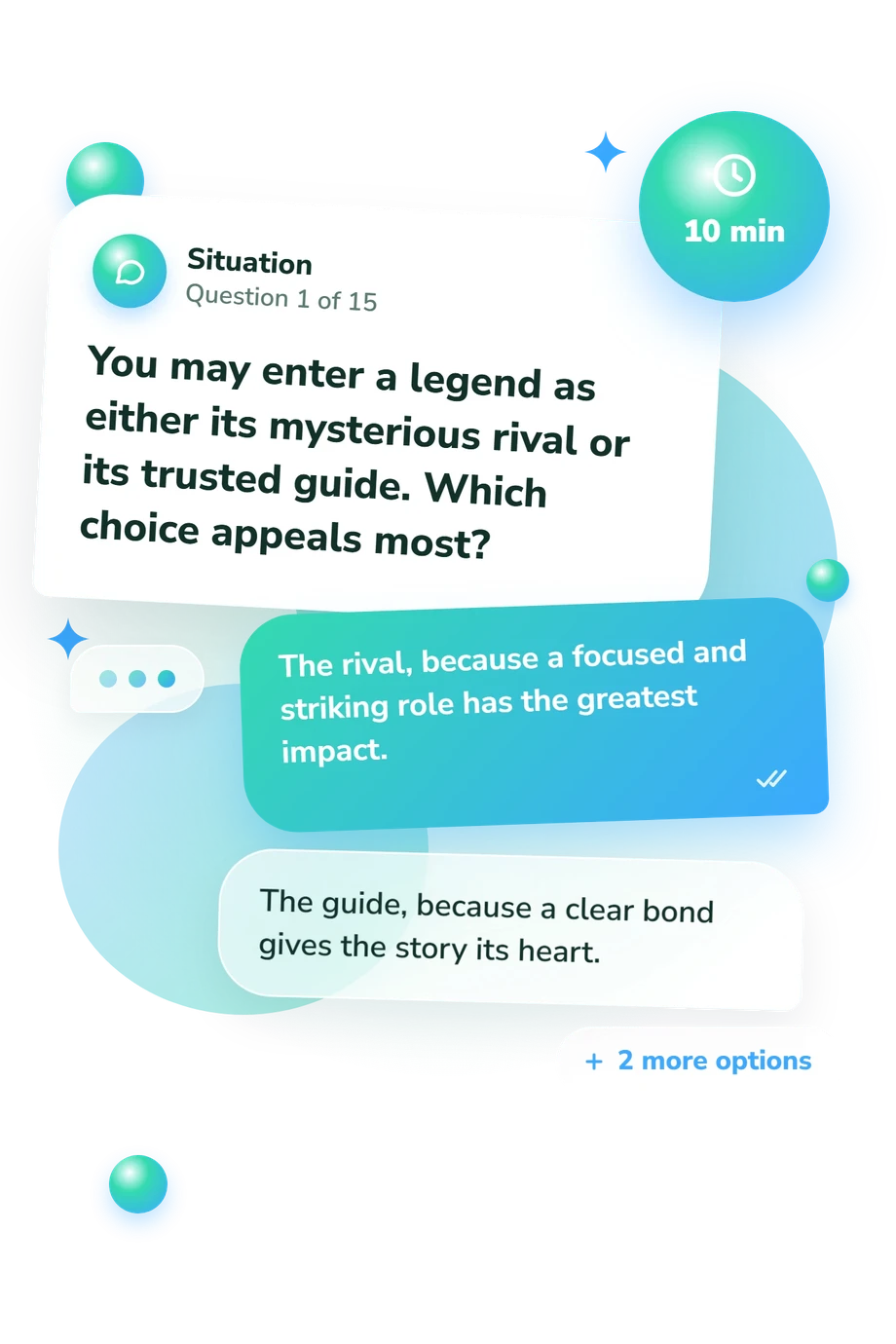
- Their ability to stand apart from ordinary expectations.
- The way they embody desire, danger, and fascination at once.
- Their place within the wider collection of sea legends.
- Mostly the ocean setting and magical atmosphere.
Siren or Mermaid Quiz - Description and methodology of the test
For readers who enjoy symbolic self-reflection, the Siren or Mermaid Quiz turns imaginative choices into a profile of preferred ways to connect, express yourself, and respond to change. This siren quiz is suited to anyone curious about whether their style leans toward openness, mystery, bold presence, or flexible movement between contrasts. It offers language for reflection, not a fixed identity.
What This Assessment Explores
Sea-inspired scenarios translate everyday preferences into a symbolic profile rather than a literal identity. They cover connection, privacy, unfamiliar people, performance, emotional intensity, changing plans, and movement between solitude and belonging. This sea-themed profile suits anyone seeking a playful vocabulary for personal self-reflection.
The three displayed dimensions are:
- Mermaid Affinity (0-15) reflects connection, curiosity, playfulness, and belonging: Distant Ripple (0-5), Open Lagoon (6-10), or Radiant Reef (11-15) indicate increasing openness, warmth, wonder, and shared discovery.
- Siren Affinity (0-15) reflects mystery, compelling expression, intensity, and influence: Quiet Echo (0-5), Gathering Song (6-10), or Magnetic Current (11-15) indicate gentler, selective, or bold presence.
- Tideborn Blend Affinity (0-15) reflects comfort with contrasts: Single Current (0-5), Shifting Tide (6-10), or Tideborn Balance (11-15) indicate consistency, adaptation, or central fluidity.
Methodology and Evidence Base
Each item presents a situation with four responses, covering welcoming a newcomer, handling disagreement, exploring an unfamiliar coast, and choosing a form of expression. Select the option closest to your likely reaction, not the most admirable one. Together, the items sample ways of relating, communicating, adapting, and influencing.
Scores compare the three outcome totals. The highest identifies your strongest affinity, while any result within one point of it joins a blended result. The bands describe degree within this profile, not universal psychological cutoffs.
The archetypal framing is conceptually consistent with Martos García (2016), which treats sirens as cross-cultural symbolic figures. Lehn and Schroeder (2004) provide historical context for related sea beings, and Gust (2024) considers mermaids in relation to shifting boundaries of gender, humanity, and identity. These works support interpretation of the imagery; this online questionnaire is not an adaptation of them.
The displayed bands are descriptive profile labels showing relative emphasis across the three outcomes in this affinity quiz. Because answers are self-reported, current mood, context, and self-image may affect the pattern, so the result is best read as a reflective snapshot rather than a clinical classification.
- Martos García, Aitana. “Sirens as Cross-Cultural Archetypes and as a Resource for Literary Education.” Didáctica. Lengua y Literatura, vol. 28, 2016, pp. 181-199. 10.5209/DIDA.54081
- Lehn, Waldemar H., and Irmgard I. Schroeder. “The Hafstramb and Margygr of the King’s Mirror: An Analysis.” Polar Record, vol. 40, no. 2, 2004, pp. 121-134. 10.1017/S0032247403003255
- Gust, Onni. “Of Mermaids and Monsters: Transgender History and the Boundaries of the Human in Eighteenth- and Early-Nineteenth-Century Britain.” Gender & History, vol. 36, no. 1, 2024, pp. 112-129. 10.1111/1468-0424.12769
Updated: