
Simple Tenses of Verbs Quiz
How the Scales are Structured
Who Usually Takes This Test?
See How You Compare
Below is a preview of how scores are typically distributed across each scale.
Example Questions From the Test
- believe
- am believe
- will believed
- believed yesterday
- boiled
- is boil
- will boiling
- boils
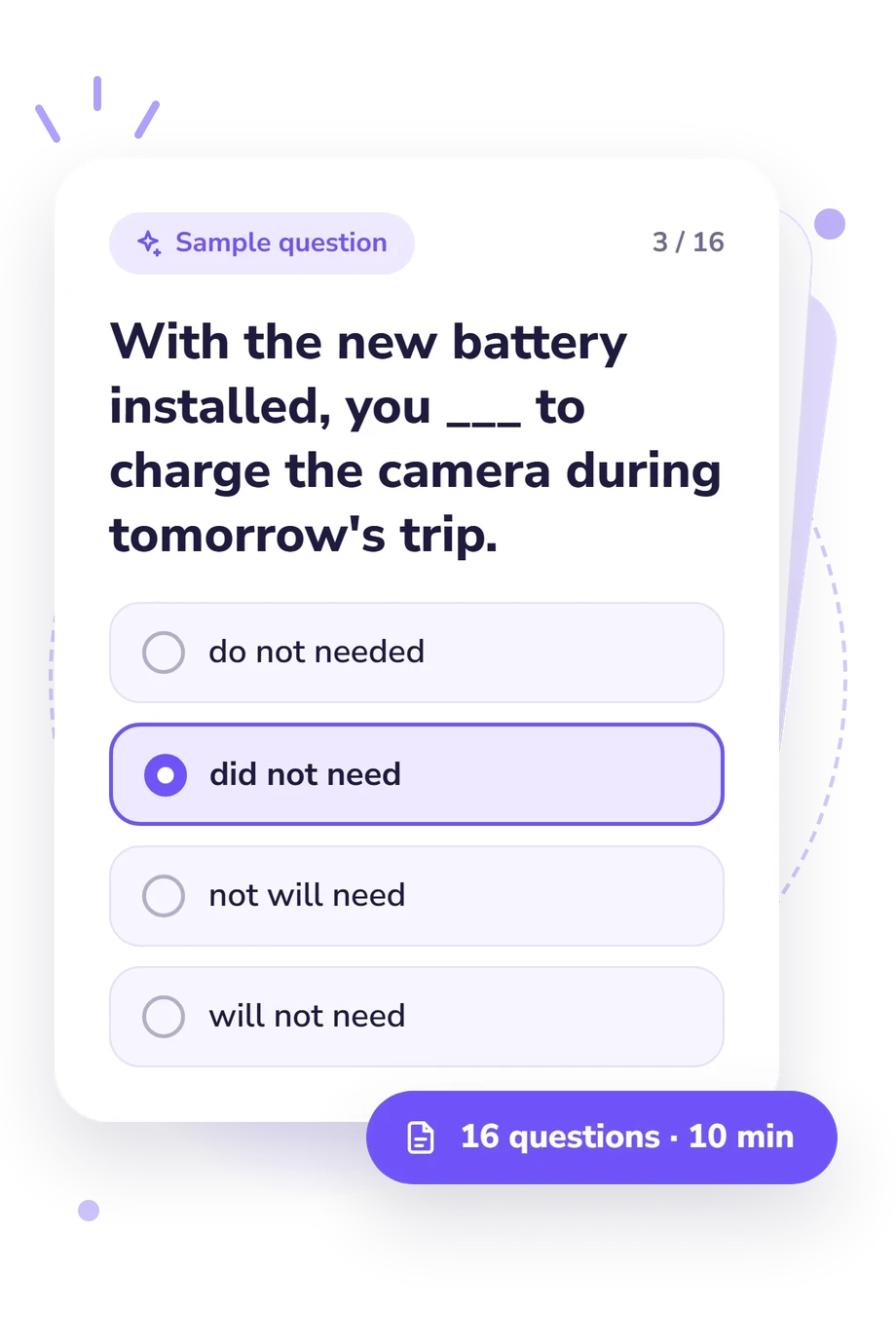
- do not needed
- did not need
- not will need
- will not need
Simple Tenses of Verbs Quiz - Description and methodology of the test
Learners who want to check their knowledge of and ability to select simple present, past, and future forms in short written contexts can use the simple tenses of verbs quiz to examine routine statements, completed events, and future plans. It is a useful quiz on simple verb tenses for students, independent learners, or anyone reviewing grammar before writing or conversation. The result points to areas for further practice.
What This Assessment Explores
The questionnaire examines the simple present, past, and future in facts, routines, completed actions, predictions, promises, schedules, and future time clauses. It checks negation, subject-verb agreement, irregular past forms, and question word order. This simple tenses quiz shows how well a learner connects form with time and sentence pattern.
One displayed scale, Simple Tenses of Verbs Knowledge (0-16), uses these result bands:
- Foundation to build (0-6) shows recognition of some simple-tense patterns, with possible benefit from reviewing forms, time cues, and sentence structure.
- Developing command (7-12) reflects many correct applications with some gaps.
- Strong command (13-16) reflects consistent distinction and formation of the three forms.
The result is relevant to learners reviewing grammar for writing, conversation, or classwork. The score is an educational snapshot, not a formal language assessment. Learners can use it to choose grammar topics to review next.
Methodology and Evidence Base
Each item presents a short sentence or question with four answer choices. The task is to select the form that fits the grammatical context: affirmative statements, negatives, questions, time clauses, and future references all appear. The score is reported against the displayed scale; no separate weighting scheme is stated, so readers should not assume that one item type contributes more than another.
The linguistic reference is Huddleston and Pullum’s grammar, whose account describes the tense and clause patterns represented here. Salaberry’s study of past-tense acquisition is relevant to learning English past tense in instructional contexts, while Purpura’s assessment work offers a perspective on interpreting grammar performance. This questionnaire is conceptually consistent with those works, not presented as an adaptation or validated version of them.
As an English verb tenses quiz, the questionnaire uses short written selection items. Selecting among written options means performance reflects recognition in these contexts, not free writing or conversation. Performance can be affected by attention, guessing, recent instruction, and familiarity with written conventions, so the bands are best used to guide practice and review.
- Rodney Huddleston and Geoffrey K. Pullum, with contributions from Laurie Bauer, Betty Birner, Ted Briscoe, Peter Collins, David Denison, David Lee, Anita Mittwoch, Geoffrey Nunberg, Frank Palmer, John Payne, Peter Peterson, Lesley Stirling, and Gregory Ward, The Cambridge Grammar of the English Language, Cambridge University Press, 2002. 10.1017/9781316423530
- M. Rafael Salaberry, The acquisition of English past tense in an instructional setting, System, 28(1), 135-152, 2000. 10.1016/S0346-251X(99)00065-2
- James E. Purpura, Assessing Grammar, Cambridge University Press, 2004. 10.1017/CBO9780511733086
Updated: