
Should I Stay with My Boyfriend After He Cheated Quiz
How the Scales are Structured
Who Usually Takes This Test?
See How You Compare
Below is a preview of how scores are typically distributed across each scale.
Example Questions From the Test
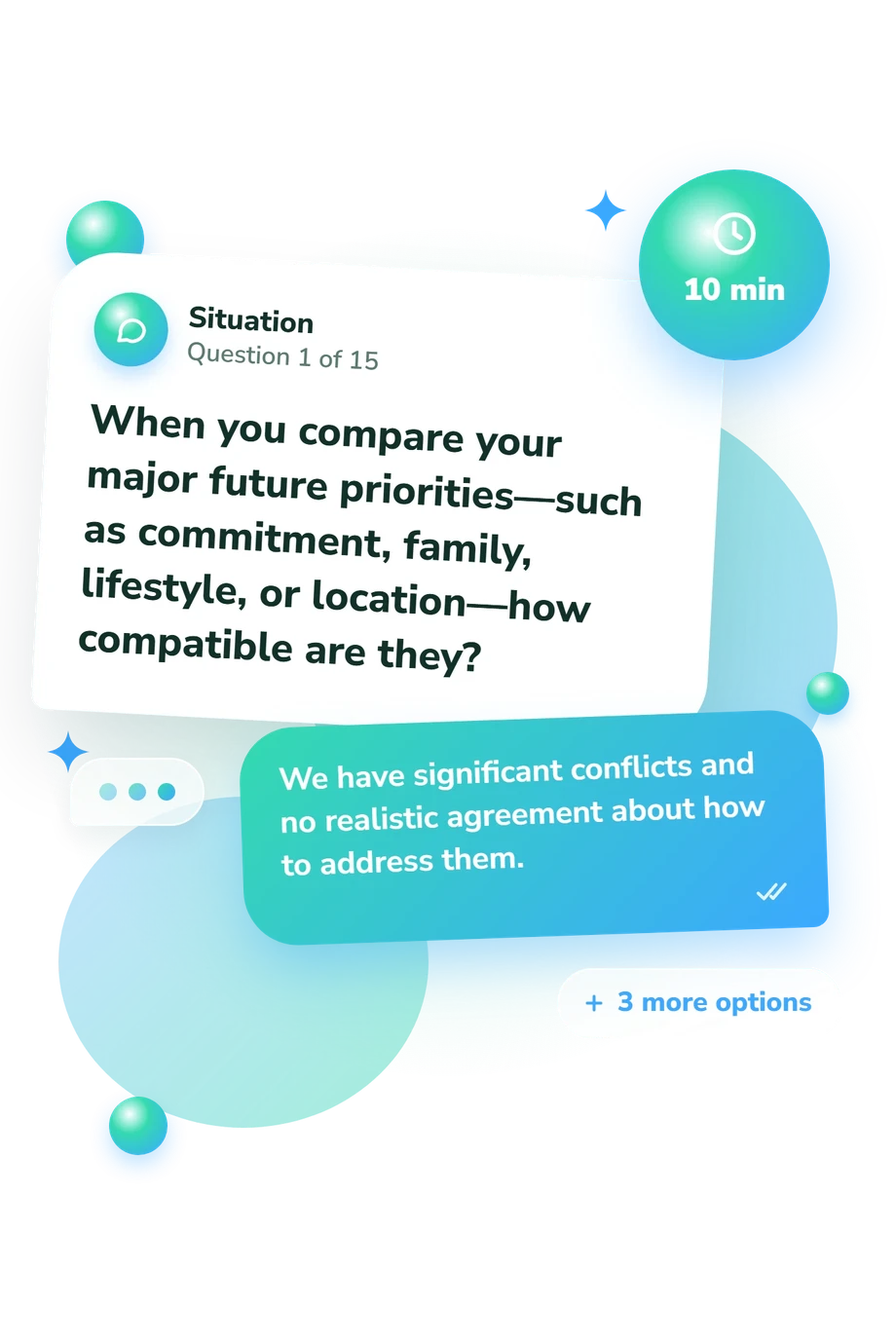
- We have significant conflicts and no realistic agreement about how to address them.
- Most priorities align, and the differences seem workable through mutual compromise.
- We agree on some priorities, but one or more major questions remain unresolved.
- Our direction is broadly compatible, although a few decisions still need honest negotiation.
- There was an apology, but little has changed in his everyday behavior.
- His actions are mostly consistent with his words, including when the subject is uncomfortable.
- He makes some changes, although they tend to fade or require repeated prompting.
- Several meaningful changes have lasted, but consistency is still developing.
- Care and responsibility are shared fairly consistently, with room for either person to need more at times.
- The balance changes: sometimes it feels mutual, but recurring areas fall mainly to one person.
- One of us usually carries much more of the emotional or practical load.
- There is some mutual effort, although I often notice an imbalance before he does.
Should I Stay with My Boyfriend After He Cheated Quiz - Description and methodology of the test
For someone deciding whether reconciliation is worth exploring, the Should I Stay with My Boyfriend After He Cheated Quiz turns a painful, uncertain choice into a guided look at conduct, capacity, and compatibility. It is designed for a partner weighing whether to continue, pause, or leave after betrayal. The question, should I stay after my boyfriend cheated, can be considered alongside history, fear, and outside pressure. The questions examine when continuing, pausing, or leaving might feel viable.
What This Assessment Explores
Rather than asking only whether love remains, the assessment separates three questions: Is he showing repair in practice? Are you ready to explore rebuilding without abandoning your boundaries? Was the relationship workable apart from the betrayal? Its items address apologies, follow-through, openness, contact boundaries, conflict, needs, priorities, and choice.
The three result dimensions are:
- Accountability and Repair Effort (0-15) reflects visible ownership and sustained repair: Limited evidence (0-5), Mixed evidence (6-10), or Stronger evidence (11-15).
- Personal Readiness to Rebuild (0-15) reflects willingness and emotional capacity to explore reconciliation while retaining boundaries: Little readiness (0-5), Uncertain readiness (6-10), or Genuine readiness (11-15).
- Relationship Foundation (0-15) considers compatibility, mutuality, and connection apart from cheating: Fragile foundation (0-5), Uneven foundation (6-10), or Substantial foundation (11-15).
These bands frame the decision; Should I Take Him Back After He Cheated Quiz cannot settle it.
Methodology and Evidence Base
Each item offers four response choices describing different patterns of conduct, relationship functioning, or personal readiness. Responses contribute to the three displayed dimensions, but no per-answer conversion is stated; the bands are descriptive summaries, not a reconstructable scoring rule.
As an infidelity recovery quiz, it organizes qualitative relationship themes into an online self-reflection questionnaire with reflective result bands. Its content is conceptually consistent with Abrahamson et al. (2012) on accountability, communication, support, and sustained change; Mitchell et al. (2022) on differing experiences of injured and involved partners; and Fife et al. (2023) on stabilization, reconnection, accountability, and trust during healing. It is an original online self-reflection tool, not an adaptation or standardized administration of those studies.
Use the bands as prompts, not instructions: they are reflective rather than clinical cutoffs, and current distress or self-report bias may influence answers. Compare the result with ongoing behavior, boundaries, safety, and the wider relationship pattern.
- Abrahamson, Iona, Rafat Hussain, Adeel Khan, and Margot J. Schofield. “What Helps Couples Rebuild Their Relationship After Infidelity?” Journal of Family Issues 33, no. 11 (2012): 1494-1519. 10.1177/0192513X11424257
- Mitchell, Erica A., Andrea K. Wittenborn, Tina M. Timm, and Adrian J. Blow. “Affair Recovery: Exploring Similarities and Differences of Injured and Involved Partners.” Journal of Marital and Family Therapy 48, no. 2 (2022): 447-463. 10.1111/jmft.12538
- Fife, Stephen T., Jacob D. Gossner, Alex Theobald, Emma Allen, Ariana Rivero, and Heather Koehl. “Couple Healing from Infidelity: A Grounded Theory Study.” Journal of Social and Personal Relationships 40, no. 12 (2023): 3882-3905. 10.1177/02654075231177874
Updated: