
Sexual Temperament Quiz
How the Scales are Structured
Who Usually Takes This Test?
See How You Compare
Below is a preview of how scores are typically distributed across each scale.
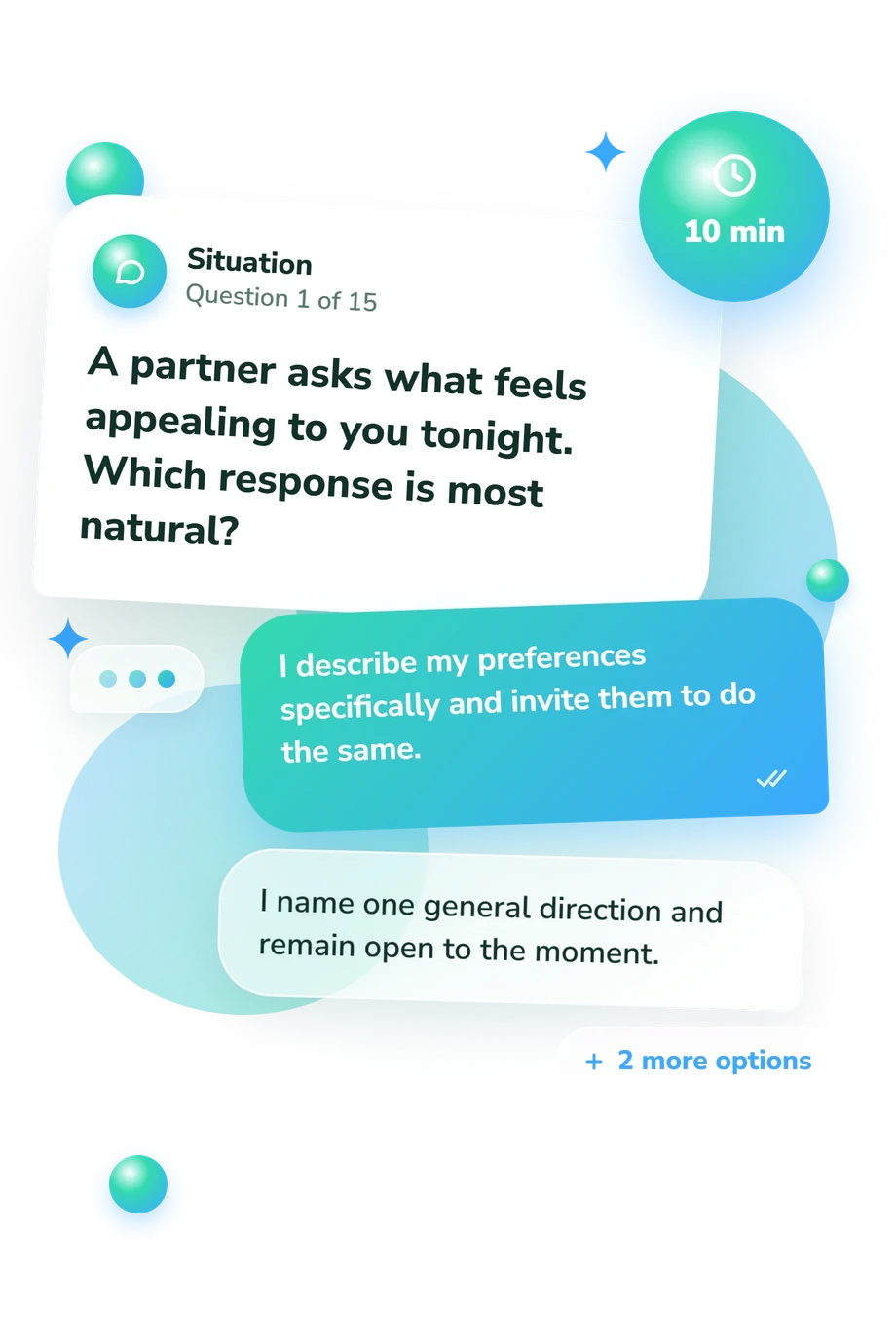
Example Questions From the Test
- I describe my preferences specifically and invite them to do the same.
- I name one general direction and remain open to the moment.
- I mention a few preferences and any important boundaries.
- I use a short phrase or established signal that we both clearly understand.
- A clear but brief confirmation of mutual interest is usually my preference.
- I like to talk through the broad mood and any relevant limits.
- I enjoy discussing specific wishes, boundaries, and possible alternatives.
- I prefer a quick check-in about what each of us has in mind.
- A familiar kind of intimacy in the different setting.
- Trying something noticeably different because the setting feels inspiring.
- Recreating a favorite experience as closely as possible.
- Mixing something familiar with one new element.
Sexual Temperament Quiz - Description and methodology of the test
People who want to understand how their intimate interest develops can use the Sexual Temperament Quiz to organize patterns they have noticed in themselves. It is intended for adults reflecting on consensual desire, communication, and comfort, not for assigning a fixed identity. This sexual temperament test offers a profile that can make conversations about timing, novelty, and boundaries more specific.
What This Assessment Explores
The items address how desire starts, how context shapes it, how a person approaches familiar or new experiences, and how preferences are communicated. They portray sexual desire patterns across safety, stress, partner, relationship context, and mood, while describing tendencies that may change with those conditions. The dimensions are read separately rather than combined into one overall label.
The three displayed dimensions are:
- Context-Responsive Desire (0-15) measures the role of emotional tone, transition time, and surroundings: More Spontaneous (0-5), Context-Flexible (6-10), or Strongly Context-Responsive (11-15).
- Novelty Openness (0-15) measures attraction to familiar or changing experiences: Familiarity-Anchored (0-5), Selectively Exploratory (6-10), or Novelty-Energized (11-15).
- Verbal Expression (0-15) measures preferred communication style: Light-Touch Expression (0-5), Situationally Explicit (6-10), or Highly Verbal (11-15).
Methodology and Scientific Basis
This structured self-report presents each item as a brief intimate scenario with four response options covering timing, preparation, communication, novelty, emotional repair, or surroundings. Selected responses are converted into three scale scores and displayed in the listed bands; the range does not reveal how many points any particular option contributes.
Methodologically, the sexual temperament assessment is conceptually consistent with the SESII-W, which considers interacting sexual excitation and inhibition; this questionnaire is not an adaptation of that inventory. Basson's 2000 model supplies a compatible account of responsive desire. Rosa's 2019 study addresses erotic variety, while Reyes and Clark's 2025 research examines partner responsiveness and sexual communication. These sources support interpretation of the constructs, not validation of this online tool.
The bands are unvalidated reflective categories, not measures of health, libido, relationship quality, communication skill, or compatibility. Self-report also reflects current context and self-perception, so the profile may prompt reflection or conversation. Consent must independently be clear, freely given, specific, and reversible.
- Graham, Cynthia A., Stephanie A. Sanders, and Robin R. Milhausen (2006). The sexual excitation/sexual inhibition inventory for women: psychometric properties. Archives of Sexual Behavior, 35(4), 397-409. DOI 10.1007/s10508-006-9041-7
- Basson, Rosemary (2000). The female sexual response: A different model. Journal of Sex & Marital Therapy, 26(1), 51-65. DOI 10.1080/009262300278641
- Rosa, M. Nicole, Sarah A. Matthews, Traci A. Giuliano, Kelly H. Thomas, Bailey A. Swift, and Melissa M. Mills (2019). Encouraging erotic variety: Identifying correlates of, and strategies for promoting, sexual novelty in romantic relationships. Personality and Individual Differences, 146, 158-169. DOI 10.1016/j.paid.2019.04.009
- Reyes, Melanie A., and Eddie M. Clark (2025). The relation between perceived partner responsiveness and sexual communication in romantic relationships. Sexual and Relationship Therapy, 40(1), 254-276. DOI 10.1080/14681994.2024.2332622
Updated: