
Research Methods Quiz
How the Scales are Structured
Who Usually Takes This Test?
See How You Compare
Below is a preview of how scores are typically distributed across each scale.
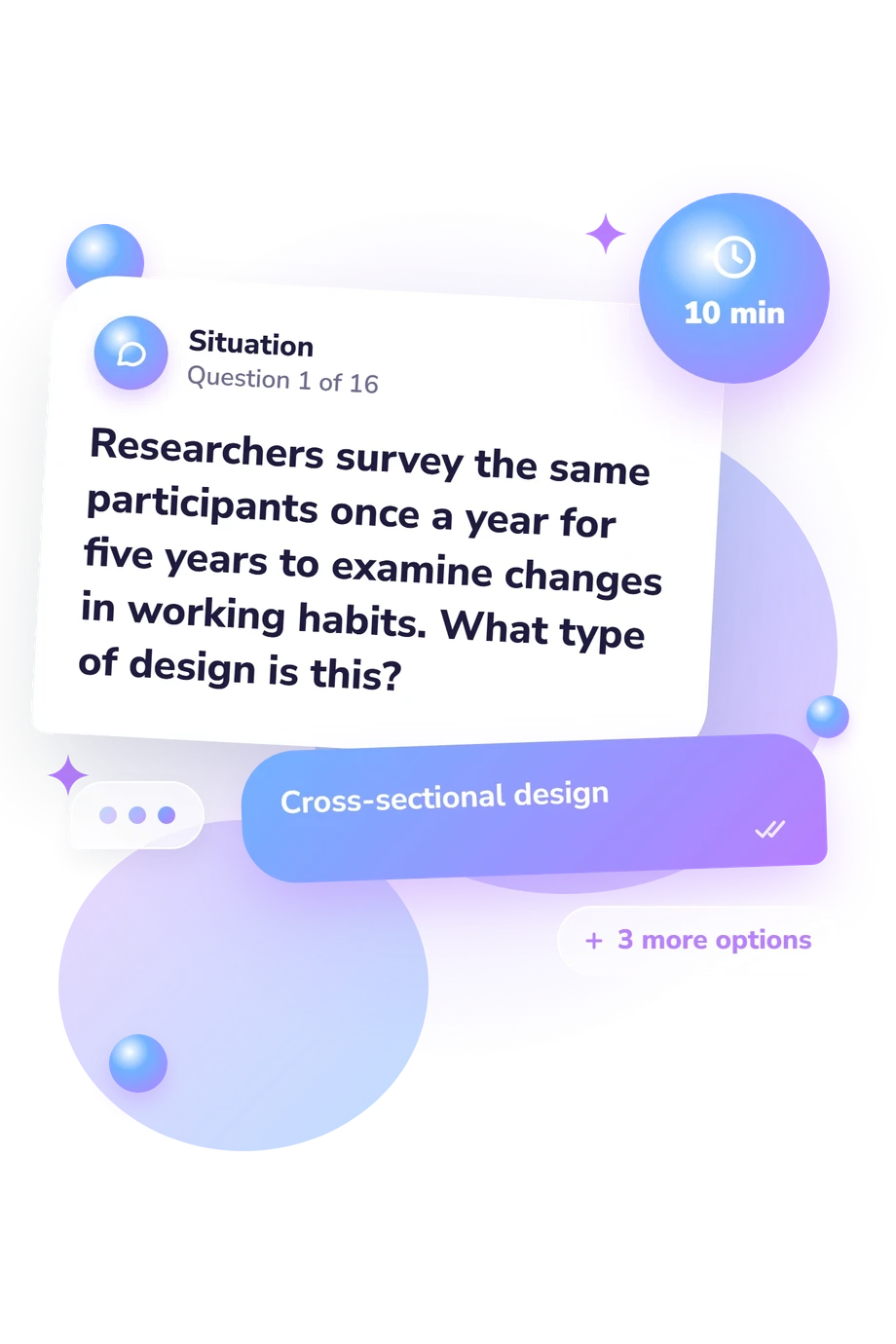
Example Questions From the Test
- Cross-sectional design
- Case-control design
- Longitudinal design
- Single-blind experiment
- Randomized controlled trial
- Thematic analysis
- Survival analysis
- Meta-analysis
- The type of instrument used to measure growth
- The growth recorded after treatment
- The amount of fertilizer applied
- The average growth calculated at the end
Research Methods Quiz - Description and methodology of the test
Students, educators, and curious readers can use this quiz on research to check how confidently they recognize the choices that shape credible studies. It suits anyone seeking a practical research methods quiz for reviewing core concepts before coursework, reading papers, or planning projects. The result places the respondent in a broad knowledge band and indicates whether additional review may be useful rather than judging general intelligence or academic potential.
What This Assessment Explores
Research literacy is the focus: recognizing designs, variables, measurement quality, statistical evidence, and ethical principles. Questions in this research quiz use scenarios involving mixed methods, confounding, blinding, replication, p-values, reliability, consent, operational definitions, and generalization. They ask whether a respondent can connect a study design with a defensible conclusion.
The result shows current understanding and points to concepts worth reviewing when reading empirical articles or evaluating evidence.
The questions cover these thematic areas, alongside the single displayed result scale:
- Research Methods Knowledge (0-16) places the result in Foundations to Build (0-6), Developing Knowledge (7-12), or Strong Knowledge (13-16).
- Study design and analysis show whether you can distinguish methods and identify confounding.
- Measurement and validity show whether scores and definitions fit the construct.
- Sampling, ethics, and inference show whether you recognize limits on participation, generalization, and causal claims.
Methodology and Scientific Basis
Each item presents a question with four answer choices, and the respondent selects the option that best fits the principle described. The score counts correct responses directly, with one point for each correct answer.
The content is conceptually consistent with the Social-Scientific Research Competency Test associated with Gess, Wessels, and Blömeke, a relevant framework for interpreting research competence, but this questionnaire is not presented as an adaptation of that instrument. Work by Gess, Wessels, and Blömeke supports attention to domain-specific competencies, while Smith and Smith provide related evidence for evaluating research methods skills through reliability and validity. This questionnaire is an educational assessment of selected competencies. This educational score is not a professional credential.
Performance can reflect careful reading, prior coursework, and familiarity with the wording as well as underlying knowledge. A respondent may understand a principle yet choose poorly when an item feels ambiguous or a distinction is missed. The score is therefore best treated as a snapshot of demonstrated knowledge and a guide for further study.
- Gess, Christopher; Geiger, Christoph; Ziegler, Matthias. Social-scientific research competency: Validation of test score interpretations for evaluative purposes in higher education. European Journal of Psychological Assessment, 35(5), 737-750, 2019. 10.1027/1015-5759/a000451
- Gess, Christopher; Wessels, Insa; Blömeke, Sigrid. Domain-specificity of research competencies in the social sciences: Evidence from differential item functioning. Journal for Educational Research Online, 9(2), 11-36, 2017. 10.25656/01:14895
- Smith, Tamarah; Smith, Samantha. Reliability and Validity of the Research Methods Skills Assessment. International Journal of Teaching and Learning in Higher Education, 30(1), 80-90, 2018.
Updated: