
Rejection Sensitive Dysphoria Test
How the Scales are Structured
Who Usually Takes This Test?
See How You Compare
Below is a preview of how scores are typically distributed across each scale.
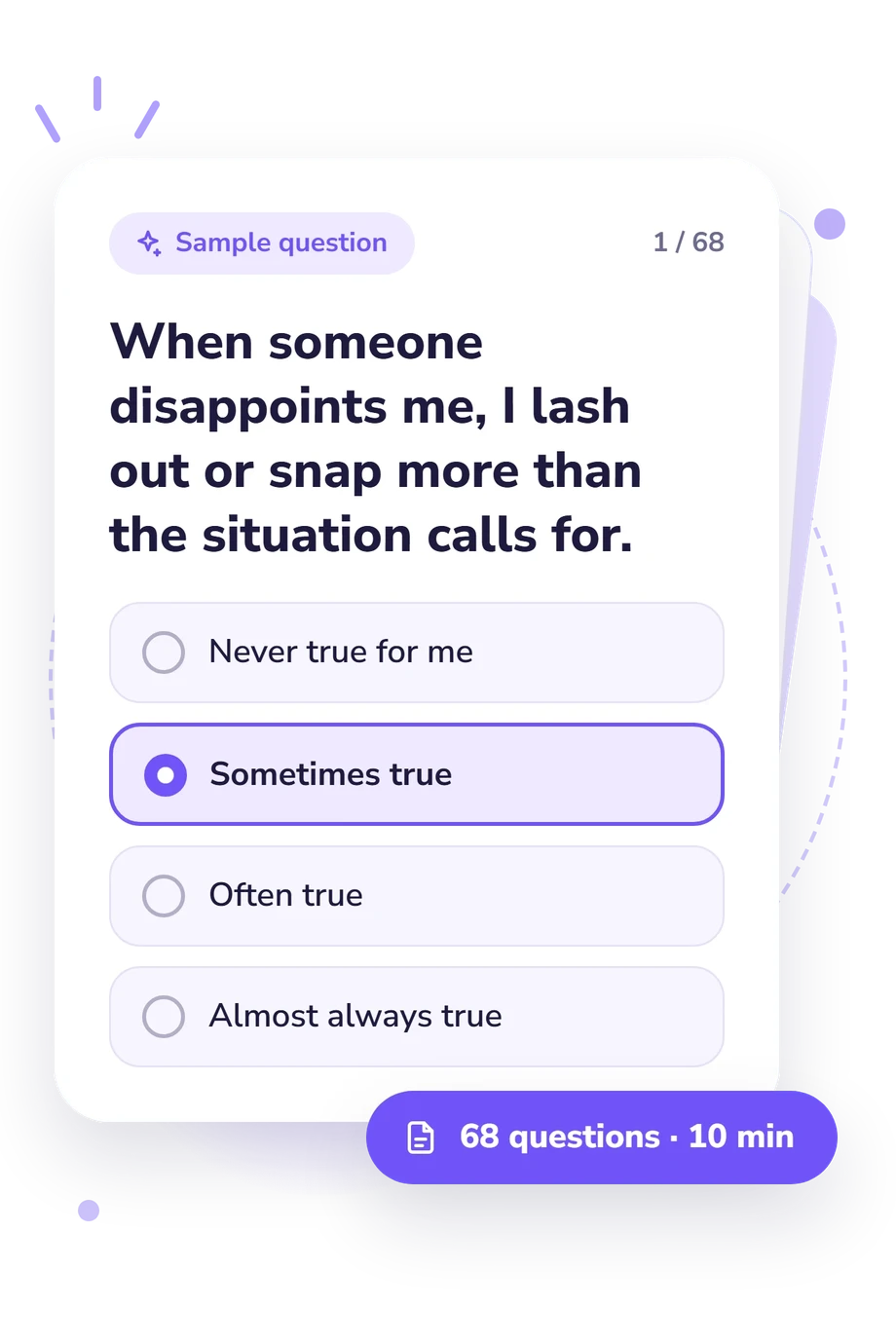
Example Questions From the Test
- Never true for me
- Sometimes true
- Often true
- Almost always true
- Strongly disagree
- Disagree
- Agree
- Strongly agree
- Strongly disagree
- Disagree
- Agree
- Strongly agree
Rejection Sensitive Dysphoria Test - Description and methodology of the test
People who experience criticism, exclusion, delayed replies, or possible disapproval as unusually intense may use the Rejection Sensitive Dysphoria Test to examine recurring response patterns. It is intended for anyone seeking a structured way to reflect on emotional surges, protective behaviors, and what follows a social setback. An RSD test can organize these experiences into a clearer profile without reducing them to one label.
What This Assessment Explores
This questionnaire examines responses to criticism, exclusion, delayed replies, cancelled plans, and disapproval. It separates immediate activation from protective coping and effects that continue afterward.
The displayed scales cover three parts:
- Rejection Coping Patterns (0-40) measures people-pleasing, avoidance, withdrawal, or defensive anger; Flexible coping is 0-13, Mixed coping is 14-26, and Rigid coping is 27-40.
- Rejection Reactivity (0-40) measures the speed and intensity of hurt, panic, anger, or shame; Lower reactivity is 0-13, Moderate reactivity is 14-26, and Higher reactivity is 27-40.
- Rumination & Aftereffects (0-40) measures replay, self-criticism, and mood disruption; Brief aftereffects is 0-13, Moderate rumination is 14-26, and Persistent rumination is 27-40.
Together, the profile shows which part of the rejection pattern is most prominent. A rejection sensitivity test result can indicate whether difficulty is concentrated in the moment, in coping behavior, or in recovery.
Methodology and Scientific Basis
The questions shown use two four-point formats: some ask how often a reaction is true, while others ask for agreement or disagreement. They cover criticism, exclusion, delayed contact, and perceived disapproval, keeping responses tied to situations.
Results are reported across three displayed dimensions, each with its stated range and named band. The profile compares the relative prominence of immediate reaction, coping, and later effects, so scores are read in relation to one another and to the situations described.
The conceptual anchor is the Rejection Sensitivity Questionnaire (Downey & Feldman, 1996), which addresses anxious expectations of rejection, readiness to perceive it, and strong reactions when it seems to occur. This questionnaire is conceptually consistent with that work, not an adaptation of the published instrument. Berenson et al. (2009) connects rejection sensitivity with attention to social-threat cues, while Pearson et al. (2011) links it with later rumination.
As an RSD-style online questionnaire about rejection-sensitivity reactions, it supports self-observation; its displayed bands are descriptive categories for this questionnaire, not population norms or clinical thresholds, and the questionnaire is not a clinical screening instrument for RSD. Stress, memory, self-awareness, and self-presentation can shape responses.
- Geraldine Downey and Scott I. Feldman (1996). Implications of rejection sensitivity for intimate relationships. Journal of Personality and Social Psychology, 70(6), 1327-1343. 10.1037/0022-3514.70.6.1327
- Kathy R. Berenson, Anett Gyurak, Ozlem Ayduk, Geraldine Downey, Matthew J. Garner, Karin Mogg, Brendan P. Bradley, and Daniel S. Pine (2009). Rejection sensitivity and disruption of attention by social threat cues. Journal of Research in Personality, 43(6), 1064-1072. 10.1016/j.jrp.2009.07.007
- Katherine A. Pearson, Edward R. Watkins, and Eugene G. Mullan (2011). Rejection sensitivity prospectively predicts increased rumination. Behaviour Research and Therapy, 49(10), 597-605. 10.1016/j.brat.2011.06.004
Updated: