
Reindeer Quiz
How the Scales are Structured
Who Usually Takes This Test?
See How You Compare
Below is a preview of how scores are typically distributed across each scale.
Example Questions From the Test
- Air resonating inside hollow antler branches
- Tendons moving over structures in the feet as the animals walk
- A specialized chamber in the lungs used for herd calls
- Upper and lower teeth striking together with every step
- Aquatic grasses
- Wild berries
- Lichens
- Conifer seeds
- Its hollow leg bones make its body nearly weightless.
- Its broad, spreading hooves distribute weight over a larger area.
- Its winter coat repels the ground beneath its feet.
- Its antlers counterbalance its full body weight.
Reindeer Quiz - Description and methodology of the test
For readers who want to understand Arctic wildlife beyond isolated facts, this reindeer quiz offers a focused educational check of biology, behavior, habitat, and seasonal adaptation. It suits curious learners, students, and natural-history enthusiasts. As a reindeer knowledge test, it shows which topics are secure and which could benefit from further reading.
What This Quiz Measures
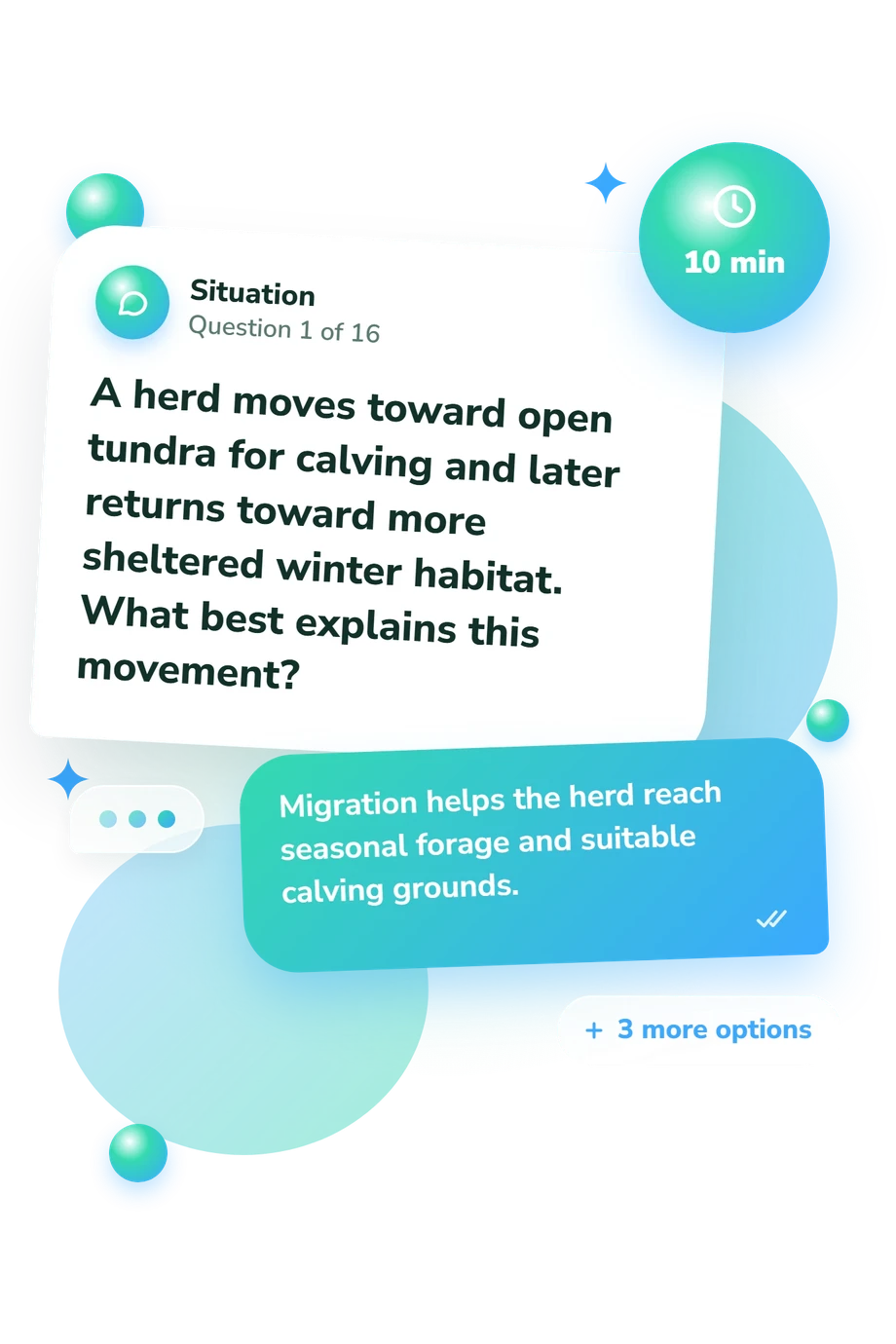
These items test knowledge in real Arctic contexts rather than isolated vocabulary. They ask readers to interpret migration, calving, feeding beneath snow, anatomy, antler cycles, and seasonal changes. As a reindeer biology quiz, it connects adaptations so the result reflects connected understanding of the animal’s biology.
The main learning areas are:
- Seasonal ecology explains how migration, calving, habitat, and winter weather affect access to food.
- Feeding and digestion show how rumination, lichens, and snow excavation support nutrition.
- Physical adaptations reveal how hooves, antlers, nasal passages, and body coverings meet Arctic demands.
- Vision and behavior show how retinal changes and herd responses support life in shifting light and landscapes.
Together, they form the displayed scale, Reindeer Knowledge (0-16): Starting Trail is 0-6, Growing Knowledge is 7-12, and Strong Reindeer Knowledge is 13-16. This is an educational result, not a scientific assessment of expertise.
Methodology and Evidence Base
Each item uses a scenario-based multiple-choice format with four answer choices. Some questions test reindeer facts by asking for the best explanation of an observation; others test a biological relationship or adaptation. The structure measures applied factual reasoning rather than personality traits.
Responses produce one total educational score; no separate psychological subscales are displayed. The questionnaire has no stated standardization, population norms, reliability coefficients, or clinical cutoffs, and item weighting is not documented. Performance may reflect prior study, guessing, and memory for particular facts.
The evidence base is biological rather than psychometric. Lin et al. (2019) provides the closest framework for the adaptations covered here. Heggberget, Gaare, and Ball (2002) supports winter forage and ice-covered feeding conditions; Hull et al. (2021) helps explain hoof and foot structures; and Stokkan et al. (2013) supports seasonal retinal reflection. These studies ground the content scientifically, but they do not validate this questionnaire as an adaptation of their instruments. Use the result to identify learning strengths and choose topics for further study.
- Lin, Zeshan, Lei Chen, Xianqing Chen, et al. (2019). Biological adaptations in the Arctic cervid, the reindeer (Rangifer tarandus). Science, 364(6446), eaav6312. 10.1126/science.aav6312
- Heggberget, Thrine Moen, Eldar Gaare, and John P. Ball. (2002). Reindeer (Rangifer tarandus) and climate change: Importance of winter forage. Rangifer, 22(1), 13-31. 10.7557/2.22.1.388
- Hull, Emily, Mitchell Semeniuk, Hanna-Leena Puolakka, et al. (2021). Tendons and ligaments of the Rangifer tarandus metapodial and hoof. Polar Biology, 44, 1803-1816. 10.1007/s00300-021-02919-z
- Stokkan, Karl-Arne, Lars Folkow, Juliet Dukes, Magella Neveu, Chris Hogg, Sandra Siefken, Steven C. Dakin, and Glen Jeffery. (2013). Shifting mirrors: adaptive changes in retinal reflections to winter darkness in Arctic reindeer. Proceedings of the Royal Society B: Biological Sciences, 280(1773), 20132451. 10.1098/rspb.2013.2451
Updated: