
Rapper Name Quiz
How the Scales are Structured
Who Usually Takes This Test?
See How You Compare
Below is a preview of how scores are typically distributed across each scale.
Example Questions From the Test
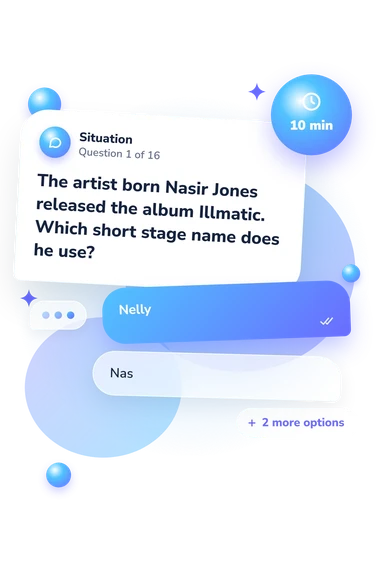
- Nelly
- Nas
- Ne-Yo
- N.O.R.E.
- A$AP Ferg
- Schoolboy Q
- Joey Bada$$
- A$AP Rocky
- Nicki Minaj
- Missy Elliott
- Lil' Kim
- Megan Thee Stallion
Rapper Name Quiz - Description and methodology of the test
Fans who enjoy connecting performers to the identities behind their music can use this rapper name quiz to check recall rather than taste. It suits casual or dedicated hip-hop listeners who want a clear knowledge profile. As a rap name quiz, it shows whether you readily spot aliases, link artists to groups and records, or connect names with wider careers. The result is a recognition check, not a nickname generator.
What This Assessment Explores
Recognition of stage names and biographical links is central. The test suits people who follow hip-hop and want to recall artists, collectives, albums, and screen careers rather than rate musical taste. Correct responses show how readily you connect a legal name with a public identity and wider career.
The questions cover three knowledge areas:
- Birth names and stage names show whether you can move between personal and performing identities.
- Groups and affiliations show whether you connect A$AP Mob, N.W.A, OutKast, and Wu-Tang Clan with performers.
- Records and careers show whether albums, acting roles, and production work help you identify an artist.
This rapper stage name test uses one scale, Rapper Name Knowledge (0-16). Its bands are Name Scout 0-6, Mic Scholar 7-12, and Alias Expert 13-16. Higher results reflect broader recall across these links, not musical taste.
Methodology and Evidence Base
Each item presents a birth name, stage name, group, record, or career clue with four choices. You select the rapper who matches it, so the format tests recognition and association rather than creative naming.
Scoring counts correct answers across the questionnaire. The bands are catalogue-defined interpretations of that total, not population norms or clinical thresholds. Meaning depends on familiarity with hip-hop history and the names used in the items.
The evidence base is conceptual, not a claim that this questionnaire reproduces a published scale. American Rap Pseudonymicon (Borysov and Syniak, 2025) offers a framework for treating rap aliases as culturally meaningful naming units, while Harrison and Arthur (2020) place artists, collectives, records, and careers in broader hip-hop history. This questionnaire is consistent with those sources, not an adaptation or validation of either source.
Because responses are self-administered and the score has no stated norm sample, performance may shift with current interests, era familiarity, and exposure to particular artists. As a hip-hop trivia quiz, it is best read as a snapshot of recall and a prompt for further exploration.
- Borysov, Oleksii, and Andrii Syniak. "Pseudonymicon of Modern American Rap Culture (on the Material of the Units with the Structural Element 'Money')." Studia Philologica, no. 2 (25), 2025, pp. 30-42. 10.28925/2412-2491.2025.252
- Harrison, Anthony Kwame, and Craig E. Arthur, editors. The Foundations of Hip-Hop Encyclopedia. Virginia Tech Publishing, 2020. 10.21061/foundations-of-hip-hop