
Psychology 101 Quiz
How the Scales are Structured
Who Usually Takes This Test?
See How You Compare
Below is a preview of how scores are typically distributed across each scale.
Example Questions From the Test
- Participants’ attention scores
- The amount of sleep participants receive
- The population from which participants were recruited
- Any difference in attention between the groups
- To ensure the sample perfectly represents the entire population
- To prevent participants from knowing the study’s purpose
- To reduce systematic preexisting differences between the groups
- To guarantee that the independent variable has a large effect
- Episodic memory
- Procedural memory
- Working memory
- Sensory memory
Psychology 101 Quiz - Description and methodology of the test
Students who want to check whether introductory ideas are connected, rather than memorized in isolation, can use this assessment to identify their strongest and least secure areas. The psy 101 quiz is suited to learners revising foundational coursework, preparing for class discussion, or deciding what to study next. Learners seeking psychology 101 quiz answers can use the result to prioritize review topics.
What This Assessment Explores
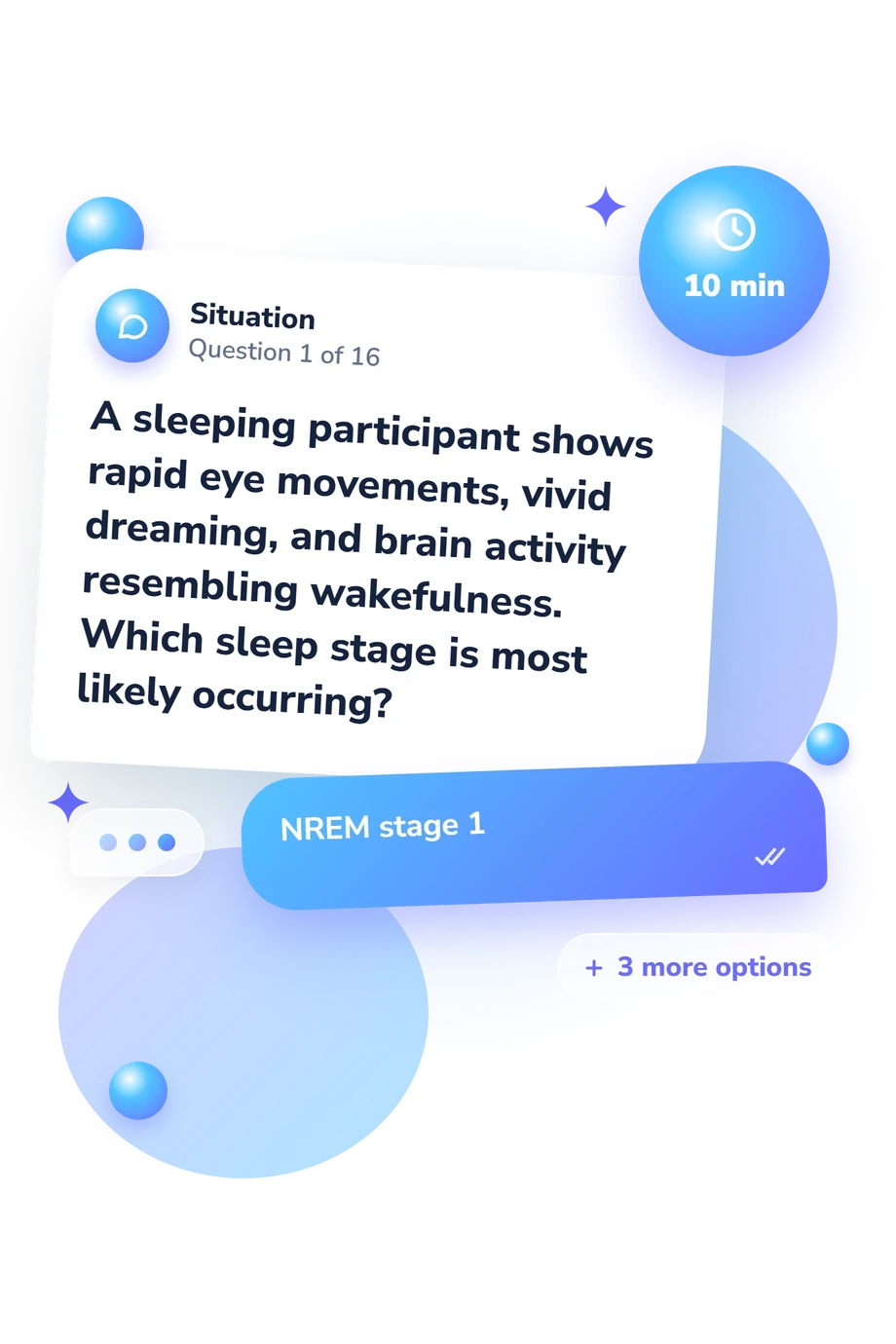
Introductory psychology is sampled through applied situations rather than isolated definitions. The items span sleep and biology, research design, learning, memory, development, personality, social judgment, and correlation versus causation. For someone using it as a psyc 101 quiz 1, the variety shows whether concepts transfer to examples.
The main themes are:
- Research methods show how variables, random assignment, and operational definitions support careful conclusions.
- Learning and behavior explain how conditioning and reinforcement change responses.
- Memory, sleep, biology, and development connect mental processes with brain systems and early-life change.
- Personality and social cognition describe traits, heuristics, and attributional judgments.
The reported scale is Psychology 101 Knowledge (0-16). Its bands are Foundations to build (0-6), Developing knowledge (7-12), and Strong foundation (13-16). The result describes educational knowledge demonstrated here, not personality or clinical functioning.
Methodology and Scientific Basis
Each item uses a short scenario followed by four answer choices, asking the learner to identify the best psychological concept or conclusion. Questions cover introductory domains, while the scoring combines responses into a single knowledge result rather than separate personality dimensions.
The assessment can serve as a psychology 101 quiz 1 checkpoint during course revision because it tests application: identifying an independent variable, distinguishing correlation from causation, or matching a behavior with a learning process. Multiple-choice construction is consistent with guidance from Haladyna, Downing, and Rodriguez (2002), which emphasizes focused stems, plausible alternatives, and a defensible best answer.
The content is conceptually consistent with Psychology 2e (Spielman et al., 2020), not presented as an adaptation of that textbook. AERA, APA, and NCME's 2014 testing standards support interpreting scores in relation to the stated construct and intended use. No normative sample, reliability estimate, or clinical validation is specified for this questionnaire. Performance can also reflect recent study, language comprehension, guessing, and test-taking conditions, so the result is best used to target review rather than to make claims about overall ability.
- Spielman, Rose M., William J. Jenkins, and Marilyn D. Lovett. (2020). Psychology 2e. OpenStax, Rice University, Houston, Texas.
- Haladyna, Thomas M., Steven M. Downing, and Michael C. Rodriguez. (2002). A Review of Multiple-Choice Item-Writing Guidelines for Classroom Assessment. Applied Measurement in Education, 15(3), 309-333. 10.1207/S15324818AME1503_5
- American Educational Research Association, American Psychological Association, and National Council on Measurement in Education. (2014). Standards for Educational and Psychological Testing. American Educational Research Association, Washington, DC.
Updated: