
Proverbs Quiz
How the Scales are Structured
Who Usually Takes This Test?
See How You Compare
Below is a preview of how scores are typically distributed across each scale.
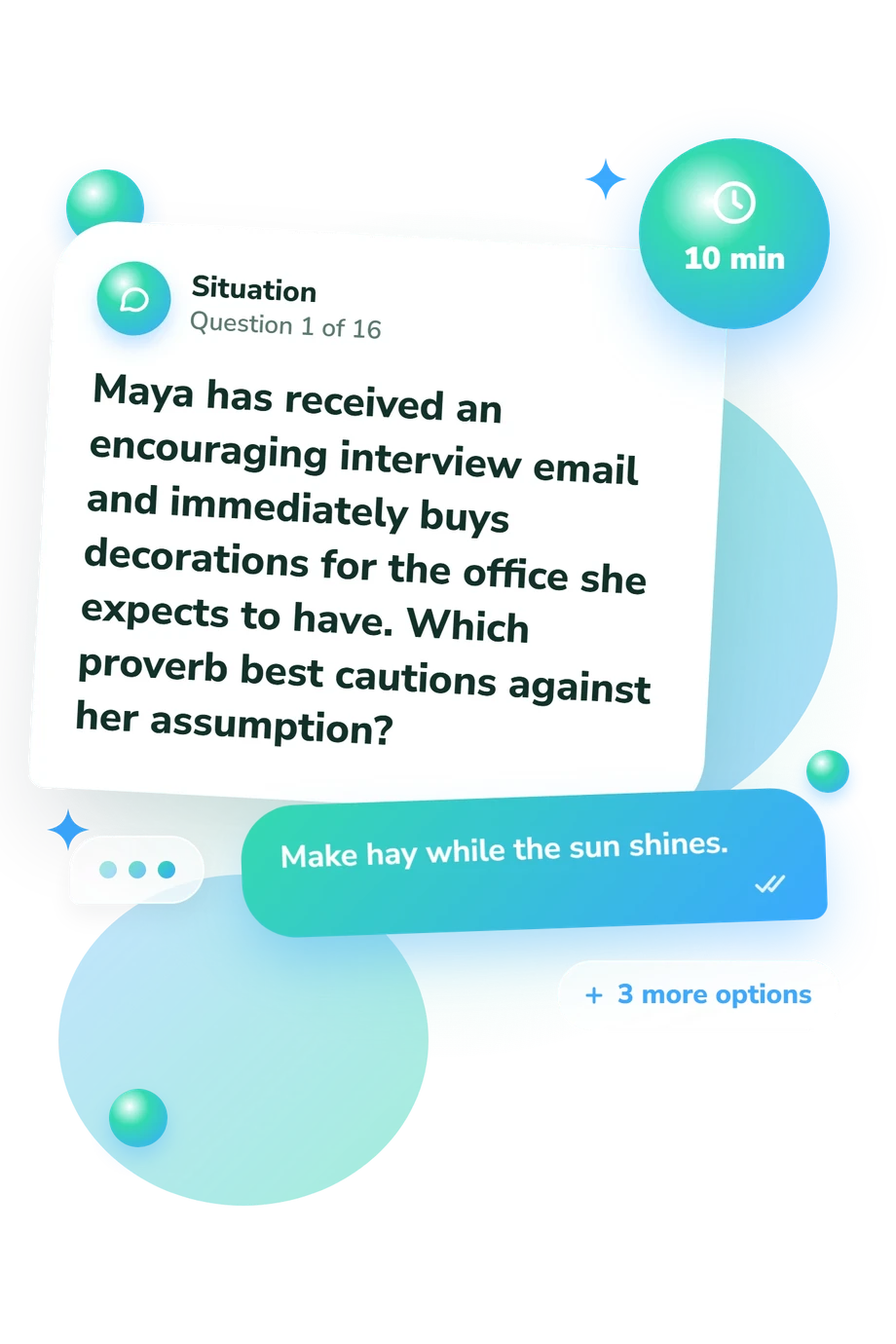
Example Questions From the Test
- Make hay while the sun shines.
- Strike while the iron is hot.
- The early bird catches the worm.
- Don’t count your chickens before they hatch.
- Complete demanding work before allowing yourself to rest.
- Use favorable conditions while the opportunity lasts.
- Plan for difficult periods by keeping ample savings.
- Choose work that produces practical, measurable results.
- Two wrongs don’t make a right.
- A bad workman blames his tools.
- There is no honor among thieves.
- The pot calling the kettle black.
Proverbs Quiz - Description and methodology of the test
For readers curious about how traditional sayings guide judgment, this proverbs quiz offers a practical look at proverb comprehension. It links familiar expressions with decisions, criticisms, risks, and social situations instead of treating them as isolated definitions. Its questions about proverbs place meanings beside everyday choices. The result can show where interpreting implied advice feels secure and where context or subtle distinctions deserve more attention.
What This Assessment Explores
The assessment measures recognition of common English proverbs and the ability to choose an interpretation that fits a practical situation. Items test more than recall: respondents distinguish careful planning from premature assumption, adaptation from rigidity, and fair criticism from hypocrisy. The result stays focused on the sayings presented rather than general intelligence, vocabulary, or reasoning.
The result functions as a proverb knowledge test focused on meaning and application. The sole scale is Proverbs Knowledge, scored from 0-16:
- Foundations to Build (0-6) indicates recognition of some proverbial ideas, with possible confusion about practical meanings.
- Developing Understanding (7-12) indicates accurate interpretation of many proverbs, with room to refine subtle distinctions.
- Strong Understanding (13-16) indicates consistent identification of meanings and appropriate applications.
These bands show the level represented by the selected answers.
Methodology and Evidence Base
Each item presents a proverb directly or within a short scenario, followed by four answer options. The possible answers to proverb questions often express nearby lessons, so the respondent must match meaning to context rather than recognize a phrase mechanically. Topics include planning, consequences, cooperation, criticism, adaptation, caution, and first impressions.
Scoring is a single knowledge total; no extra weighting, subscales, or clinical cutoffs are stated. The bands are descriptive categories, not population norms.
Methodologically, the questionnaire is conceptually consistent with the Gorham Proverbs Test (Gorham, 1956), an early reference for proverb understanding, but it is not that published instrument or a validated adaptation. Rehmel, Brown, and Paul (2016) also treat proverb comprehension as involving meaning and context. The Delis-Kaplan Executive Function System manual offers a broader comparison for structured performance tasks, not norms or scoring here.
Interpretation may vary with exposure to English idioms, language background, education, guessing, and attention. The result describes responses to these items rather than overall reasoning or communication ability.
- Donald R. Gorham (1956). A proverbs test for clinical and experimental use. Psychological Reports, 2 (Monograph Supplement 1), 1-12. 10.2466/PR0.2..1-12
- Jamie L. Rehmel, Warren S. Brown, and Lynn K. Paul (2016). Proverb comprehension in individuals with agenesis of the corpus callosum. Brain and Language, 160, 21-29. 10.1016/j.bandl.2016.07.001
- Dean C. Delis, Edith Kaplan, and Joel H. Kramer (2001). The Delis-Kaplan Executive Function System: Technical Manual. San Antonio, TX: The Psychological Corporation.
Updated: