
Pride Quiz
How the Scales are Structured
Who Usually Takes This Test?
See How You Compare
Below is a preview of how scores are typically distributed across each scale.
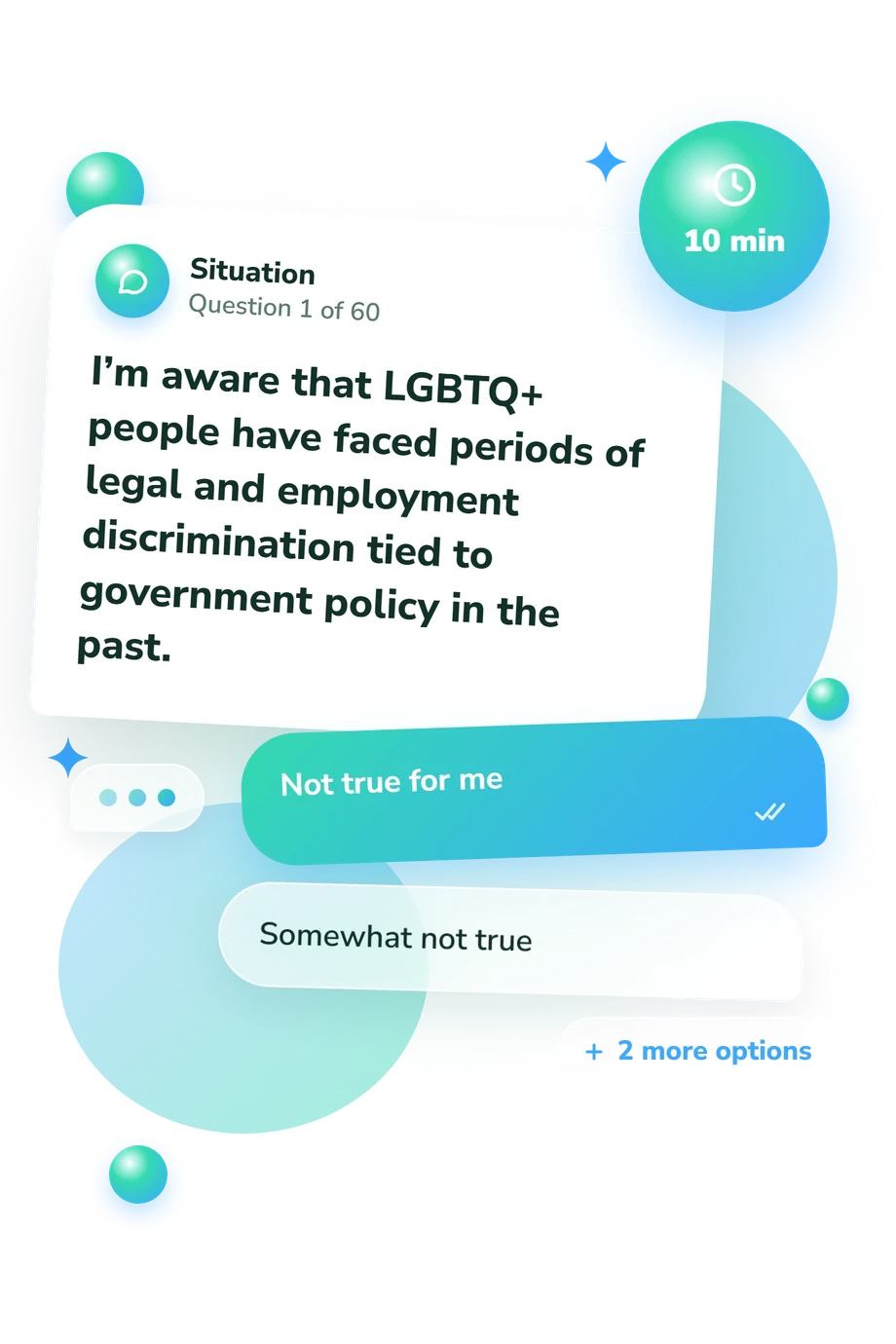
Example Questions From the Test
- Not true for me
- Somewhat not true
- Not sure
- True for me
- Strongly disagree
- Disagree
- Not sure
- Agree
- Not true for me
- Somewhat not true
- Not sure
- True for me
Pride Quiz - Description and methodology of the test
People who want a clearer picture of their LGBTQ+ knowledge and everyday support skills can use this pride quiz as a structured starting point. It also works as an LGBTQ+ allyship test for learners, friends, colleagues, educators, and allies who want to examine what they know, how they respond, and where reflection may strengthen respectful communication. Results organize those patterns into practical areas rather than a single pass-or-fail judgment.
What This Assessment Explores
The questionnaire combines knowledge, historical awareness, and behavior-oriented self-report. Items address identities and terms including nonbinary, pansexual, asexual, queer, intersex, gender dysphoria, chosen names, and pronouns. They also cover privacy, misgendering, inclusive language, assumptions, myths, and supportive responses. Linking factual understanding with respectful action, the questionnaire uses a pride test format to explore everyday allyship.
The result is organized into three dimensions:
- Everyday Allyship & Inclusive Language (0-20) shows recognition of myths and use of supportive actions and language; Developing 0-8, Growing 9-14, Strong 15-20.
- LGBTQ+ Terms & Pronouns (0-20) reflects knowledge of identities, definitions, introductions, and pronoun etiquette; Developing 0-8, Proficient 9-15, Confident 16-20.
- Pride History & Milestones (0-20) reflects awareness of events, movements, legal change, and Pride’s civil-rights context; Developing awareness 0-7, Solid knowledge 8-14, Strong historical awareness 15-20.
Together, scores show strengths and areas for learning.
Methodology and Scientific Basis
Items use self-report statements. Response choices address agreement, familiarity, perceived truth, or uncertainty, capturing reported knowledge and intended conduct rather than observed interaction or objective examination.
The displayed scores combine responses across the dimensions, but the questionnaire does not specify how individual responses are weighted. The bands describe reported results; uncertainty and later learning remain relevant to interpretation.
The framework is conceptually consistent with the Ally Identity Measure (AIM; Jones et al., 2014), a measure of LGBT ally identity, and Ji and Fujimoto’s 2013 Rasch analysis of heterosexual LGBT ally development. Those studies offer conceptual comparison only; they do not establish norms or validity for this online questionnaire, which is neither an adaptation nor a standardized administration of either instrument.
History items in the pride history quiz indicate self-reported familiarity with Stonewall, HIV/AIDS activism, early marches, diagnostic change, legal milestones, and community spaces. Interpretation is strongest alongside current learning, cultural context, and behavior. Memory, uncertainty, social desirability, and present experiences can affect self-report, so the result is a reflective profile rather than a diagnosis or complete account of allyship.
- Jones, K. Nicole, Melanie Elyse Brewster, and Jacob A. Jones. The creation and validation of the LGBT Ally Identity Measure. Psychology of Sexual Orientation and Gender Diversity, 1(2), 181-195, 2014. DOI 10.1037/sgd0000033
- Ji, Peter, and Ken Fujimoto. Measuring Heterosexual LGBT Ally Development: A Rasch Analysis. Journal of Homosexuality, 60(12), 1695-1725, 2013. DOI 10.1080/00918369.2013.834211
Updated: