
Potato Quiz
How the Scales are Structured
Who Usually Takes This Test?
See How You Compare
Below is a preview of how scores are typically distributed across each scale.
Example Questions From the Test
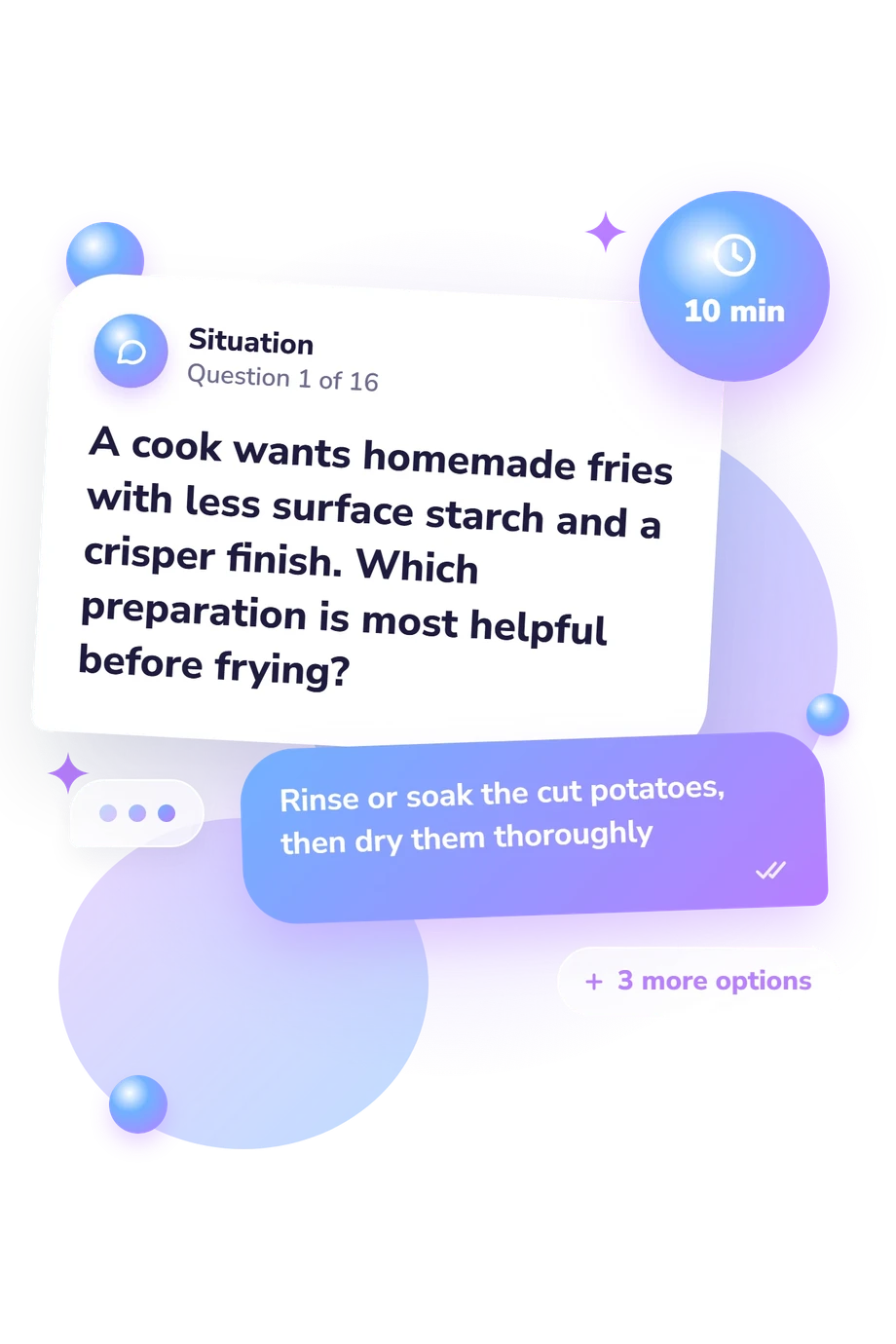
- Rinse or soak the cut potatoes, then dry them thoroughly
- Leave the cut potatoes wet so the water creates a crust
- Warm the cut potatoes in a sealed container until soft
- Coat the cut potatoes in mashed potato
- Seeds embedded in the tuber's skin
- Openings used exclusively to absorb water
- Buds that can develop into new shoots
- Scars left by insect pollination
- Wrap the wet potato tightly in foil
- Place it in a covered dish filled with water
- Dry it, lightly coat the skin with oil, and bake it uncovered
- Peel it completely and cook it in a sealed bag
Potato Quiz - Description and methodology of the test
Curious home cooks, students, and food enthusiasts can use this potato quiz when they want to check their factual knowledge and choose a useful starting point for further learning. The result offers a focused snapshot rather than a personality description. As a potato knowledge assessment, it places the reader at an overall level of potato knowledge.
What This Assessment Explores
The questionnaire treats the potato as both a crop and a food. Its potato-focused quiz questions cover tuber morphology, domestication, disease, nutrients, storage, browning, greening, crispness, and mashed-potato texture. Some items ask for factual recognition; others present a kitchen situation and ask which action or explanation fits.
The main themes are:
- Botany and origins explain the tuber’s structure and the crop’s domestication.
- Cooking technique shows how preparation, heat, moisture, and handling affect texture.
- Nutrition, storage, and safety connect carbohydrate content, nutrient preservation, and green coloration with practical choices.
- History and disease place the crop in the story of European spread and the Irish famine.
Together, these themes contribute to the Potato Knowledge scale, scored 0-16. The displayed bands-Sprouting Knowledge 0-6, Growing Knowledge 7-12, and Well-Rounded Knowledge 13-16-indicate, respectively, basic knowledge needing review in botany, storage, and cooking; a practical foundation with weaker historical or scientific areas; and strong command applicable in common kitchen situations.
Methodology and Scientific Basis
Each item uses four answer choices and focuses on one observable fact or decision. The format is self-administered, but the content is factual rather than a measure of mood, personality, or symptoms. The questionnaire reports one aggregate result and displays three bands; topics receive no separate scores.
Conceptually, the questionnaire functions as a potato trivia test and is consistent with the 1989 book by Lisinska and Leszczynski, which covers composition, handling, storage, and culinary properties. Huaman’s 1986 work supports the botanical treatment of tubers, eyes, and domestication. Friedman’s 2006 work provides context for glycoalkaloids and green potatoes, while Yoshida and colleagues’ 2013 work supports the disease reference to the Irish famine. These sources establish factual anchors; they do not make this online questionnaire an adaptation of any one published instrument.
This questionnaire is presented without standardization, norms, reliability estimates, or clinical cutoffs. Results are most useful for identifying topics to review and guiding self-reflection about food knowledge. Memory, wording interpretation, cultural familiarity, and current attention can affect performance, so a single band is not a complete measure of expertise.
- Lisinska, G., and Leszczynski, Waclaw. 1989. Potato Science and Technology. Elsevier Applied Science Publishers, London and New York, 391 pp.
- Huaman, Zosimo. 1986. Systematic Botany and Morphology of the Potato. 2nd ed., revised. Technical Information Bulletin 6. International Potato Center, Lima, Peru, 22 pp.
- Friedman, Mendel. 2006. Potato Glycoalkaloids and Metabolites: Roles in the Plant and in the Diet. Journal of Agricultural and Food Chemistry 54(23): 8655-8681. 10.1021/jf061471t
- Yoshida, Kentaro, et al. 2013. The Rise and Fall of the Phytophthora infestans Lineage That Caused the Irish Potato Famine. eLife 2: e00731. 10.7554/eLife.00731
Updated: