
Postpartum Anxiety Test
How the Scales are Structured
Who Usually Takes This Test?
See How You Compare
Below is a preview of how scores are typically distributed across each scale.
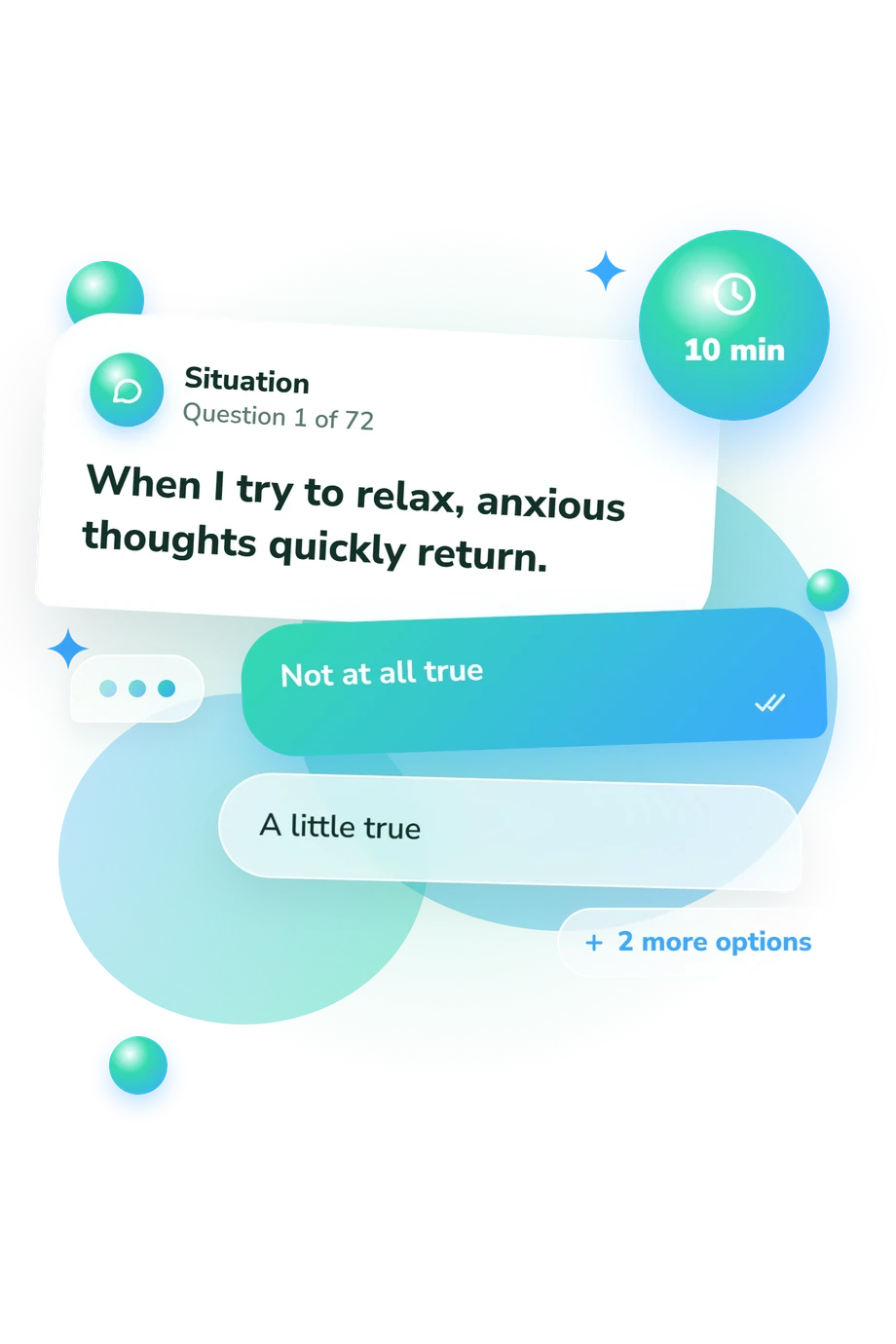
Example Questions From the Test
- Not at all true
- A little true
- Mostly true
- Very true
- Not at all true
- Sometimes true
- Often true
- Almost always true
- Not at all true
- A little true
- Mostly true
- Very true
Postpartum Anxiety Test - Description and methodology of the test
Parents who feel persistently on edge, mentally overloaded, or unable to settle after childbirth can use this questionnaire to organize experiences that are difficult to describe. The postpartum anxiety quiz focuses on sleep and irritability impact, physical tension, persistent worry or rumination, and day-to-day coping. Taking this post partum anxiety test can help a new parent notice which of these areas feels most disruptive right now.
What This Assessment Explores
Questions address worries about a baby’s health, feeding, sleep, safety, and the parent’s sense of doing things correctly. Other items examine racing thoughts, mental checking, worst-case scenarios, physical activation, irritability, and difficulty sleeping even when rest is available. These postpartum anxiety symptoms are considered as patterns affecting thought, body, recovery, and day-to-day caregiving.
The result organizes those experiences into three domains:
- Sleep & Irritability Impact (0-20) shows how anxiety-related sleep difficulty and irritability affect wellbeing and coping; Low impact 0-6, Moderate impact 7-13, High impact 14-20.
- Somatic Tension (0-20) reflects physical anxiety symptoms, including muscle tension, restlessness, and feeling keyed up; Low 0-6, Moderate 7-13, High 14-20.
- Worry & Rumination (0-20) indicates persistent worry, racing thoughts, and hard-to-control what-if fears; Low 0-6, Moderate 7-13, High 14-20.
Methodology and Evidence Base
Items ask you to rate an experience’s truth or frequency through four ordered choices, such as Not at all true to Very true or Never to Almost always. Some bodily questions use a recent two-week frame. Responses form domain scores, but the questionnaire gives no point value for each response or diagnostic cutoff.
The closest conceptual reference for this online questionnaire is the Postpartum Specific Anxiety Scale (Fallon et al., 2016), which focuses on anxiety specific to the postpartum context. It also overlaps with the Postpartum Worry Scale-Revised (Moran et al., 2014) and the Perinatal Anxiety Screening Scale (Somerville et al., 2014). These published instruments are reference points, not proof that this online version adapts or reproduces them in standardized form.
For someone considering this postpartum anxiety assessment, the grouped result offers a structured profile. A higher band means more disruption or symptom intensity in that domain, not a diagnosis. Because the questions cover sleep disruption, bodily tension, recurring fears, and irritability, results can shift with current sleep loss, stress, recall, self-awareness, and willingness to report uncomfortable thoughts.
- Victoria Fallon, Jason Christian Grovenor Halford, Kate Mary Bennett, and Joanne Allison Harrold. The Postpartum Specific Anxiety Scale: development and preliminary validation. Archives of Women's Mental Health, 19(6), 1079-1090, 2016. 10.1007/s00737-016-0658-9
- Tracy E. Moran, Joshua R. Polanin, and Amy Wenzel. The Postpartum Worry Scale-Revised: an initial validation of a measure of postpartum worry. Archives of Women's Mental Health, 17(1), 41-48, 2014. 10.1007/s00737-013-0380-9
- Susanne Somerville, Kellie Dedman, Rosemary Hagan, Elizabeth Oxnam, Michelle Wettinger, Shannon Byrne, Soledad Coo, Dorota Doherty, and Andrew C. Page. The Perinatal Anxiety Screening Scale: development and preliminary validation. Archives of Women's Mental Health, 17(5), 443-454, 2014. 10.1007/s00737-014-0425-8
Updated: