
Paramedic Quiz
How the Scales are Structured
Who Usually Takes This Test?
See How You Compare
Below is a preview of how scores are typically distributed across each scale.
Example Questions From the Test
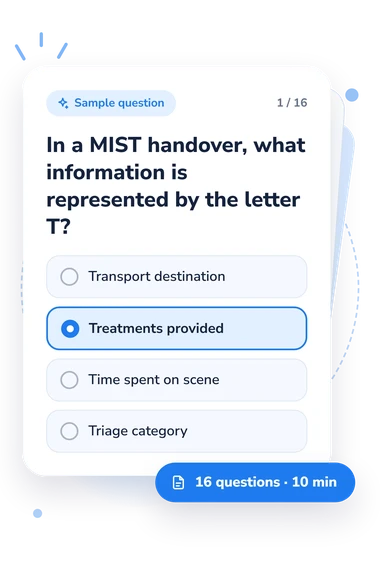
- Transport destination
- Treatments provided
- Time spent on scene
- Triage category
- Warm dry skin, a slow strong pulse, and normal alertness
- Flushed skin, a bounding pulse, and increased appetite
- Localized bruising with otherwise normal vital signs
- Cool clammy skin, a rapid weak pulse, and altered mental status
- Assessment findings
- Airway sounds
- Age
- Allergies
Paramedic Quiz - Description and methodology of the test
People deciding whether to take this paramedic quiz can use it to obtain a focused snapshot of their current grasp of emergency-care principles. As a paramedic knowledge check, it clarifies which areas deserve closer review and helps a learner choose where to direct subsequent study or supervised discussion. The result supports a practical decision about next steps.
What This Assessment Explores
Items sample prehospital knowledge through scene safety, structured assessment, and action. Scenarios cover hazards, airway compromise, shock, anaphylaxis, hypoglycemia, stroke, trauma, respiratory decline, and triage. This paramedic assessment quiz links recall with application.
The questions sample paramedic knowledge across these areas:
- Scene safety and handover show whether hazards, priorities, treatments, and destination are recognized.
- Assessment frameworks show whether SAMPLE, OPQRST, FAST, ABCs, and reassessment are applied.
- Resuscitation and airway care measure recognition of agonal gasps, obstruction, shock, and urgent interventions.
- Trauma and medical response examine spinal precautions, oxygen safety, respiratory decline, and triage.
Together, these themes feed one score across the content, not separate dimensions. Paramedic Knowledge runs 0-16. Bands are Foundations to strengthen (0-6), Developing knowledge (7-12), and Strong knowledge (13-16): the first signals review needs, the middle developing recognition, and the highest a solid grasp of tested concepts.
Methodology and Scientific Basis
Each item presents a direct knowledge prompt or brief prehospital scenario with four response options and one best answer. The learner selects the safest action, identifies a clinical sign, or completes a framework such as MIST, SAMPLE, OPQRST, or FAST. This fixed-choice format combines recognition with basic application and produces a straightforward total score.
Someone using the questionnaire for paramedic exam preparation can compare its coverage with the 2019 EMS Practice Analysis, the paramedic content-domain study by Gugiu and colleagues (2021), and the National Registry’s 2024 examination specifications. The questionnaire is conceptually consistent with these published works, but it is not an adaptation of them and is not validated by them.
The questionnaire reports one total on the displayed scale and assigns a descriptive band. The score is an unvalidated educational indicator, so it cannot establish readiness, certification, or clinical competence. Performance can vary with current concentration, familiarity with the tested frameworks, and prior exposure to local protocols; apply the result alongside qualified instruction and applicable protocols.
- Panchal, Ashish R., Madison K. Rivard, Rebecca E. Cash, John P. Corley Jr., Marjorie Jean-Baptiste, Kirsten Chrzan, and Mihaiela R. Gugiu. "Methods and Implementation of the 2019 EMS Practice Analysis." Prehospital Emergency Care, 26(2), 212-222, 2022. 10.1080/10903127.2020.1856985
- Gugiu, Mihaiela R., Rebecca Cash, Madison Rivard, Jennifer Cotto, Remle P. Crowe, and Ashish R. Panchal. "Development and Validation of Content Domains for Paramedic Prehospital Performance Assessment: A Focus Group and Delphi Method Approach." Prehospital Emergency Care, 25(2), 196-204, 2021. 10.1080/10903127.2020.1750743
- National Registry of Emergency Medical Technicians. National Registry Paramedic Examination Specifications. 2024.