
Noun Quiz
How the Scales are Structured
Who Usually Takes This Test?
See How You Compare
Below is a preview of how scores are typically distributed across each scale.
Example Questions From the Test
- the two teacher’s lounge
- the teachers’ separate lounges
- the teacher lounge area
- the teachers’ lounge
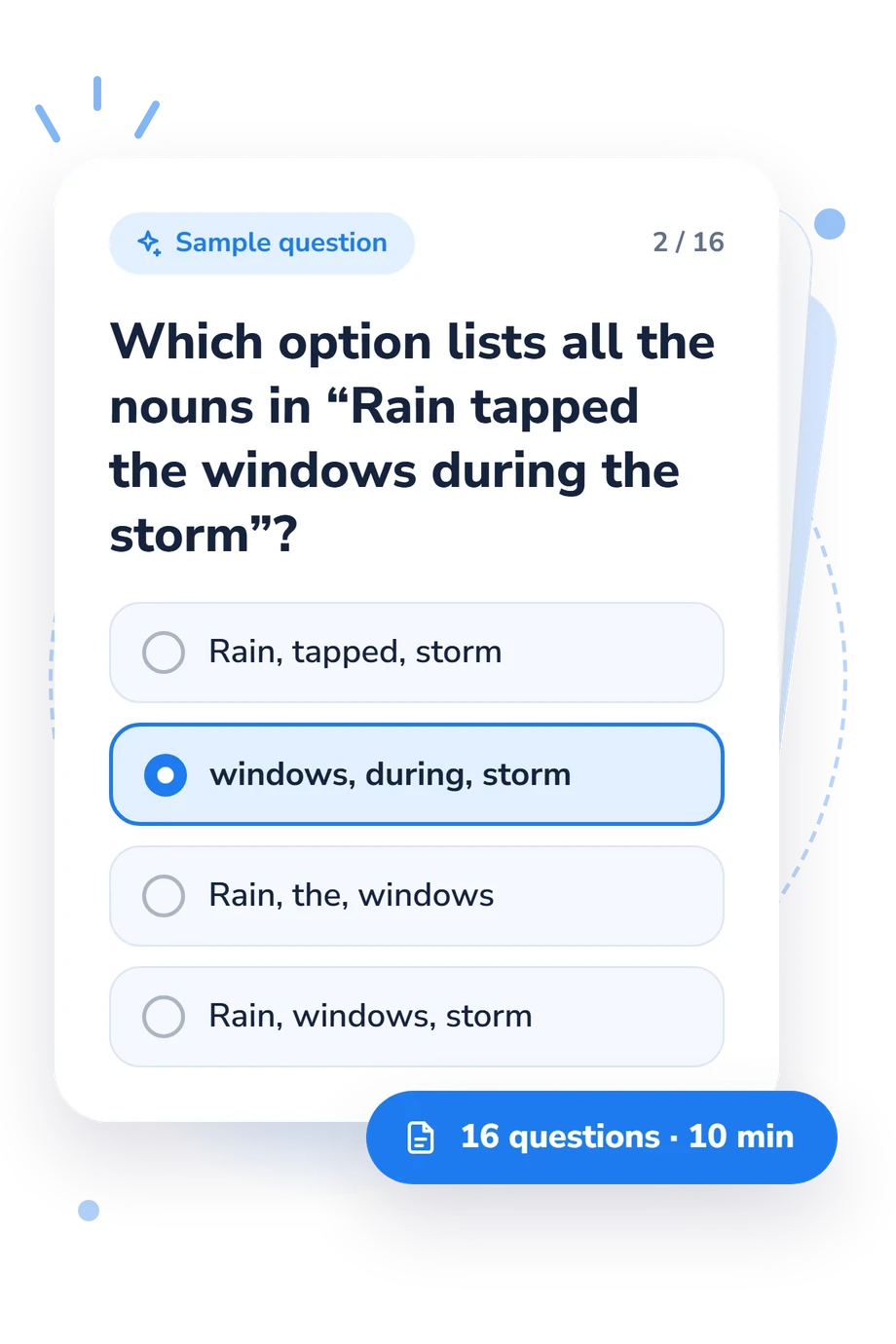
- Rain, tapped, storm
- windows, during, storm
- Rain, the, windows
- Rain, windows, storm
- loyalty
- justice
- courage
- perfume
Noun Quiz - Description and methodology of the test
Readers who want to strengthen everyday grammar can use the noun quiz to examine how well they recognize and apply noun forms in sentences. It is suited to learners, teachers checking foundational understanding, and anyone revising parts of speech. This quiz on nouns gives an overall result, showing whether core concepts are secure or need targeted practice.
What This Test Measures
The assessment combines direct definitions with contextual examples. It covers identification, common and proper categories, concrete and abstract meaning, countability, irregular plurals, possessives, compounds, appositives, gerunds, objects, and collective nouns. A quiz about nouns therefore reflects overall noun knowledge through both recognition and practical usage.
The main themes are:
- Identification shows whether you distinguish nouns from other parts of speech.
- Classification shows how you separate common, proper, concrete, abstract, noncount, and collective nouns.
- Form and possession show whether plurals, apostrophes, and naming conventions are handled accurately.
- Function shows how well you recognize objects, appositives, gerunds, and multiword noun phrases.
The Noun Knowledge scale ranges from 0-16. Its result bands are Foundations to Review (0-6), Developing Knowledge (7-12), and Strong Knowledge (13-16). This overall level reflects noun knowledge across these areas, not separate topic scores or general language ability.
Methodology and Evidence
Each item uses a four-option multiple-choice format, asking the reader to select the answer that fits a definition, sentence, or usage rule. The answer-choice format makes the task concrete: distractors represent plausible errors. Each correct response contributes one point to the total, and the displayed score bands indicate the resulting level.
This is a structured grammar knowledge check, not a personality or symptom measure. Its distinctions are consistent with Huddleston and Pullum (2002), while Huddleston, Pullum, and Reynolds (2022) explain related categories such as countability, possessives, noun phrases, and syntactic function. The questionnaire is conceptually consistent with these works, not an adaptation of either book.
As a grammar quiz on nouns, this assessment gives feedback on the concepts tested here. Higher bands indicate more reliable performance across those distinctions, while lower bands point to topics for revision. The categories are descriptive for this online assessment, not population norms or clinical thresholds. Prior instruction, vocabulary, and sentence wording can affect performance, so reviewing missed concepts is more informative than treating the total as a complete measure of noun use.
- Huddleston, Rodney, and Geoffrey K. Pullum. The Cambridge Grammar of the English Language. Cambridge University Press, 2002. 10.1017/9781316423530.
- Huddleston, Rodney, Geoffrey K. Pullum, and Brett Reynolds. A Student's Introduction to English Grammar. 2nd ed. Cambridge University Press, 2022. 10.1017/9781009085748.
Updated: