
Navy General Orders Quiz
How the Scales are Structured
Who Usually Takes This Test?
See How You Compare
Below is a preview of how scores are typically distributed across each scale.
Example Questions From the Test
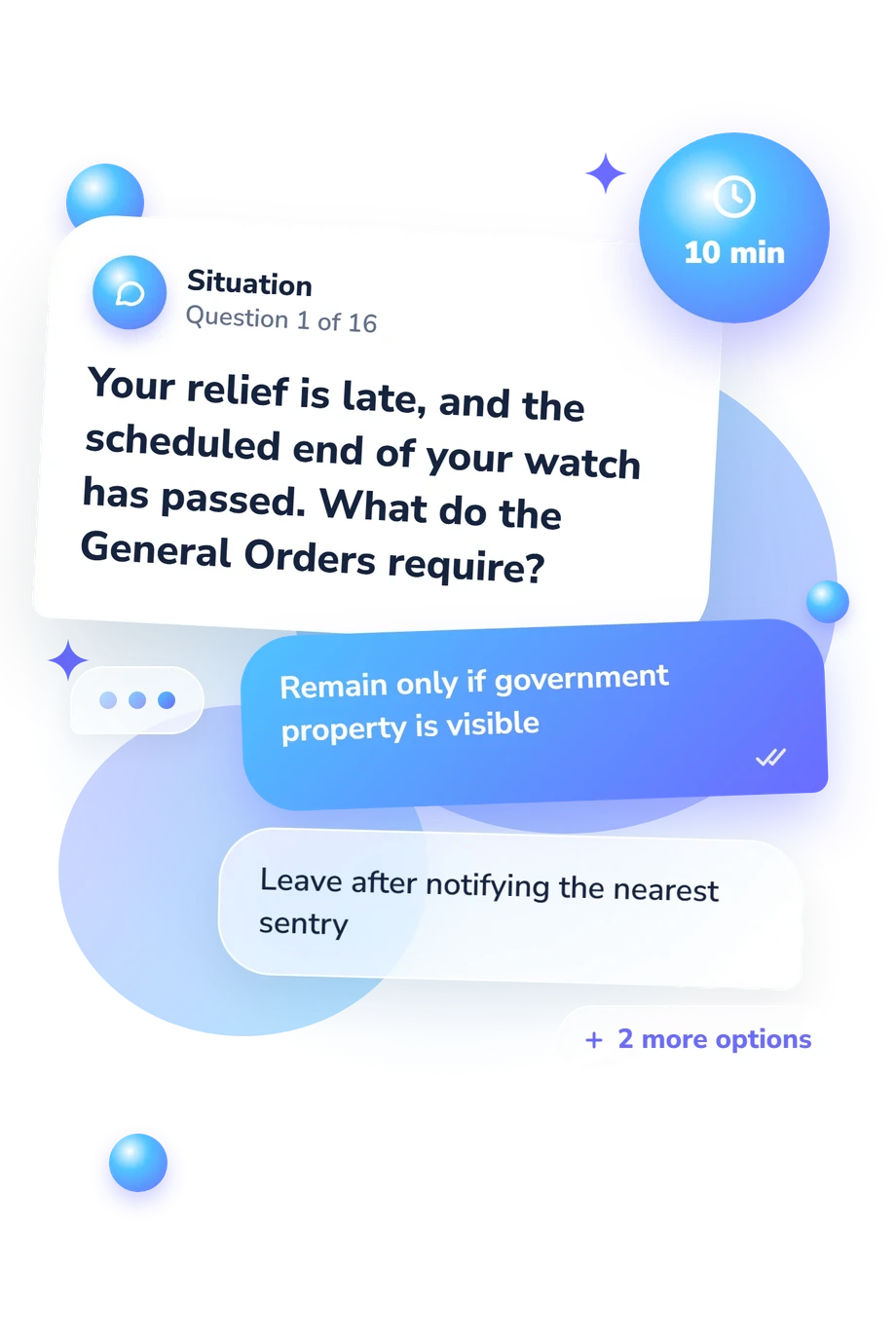
- Remain only if government property is visible
- Leave after notifying the nearest sentry
- Secure the post and report to the guardhouse
- Remain at the post until properly relieved
- Resolve it independently and report it at the end of watch
- Call the officer of the deck
- Wait until your relief arrives to ask for guidance
- Repeat a call to the nearest post
- Only officers who first address the sentry
- All military personnel who enter the post
- All officers and all colors and standards not cased
- Only the commanding officer and the national ensign
Navy General Orders Quiz - Description and methodology of the test
For anyone checking watchstanding knowledge, the Navy General Orders Quiz uses situations to evaluate accurate recall and application of sentry duties. Sentry duty questions are framed as scenarios rather than isolated definitions. Each choice asks you to distinguish responsibilities, respond to unusual events, and select the action that fits a specific order. The result offers an overall educational indication of knowledge and application across the eleven General Orders.
What This Assessment Explores
The questionnaire measures knowledge of the eleven General Orders: how a sentry protects a post, follows authority, communicates official information, and reacts to danger. It suits people learning or reviewing watchstanding duties. The single result indicates recall, understanding, and practical application across the orders.
As a navy general orders test, this questionnaire groups the situations into four themes:
- Post responsibility asks you to remain at the post, protect government property in view, and wait for proper relief.
- Alertness asks you to monitor everything within sight or hearing while walking the post.
- Communication asks you to pass calls, report violations, answer line-of-duty questions, and seek guidance.
- Authority and emergencies ask you to follow valid orders, challenge appropriately, and give the alarm when danger appears.
Together, these themes describe situations used for the one overall score; they are not separate result dimensions.
Methodology and Scientific Basis
Each item presents a duty, event, or rule with four choices. Selecting a response tests recognition and application of the General Orders, including distinctions between staying until relieved, reporting violations, repeating distant calls, and giving an alarm.
Relevant manuals include The Bluejacket's Manual and Ridley McLean's manual on Navy General Orders of a Sentry; United States Navy training material also describes the duties. The questionnaire is conceptually consistent with the eleven-order framework in those works, while its score is an educational indication.
Johnson and McMenemy's simulated sentry-duty study adds a limitation: knowledge questions can examine recall and judgment but cannot establish operational competence during an actual watch.
Responses produce one aggregate Navy General Orders Knowledge score from 0-16, with Foundation to Build (0-6), Developing Command (7-12), and Strong Command (13-16). These bands describe educational recall and practical understanding, not official qualification. The educational band can show when a review of sentry duty knowledge may be useful.
Performance can vary with attention, training, wording familiarity, and current context. Command guidance and training materials take precedence.
- Cutler, Thomas J., Mark T. Hacala, and Paul A. Kingsbury. The Bluejacket's Manual, 26th Edition. Annapolis, MD: Naval Institute Press, 2023. ISBN 978-1-68247-843-1.
- United States Navy. U.S. Navy Recruit START Guide. Navy Recruiting Command, December 2015. Publication no. 011-0144 (Rev. 12/15).
- McLean, Ridley. The Bluejacket's Manual. 1st ed. Annapolis, MD: United States Naval Institute, 1902.
- Johnson, Richard F., and Donna J. McMenemy. "Target Detection, Rifle Marksmanship, and Mood during Three Hours of Simulated Sentry Duty." Proceedings of the Human Factors Society Annual Meeting 33, no. 20 (1989): 1414-1418. 10.1177/154193128903302011.
Updated: