
Micrometer Quiz
How the Scales are Structured
Who Usually Takes This Test?
See How You Compare
Below is a preview of how scores are typically distributed across each scale.
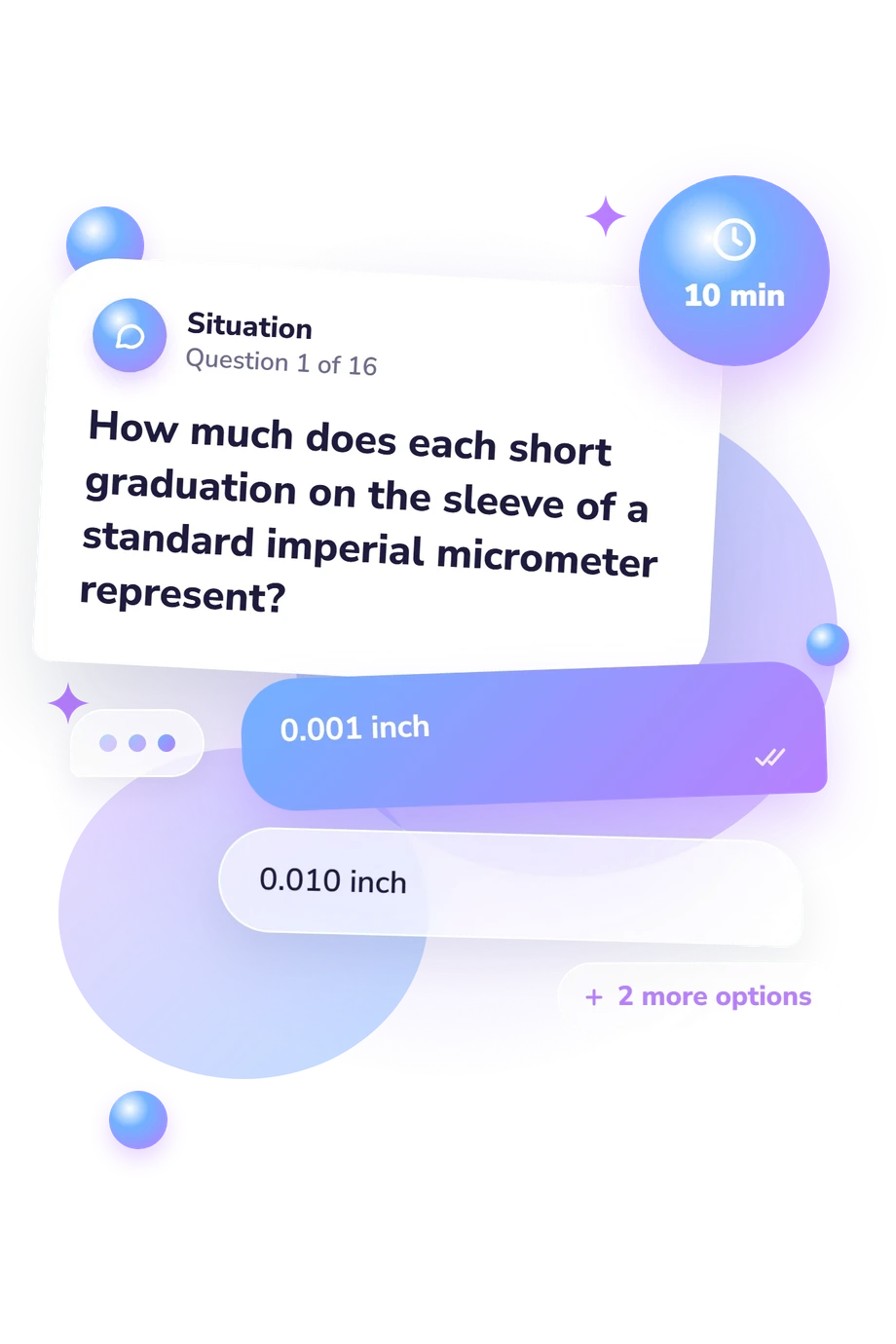
Example Questions From the Test
- 001 inch
- 010 inch
- 100 inch
- 025 inch
- Use the thimble value alone whenever its zero is not visible
- Add the last visible sleeve value to the aligned thimble value
- Subtract the sleeve reading from the thimble reading
- Multiply the sleeve value by the aligned thimble number
- Cleaning increases the micrometer's stated resolution
- Dirt or debris can add to the measured gap and distort the result
- Cleaning resets the sleeve graduations to zero
- Debris affects only metric micrometers, not imperial ones
Micrometer Quiz - Description and methodology of the test
Designed for people learning, revising, or checking their knowledge of standard imperial micrometers, this micrometer quiz checks practical knowledge rather than general mathematics. With four answer choices per item, this micrometer knowledge test lets you examine how confidently you read graduations, select tools, control measuring force, and correct common errors. The result indicates overall knowledge and points to topics that merit focused review.
What This Assessment Explores
Readers who want to build or check practical measurement skills can use this imperial micrometer test to examine how they handle a standard instrument. It suits classroom revision, workplace refreshers, and self-directed technical learning.
The items move from basic graduations to applied decisions involving temperature, contact force, tool range, zero error, and verification. The questions cover several connected themes:
- Reading and calculation covers how accurately you combine sleeve and thimble values and interpret a stated indication.
- Technique, tool choice, and error control cover awareness of stabilization, clean contact surfaces, consistent force, suitable range, and calibration checks.
- Imperial Micrometer Knowledge (0-16) summarizes the result: Foundations to Review 0-6, Developing Accuracy 7-12, and Strong Working Knowledge 13-16.
Taken together, the questions indicate overall knowledge and point to areas where targeted review could strengthen accuracy.
Methodology and Evidence Base
Each item presents a short measurement scenario or direct technical question with four answer choices. The format asks the respondent to select a reading, correction, procedure, or explanation, testing applied understanding rather than written calculation. Topics include sleeve graduations, thimble divisions, complete revolutions, measurement range, temperature, cleanliness, force, zero error, and comparison with a standard.
The questionnaire reports a result on the displayed knowledge scale and applies the displayed bands. The result offers an overall knowledge indication, while a middle result points to fundamentals that may benefit from more micrometer reading practice.
ASME B89.1.13-2013 supplies the technical framework for relevant micrometer conventions and performance considerations. Curtis and Farago and Dotson provide complementary instruction on dimensional measurement, reading technique, environmental effects, and metrology practice, while Stoup and Doiron offer a specialized high-accuracy example. The question themes are conceptually consistent with these sources, but that relationship does not establish that the online questionnaire itself is standardized, normed, or validated.
Results can vary with prior training, attention, and familiarity with terminology, so they work best as a learning snapshot rather than proof of formal competence.
- ASME B89.1.13-2013 (R2022), Micrometers. American Society of Mechanical Engineers, 2013.
- Curtis, Mark A., and Francis T. Farago. Handbook of Dimensional Measurement. 4th ed. Industrial Press, 2007. ISBN 978-0-8311-3262-0.
- Dotson, Connie L. Fundamentals of Dimensional Metrology. 6th ed. Cengage Learning, 2016. ISBN 978-1-133-60089-3.
- Stoup, John R., and Theodore D. Doiron. A Novel High Accuracy Micrometer for the Measurement of Diameter. Metrologia 58, no. 2 (2021): 025002. 10.1088/1681-7575/abd3b2.
Updated: