
Med Tech Quiz
How the Scales are Structured
Who Usually Takes This Test?
See How You Compare
Below is a preview of how scores are typically distributed across each scale.
Example Questions From the Test
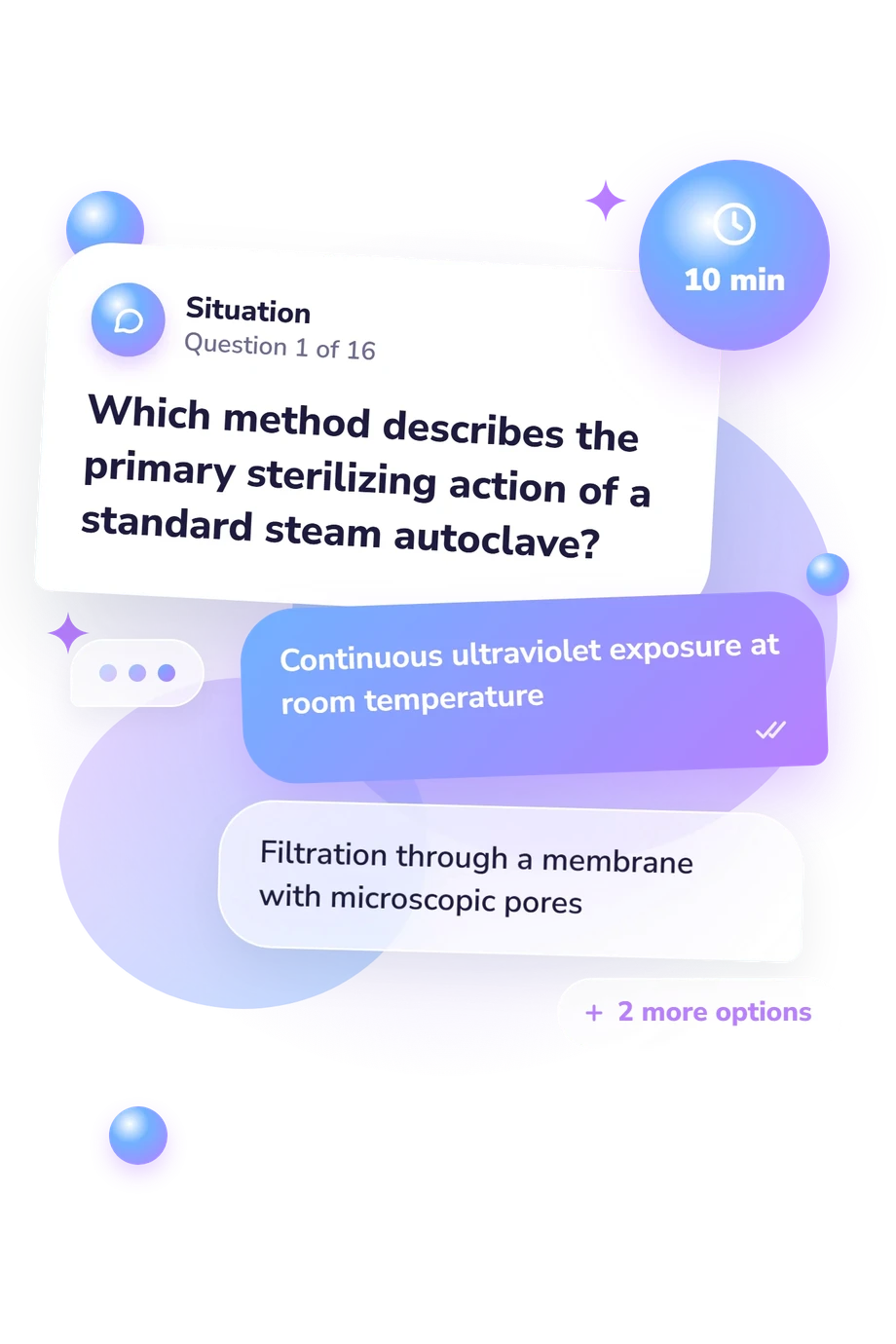
- Continuous ultraviolet exposure at room temperature
- Filtration through a membrane with microscopic pores
- Saturated steam under pressure applied for a validated time and temperature
- Dry heat combined with chemical disinfectant vapor
- Cells emit light after binding a radioactive tracer.
- Cells are identified solely by their sedimentation speed.
- Cells passing through an aperture produce changes in electrical resistance.
- Cells generate voltage through metabolic activity.
- True negatives divided by all people without the condition
- True positives divided by all positive test results
- True negatives divided by all negative test results
- True positives divided by all people who have the condition
Med Tech Quiz - Description and methodology of the test
Students, trainees, and laboratory professionals who want to check practical understanding can use the med tech quiz as a focused review of core clinical laboratory knowledge. As a medical laboratory quiz, it helps readers see which concepts feel secure and which deserve more study. The result indicates which covered knowledge areas may need review, helping readers direct further study toward routine procedures, instrumentation, quality practices, and interpretation.
What This Assessment Explores
The questions sample decisions and concepts that support dependable laboratory work rather than personal attitudes. They cover sterilization, specimen identification, centrifugation, microscopy calibration, hematology, immunoassay principles, PCR, reference intervals, blood gases, information systems, and quality control. This makes the laboratory knowledge test useful for learners refreshing core practice.
The result is descriptive: it shows how well your answers match the knowledge represented by these topics, not how you perform a procedure at the bench.
The displayed Medical Technology Knowledge scale organizes the result into three bands:
- Foundation Building (0-6) indicates that some concepts are recognized, while specimen handling, instrumentation, quality control, or interpretation may need review.
- Developing Knowledge (7-12) shows understanding of many essentials, with selected topics still needing reinforcement.
- Strong Knowledge (13-16) reflects a solid command of the concepts represented in the questionnaire.
These bands are educational summaries, not certification or clinical cutoffs.
Methodology and Evidence Base
Each item offers four response options and asks for best answer to a laboratory problem. Scenarios move from principles to applied interpretation, checking mechanisms, safety steps, quality decisions, and links between findings and test results.
The questionnaire reports one result on the displayed scale, and three bands provide its interpretation. As a medtech quiz focused on laboratory fundamentals, it works as a study checkpoint: a lower result identifies topics to revisit, while a higher result suggests concepts are more secure.
Tille and Harr's review, ASCP's MLS content guidance, and CLSI QMS01's quality-management model address represented areas. Topic coverage is conceptually consistent with these sources, but they do not establish this questionnaire as an adaptation or validated instrument. Specimen-identification emphasis also reflects patient-safety evidence from Wagar and colleagues (2006).
Interpretation should stay tied to learning goals and current testing context. Recall, guessing, recent coursework, and familiarity with laboratory terminology can influence performance, while written knowledge of topics cannot demonstrate hands-on competence in laboratory work or safe procedure execution. When safety decisions are involved, supervised assessment remains essential.
- Tille, Patricia M., and Robert R. Harr. Medical Laboratory Science Review. 6th ed. F.A. Davis, 2026. ISBN 9781719651240.
- American Society for Clinical Pathology Board of Certification. Medical Laboratory Scientist, MLS(ASCP) and MLS(ASCPi) Examination Content Guideline. Revised September 25, 2025. ASCP Board of Certification, 2025.
- Clinical and Laboratory Standards Institute. A Quality Management System Model for Laboratory Services. 5th ed. CLSI guideline QMS01. Wayne, PA: Clinical and Laboratory Standards Institute, 2019.
- Wagar, Elizabeth A., Lorraine Tamashiro, Bushra Yasin, Lee Hilborne, and David A. Bruckner. Patient Safety in the Clinical Laboratory: A Longitudinal Analysis of Specimen Identification Errors. Archives of Pathology & Laboratory Medicine 130, no. 11 (2006): 1662-1668. 10.5858/2006-130-1662-PSITCL
Updated: