
Love Language Quiz in Spanish
How the Scales are Structured
Who Usually Takes This Test?
See How You Compare
Below is a preview of how scores are typically distributed across each scale.
Example Questions From the Test
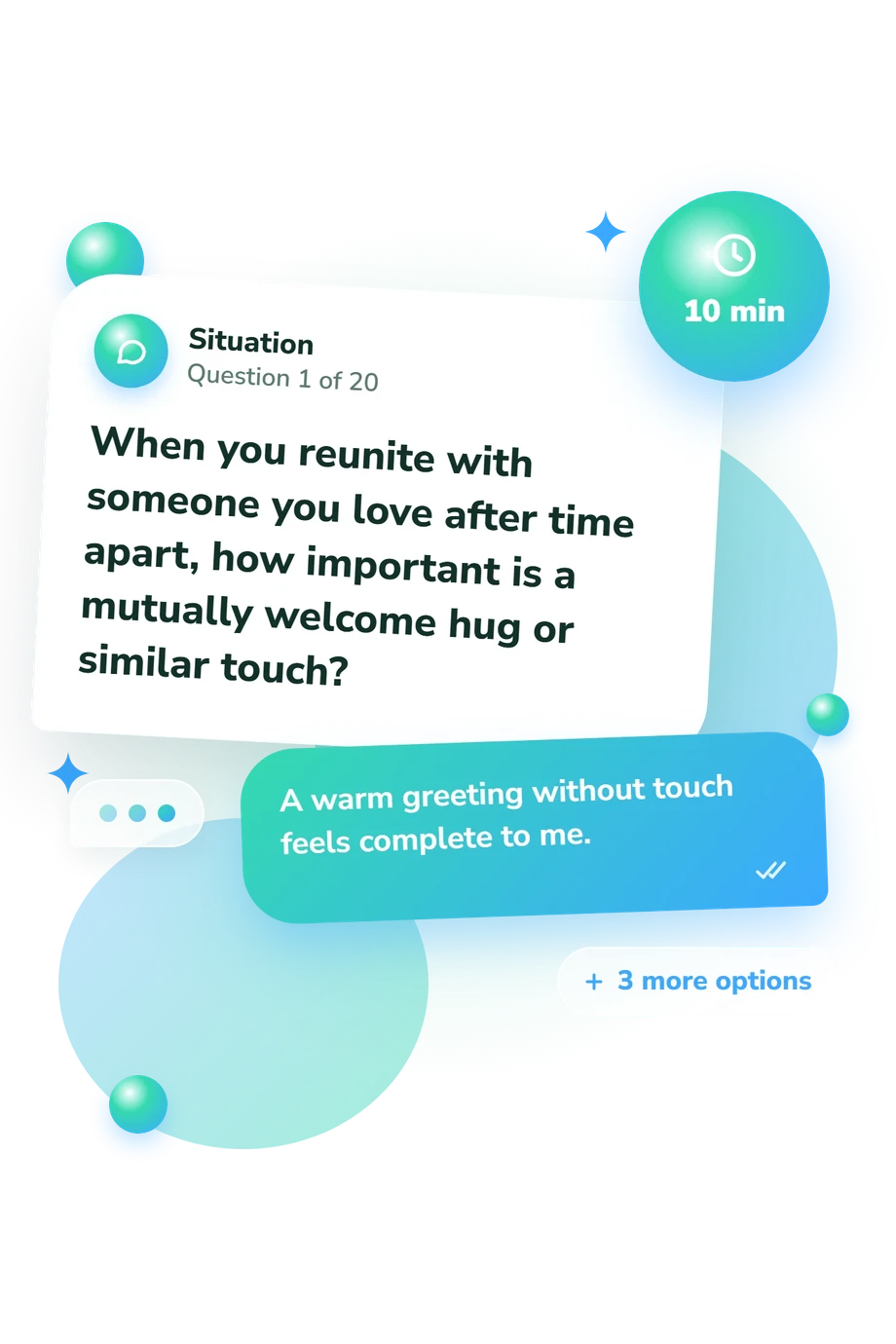
- A warm greeting without touch feels complete to me.
- A quick touch is pleasant but not especially important.
- A hug noticeably strengthens the sense of reunion.
- Affectionate physical contact is the moment that makes me feel truly reconnected.
- Plenty of independent time, with no expectation of shared plans.
- A casual shared meal or short activity if convenient.
- At least one intentional stretch of time together.
- A substantial shared experience where we can be fully present with each other.
- It has little emotional meaning; I can make another arrangement.
- Completing it is helpful, though mostly practical.
- Following through makes me feel considered and supported.
- Reliable action strongly shapes whether I feel cared for.
Love Language Quiz in Spanish - Description and methodology of the test
People who want to understand which expressions of care feel most meaningful to them can use the Love Language Quiz in Spanish as guided relationship self-reflection. As a Spanish love language test, it creates a comparative profile of preferred signals and may support clearer conversations about affection, attention, and boundaries. It suits people reflecting on their own experiences, not judging a partner’s character.
What This Assessment Explores
The questionnaire asks how affection is recognized in reunion, stress, conflict, celebration, and connection. It supports self-reflection by describing ways of receiving care, not judging relationships.
The questionnaire, presented as a Spanish love language quiz, compares five channels and permits blended preferences. The result prompts discussion of consent and effort.
Dimensions include:
- Acts of Service (0-12) places practical help in Independence focused (0-4), Meaningful channel (5-8), or Strong affinity (9-12).
- Physical Touch (0-12) places consensual closeness in Selective comfort (0-4), Meaningful channel (5-8), or Strong affinity (9-12).
- Quality Time (0-12) places focused togetherness in Flexible presence (0-4), Meaningful channel (5-8), or Strong affinity (9-12).
- Receiving Gifts (0-12) places symbolic gifts in Limited symbolism (0-4), Meaningful channel (5-8), or Strong affinity (9-12).
- Words of Affirmation (0-12) places praise in Occasional value (0-4), Meaningful channel (5-8), or Strong affinity (9-12).
Methodology and Scientific Basis
Each item presents a relationship situation with four response choices. The options move from low emotional importance or self-reliance toward stronger preference, so respondents choose the description that best fits them. Situations address practical support, attention, touch, gifts, and verbal repair across ordinary relationship contexts.
The scoring of this love language assessment is comparative. The five displayed scores are compared: the highest score indicates the strongest affinity, while scores within one point suggest a blended profile. The display does not specify how many points each response adds.
The categories are conceptually consistent with the Love Language Scale described by Mostova and colleagues, a measure of love-language preferences used in research that also examined relationship satisfaction, but this questionnaire is not presented as its adaptation. Chapman’s 1992 book supplies the five-category framework, while Impett and colleagues’ contemporary relationship-science analysis evaluates love-language claims. These sources provide context, not standardization of this online tool.
Honest self-report, current context, memory, and expectations can shape answers. The displayed bands are not population norms or clinical cutoffs; use the profile as a reflection and conversation aid rather than a diagnosis.
- Mostova, Olha, Maciej Stolarski, and Gerald Matthews. (2022). I love the way you love me: Responding to partner’s love language preferences boosts satisfaction in romantic heterosexual couples. PLOS ONE, 17(6), e0269429. 10.1371/journal.pone.0269429
- Chapman, Gary. (1992). The Five Love Languages: How to Express Heartfelt Commitment to Your Mate. Chicago: Northfield Publishing.
- Impett, Emily A., Haeyoung Gideon Park, and Amy Muise. (2024). Popular Psychology Through a Scientific Lens: Evaluating Love Languages From a Relationship Science Perspective. Current Directions in Psychological Science, 33(2), 87-92. 10.1177/09637214231217663
Updated: