
Lipids Quiz
How the Scales are Structured
Who Usually Takes This Test?
See How You Compare
Below is a preview of how scores are typically distributed across each scale.
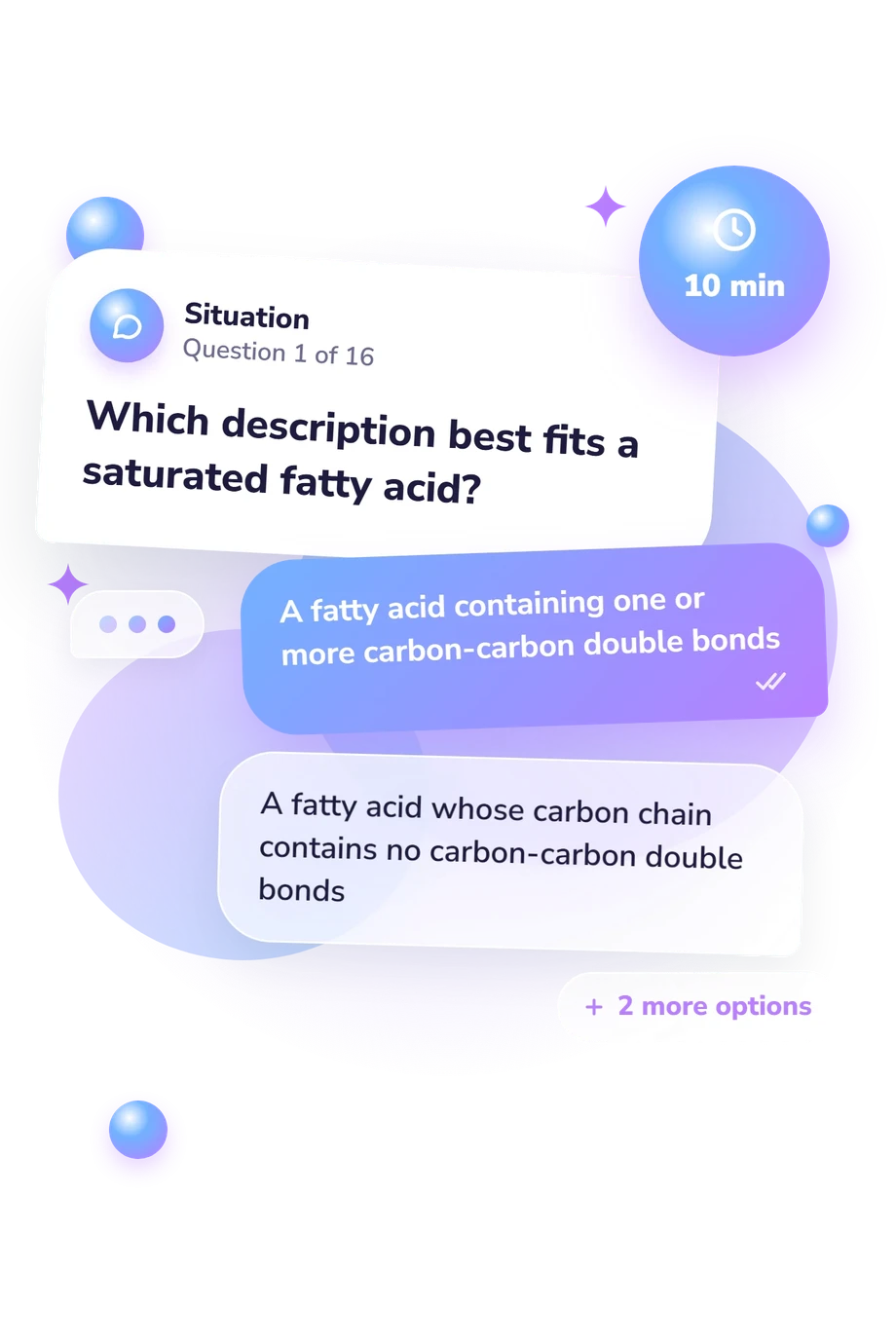
Example Questions From the Test
- Glucose and phosphate
- Amino acids and glycerol
- Cholesterol and nucleotides
- Free fatty acids and monoacylglycerols
- Three glycerol molecules and one fatty acid
- One glycerol molecule and three fatty acids
- One phosphate group, glycerol, and one amino acid
- Four fused carbon rings and a hydroxyl group
- Vitamins A, D, E, and K
- Vitamins B1, B2, B6, and B12
- Vitamin C and the B vitamins
- Vitamins B9 and C only
Lipids Quiz - Description and methodology of the test
Students, trainees, and curious readers who want to check their grasp of lipid biology can use this focused assessment. The lipids quiz turns fatty-acid structure, membranes, digestion, and energy use into applied questions rather than a vocabulary drill. This lipid biochemistry quiz asks you to connect molecular features with biological processes across familiar scenarios.
What This Assessment Explores
The questions examine whether you can apply core lipid concepts, not merely recognize isolated definitions. They suit learners reviewing introductory biochemistry or anyone wanting a structured check of how lipid structure connects with biological function.
The main knowledge areas are:
- Structure links saturation, cis double bonds, amphipathic character, and glycerol-based composition to function.
- Digestion and nutrition explain bile, lipase, lipoproteins, fat-soluble vitamins, and movement through aqueous blood.
- Energy storage and metabolism cover triglyceride mobilization, beta-oxidation, and efficient long-term fuel storage.
- Membranes, insulation, and signaling address related but distinct roles for phospholipids, fluidity, body-fat heat transfer, and cholesterol-derived molecules.
In this lipid biology quiz, the result is reported as Lipids Knowledge: 0-16, with Foundations to Review (0-6), Developing Knowledge (7-12), or Strong Knowledge (13-16). These bands show whether your understanding needs review, is developing, or is strong across common applications.
Methodology and Scientific Basis
The format is a multiple-choice lipid knowledge quiz: each item presents one question with four answer choices, and responses are combined into a single result. Definitions, mechanisms, and brief biological scenarios require connections between structure and function.
Horn and Hernick (2015) describe lipid-concept testing in biochemistry learning as a way to expose gaps while reinforcing retrieval; that study is conceptually consistent with this quiz's knowledge and retrieval focus, but it does not validate or establish the provenance of this online questionnaire. Liang and colleagues’ dyslipidemia dietary knowledge questionnaire offers a relevant model for multiple-choice item construction, content review, and item analysis. Roediger and Karpicke (2006) provide the testing-effect framework for learning through retrieval.
This online quiz has no stated norms, reliability estimates, or clinical cutoffs, so its result is a focused snapshot and its bands are descriptive guidance; performance may reflect recent study, terminology familiarity, concentration, and the self-administered format. Use missed concepts to guide review by returning to relevant mechanisms-such as membrane fluidity, lipid transport, or beta-oxidation-and verify difficult material in a reliable biochemistry source.
- Savannah Horn and Marcy Hernick. Improving student understanding of lipids concepts in a biochemistry course using test-enhanced learning. Chemistry Education Research and Practice, 2015, 16(4), 918-928. 10.1039/C5RP00133A
- Na Liang, Qiuli Zhao, Yuhua He, Jingshu Li, and Li Yang. Development and Validity of a Questionnaire on Dyslipidemia Dietary Knowledge. BioMed Research International, 2019, Article ID 5382130, 9 pages. 10.1155/2019/5382130
- Henry L. Roediger and Jeffrey D. Karpicke. Test-enhanced learning: Taking memory tests improves long-term retention. Psychological Science, 2006, 17(3), 249-255. 10.1111/j.1467-9280.2006.01693.x
Updated: