
Is Boarding School Right for Me Quiz
How the Scales are Structured
Who Usually Takes This Test?
See How You Compare
Below is a preview of how scores are typically distributed across each scale.
Example Questions From the Test
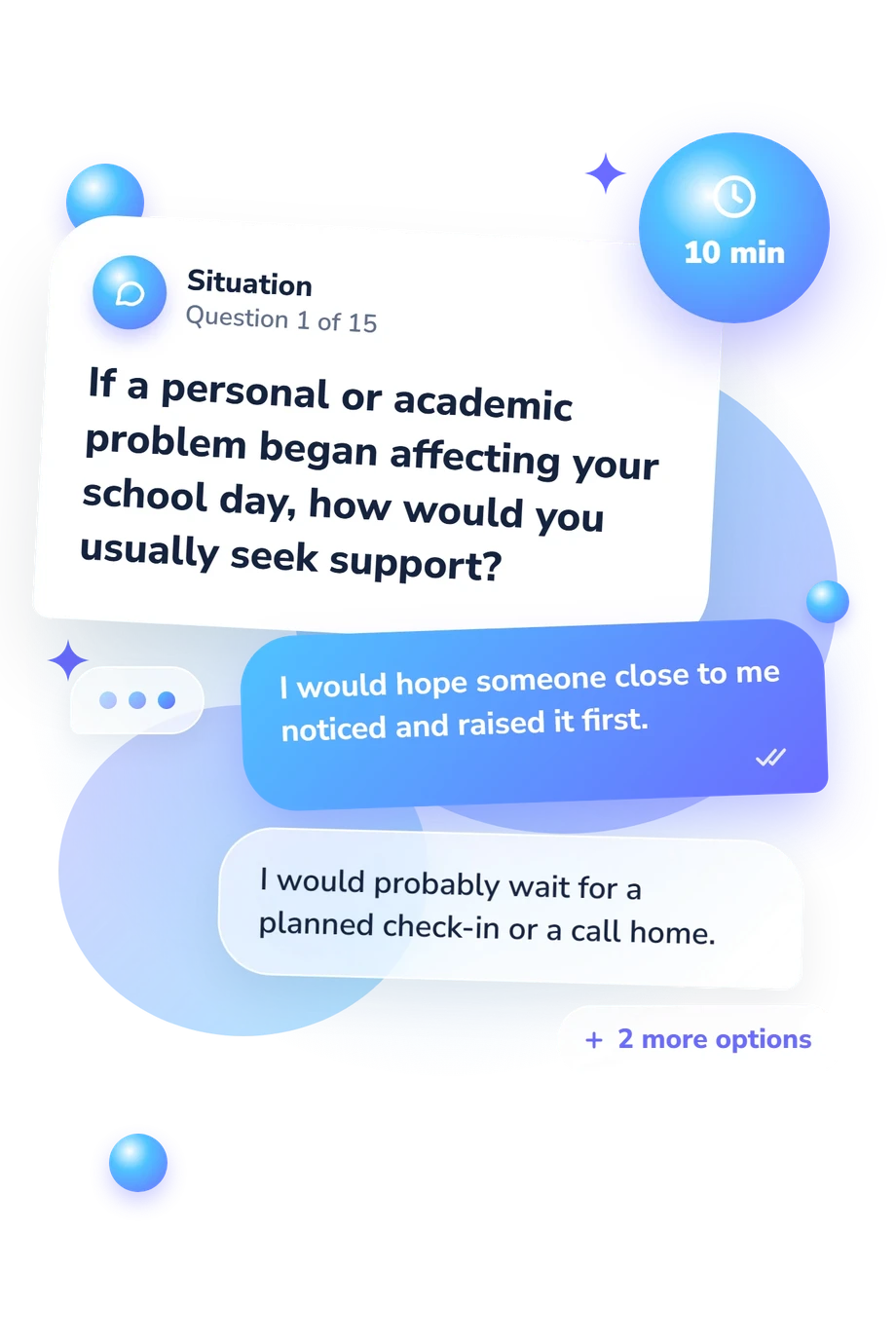
- I would hope someone close to me noticed and raised it first.
- I would probably wait for a planned check-in or a call home.
- I would approach an adult I already knew well, even if they were not the exact person responsible.
- I would identify an appropriate teacher, adviser, or house adult and explain what I needed.
- Classes followed by mostly unplanned time that I can organize from day to day.
- Classes plus one main activity, with plenty of open time around it.
- Classes and a couple of regular commitments that I can balance through planning.
- A full but predictable mix of classes, study, activities, and community events, with permission to reduce commitments if overloaded.
- I would mainly want to leave and return home as soon as possible.
- I would keep it to myself while waiting for someone from home to contact me.
- I would contact home and spend time with a trusted friend or familiar group.
- I would use familiar coping routines and approach a house adult if the feeling continued.
Is Boarding School Right for Me Quiz - Description and methodology of the test
Students and families weighing residential education can use the Is Boarding School Right for Me Quiz to examine whether everyday boarding-school demands match current preferences, habits, and support needs. As a should I go to boarding school quiz, it turns a broad decision into practical questions about privacy, routines, support, and motivation. It is intended for thoughtful comparison, not a verdict about one school.
What This Assessment Explores
Fit is treated as multidimensional, not as one score. Items cover shared facilities, peer contact, unfamiliar customs, homesickness, study, weekend duties, self-management, help-seeking, and conflict repair. The questionnaire functions as a which boarding school is right for me quiz by identifying features to compare, including rooming arrangements, quiet space, pastoral support, schedules, and opportunities for independent choice.
The displayed dimensions are:
- Communal Living Adaptability (0-15) shows comfort with shared space, peer contact, negotiated boundaries, and varied social settings: Privacy-first (0-5), Conditionally adaptable (6-10), or Communal-life affinity (11-15).
- Independent Living and Support Readiness (0-15) reflects daily self-management and help-seeking away from home: Support-dependent (0-5), Building readiness (6-10), or Ready to practice independence (11-15).
- Purpose and Structured Learning Fit (0-15) reflects motivation for residential education and fit with an integrated routine: Flexible-path preference (0-5), Selective fit (6-10), or Strong structured-learning affinity (11-15).
Methodology and Scientific Basis
Each item presents a situation involving homesickness, shared facilities, routines, conflict, support-seeking, or study expectations. Four response options let the respondent choose the response, moving from strain or reliance on others toward adaptation and help-seeking.
This boarding school readiness quiz uses a self-report, situational format. Scoring organizes answers into dimensions, but the displayed bands are descriptive; this is not a standardized measure with published norms or clinical cutoffs. The questionnaire does not state a item-weighting key, so scores should not be treated as population comparisons.
Mander and Lester (2019) is the closest reference because it examines readiness, wellbeing, and support around boarding-school transition. This questionnaire is conceptually consistent with that work, but is not an adaptation of its measure. Fisher, Frazer and Murray (1986), together with Fisher’s 1989 book, supports attention to homesickness and the cognitive and health effects of separation from home.
Results can help students prepare questions about rooming, pastoral care, schedules, workload, contact with home, and conflict support. Because self-report shifts with context, self-awareness, and willingness to disclose, interpret the profile alongside experience and each school’s arrangements.
- Mander, David J., and Leanne Lester. "The self-reported perceptions, readiness and psychological wellbeing of primary school students prior to transitioning to a secondary boarding school." Children Australia 44, no. 3 (2019): 136-145. 10.1017/cha.2019.20
- Fisher, Shirley, Norman Frazer, and Keith Murray. "Homesickness and health in boarding school children." Journal of Environmental Psychology 6, no. 1 (1986): 35-47. 10.1016/S0272-4944(86)80033-0
- Fisher, Shirley. Homesickness, Cognition and Health. Routledge, 1989.
Updated: