
Image Personality Quiz
How the Scales are Structured
Who Usually Takes This Test?
See How You Compare
Below is a preview of how scores are typically distributed across each scale.
Example Questions From the Test
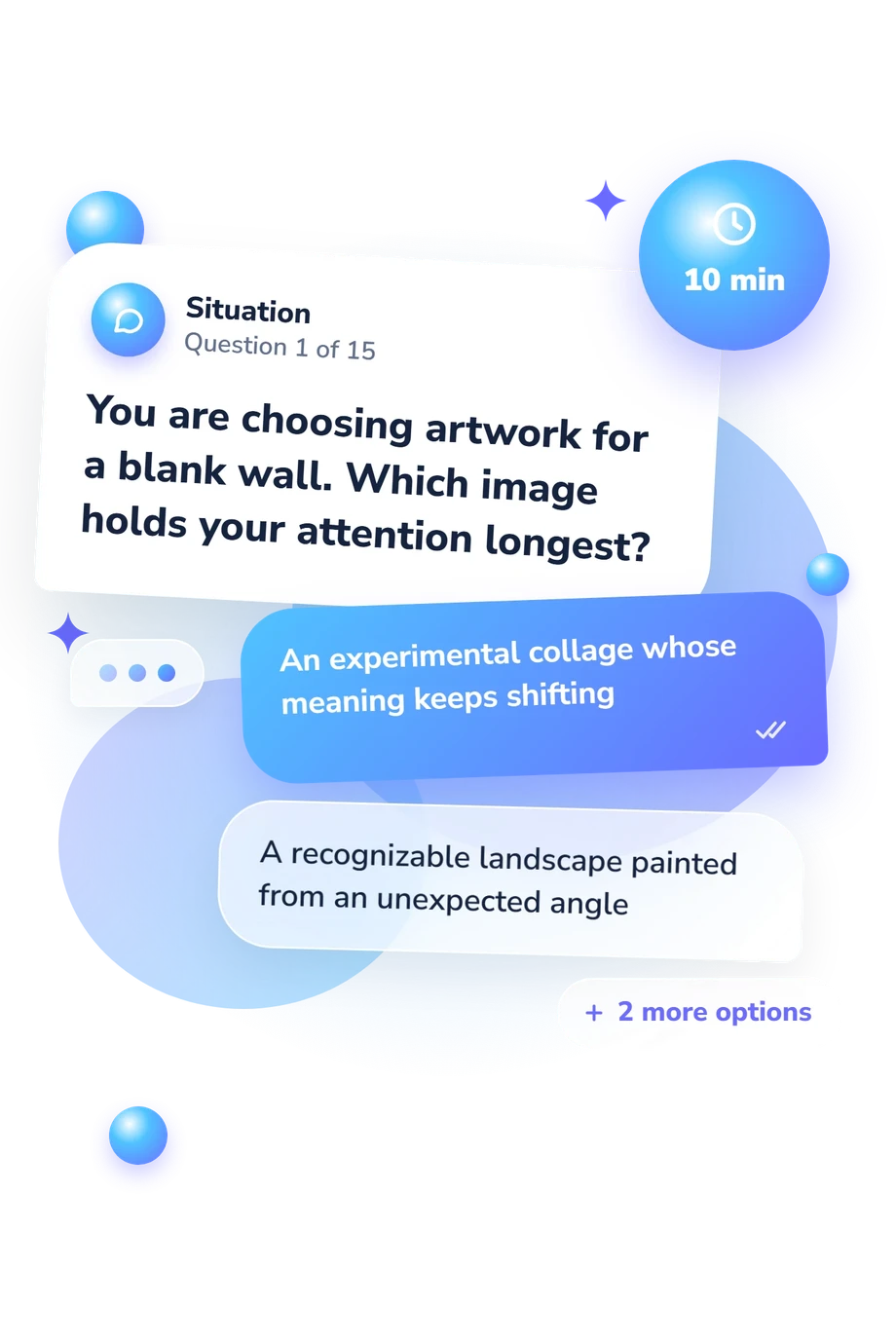
- An experimental collage whose meaning keeps shifting
- A recognizable landscape painted from an unexpected angle
- A calm print that complements the room's existing style
- A familiar subject with one unusual splash of color
- A blank page for following whatever mood arrives
- A short list of possibilities with no fixed order
- Two planned anchors with open time between them
- A complete schedule with activities, times, and preparations
- A private message sent after I have gathered my thoughts
- A conversation with one person whose reaction matters to me
- A cheerful update shared with a chosen circle
- An animated announcement that invites everyone into the moment
Image Personality Quiz - Description and methodology of the test
People who want a quick, nonverbal way to reflect on their preferences may find the image personality quiz useful. Rather than asking you to endorse trait statements, this personality quiz based on pictures invites choices among scenes, objects, routes, and social situations. The result is intended to highlight recurring attractions in your visual selections, helping you consider how you approach unfamiliar experiences, visibility with others, and organized environments.
What This Assessment Explores
These choices make the personality picture quiz a reflection on preferences rather than ability, morality, or fixed identity. The scenes touch on novelty, planning, concentration, travel, creativity, celebration, and sharing ideas. Together, they show whether attention tends toward familiar or unusual settings, private observation or visible exchange, and flexible or arranged surroundings.
Your profile is organized across three dimensions:
- Novelty Seeking (0-15) shows attraction to unfamiliar, varied, and exploratory imagery: Familiarity Anchored (0-5), Selectively Curious (6-10), or Exploration Drawn (11-15).
- Social Expressiveness (0-15) reflects private observation versus visible exchange: Quietly Reflective (0-5), Contextual (6-10), or Open (11-15).
- Structured Focus (0-15) reflects attraction to order and planning: Flexible Flow (0-5), Practical Organizer (6-10), or Structured Focus (11-15).
Methodology and Scientific Basis
Each item presents four illustrated alternatives, and you choose the image that best matches your preference. This forced-choice format compares scenes rather than rating statements independently, with themes spanning creativity, routes, workspaces, social settings, travel, and planning.
Selections are grouped into the three displayed dimensions, and the combined pattern determines the band shown for each one. Read the result as relative attractions, not a ranking of intelligence, sociability, discipline, or worth. A personality quiz based on pictures describes visual preferences rather than a complete personality.
Visually mediated forced choice is conceptually consistent with Hilliard et al. (2022) and Leutner et al. (2017), whose studies examined image-based assessment and response scales. Its domain structure also relates to the aspect-level perspective of DeYoung, Quilty, and Peterson (2007), but this questionnaire is not an adaptation of those instruments.
The displayed categories are descriptive, not population norms. As an online self-report, the profile can shift with mood, cultural associations, self-awareness, and familiarity with the scenes; it is not a standardized diagnostic measure. A photo personality quiz works best as a focused prompt for reflection when the dimensions point in different directions.
- Hilliard, Airlie, Emre Kazim, Theodoros Bitsakis, and Franziska Leutner. “Measuring Personality through Images: Validating a Forced-Choice Image-Based Assessment of the Big Five Personality Traits.” Journal of Intelligence 10, no. 1 (2022): 12. 10.3390/jintelligence10010012
- Leutner, Franziska, Adam Yearsley, Sonia C. Codreanu, Yossi Borenstein, and Gorkan Ahmetoglu. “From Likert Scales to Images: Validating a Novel Creativity Measure with Image Based Response Scales.” Personality and Individual Differences 106 (2017): 36-40. 10.1016/j.paid.2016.10.007
- DeYoung, Colin G., Lena C. Quilty, and Jordan B. Peterson. “Between Facets and Domains: 10 Aspects of the Big Five.” Journal of Personality and Social Psychology 93, no. 5 (2007): 880-896. 10.1037/0022-3514.93.5.880
Updated: