
Ideal Partner Quiz
How the Scales are Structured
Who Usually Takes This Test?
See How You Compare
Below is a preview of how scores are typically distributed across each scale.
Example Questions From the Test
- Mostly separate plans, perhaps reconnecting briefly afterward
- One shared activity with the rest of the weekend independent
- Spending most of one day together and keeping some personal time
- Making the weekend a shared experience from start to finish
- Little or no contact until we are both free
- One practical or friendly message during the day
- A few short updates or affectionate messages
- An ongoing thread of messages whenever either of us has a moment
- Separate hobbies would keep the relationship interesting
- One occasional shared interest would be plenty
- Several regular activities together would feel connecting
- I would want shared interests to be a major part of our lifestyle
Ideal Partner Quiz - Description and methodology of the test
People reflecting on dating preferences, a new relationship, or an established bond can use the ideal partner quiz to clarify what kind of connection feels sustainable. When you take a quiz about your ideal partner, the result is best read as a profile of desired relationship conditions, not a verdict about a current partner. It helps you compare expectations about closeness, independence, emotional exchange, and shared direction.
What This Assessment Explores
Readers can use it before dating decisions or while reviewing a current partnership. Rather than treating the result as a perfect partner quiz answer, read it as preferred conditions for connection; no single profile is the correct match.
The three result dimensions are:
- Commitment & Future Alignment (0-15) measures desired commitment and planning: Present-Focused Flexibility (0-5) favors autonomy; Emerging Partnership (6-10) balances flexibility; Intentional Future-Building (11-15) favors coordinated direction.
- Emotional Attunement (0-15) measures desired emotional discussion: Quiet Connection (0-5) values space; Responsive Connection (6-10) balances availability; Deep Attunement (11-15) emphasizes reassurance and vulnerability.
- Everyday Togetherness (0-15) measures desired shared life: Spacious Partnership (0-5) protects independence; Flexible Togetherness (6-10) combines closeness and space; Closely Shared Life (11-15) favors frequent contact.
Together, the scores describe relationship rhythm, not healthier or worse outcomes.
Methodology and Evidence Base
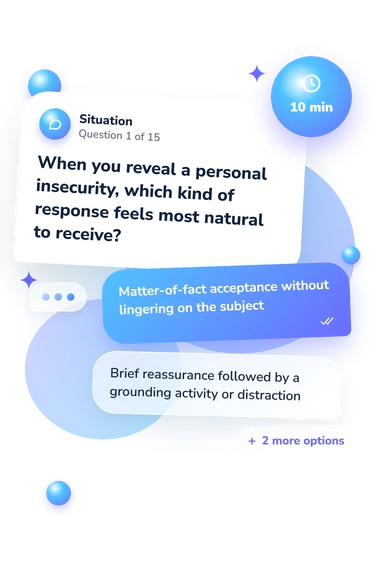
Each item presents a situation with four response options. Scenarios cover insecurity, conflict, money, social life, home routines, time apart, affection, milestones, and hobbies. Choices range from independence or lower emotional involvement to integration, reassurance, predictability, and joint decisions.
Responses form three profile dimensions, reported separately. No per-answer weighting rule is stated online, so interpret displayed bands rather than infer point formulas. Profiles can mix closeness and independence. It can function as a what kind of partner do i need quiz, organizing preferences without assigning identity.
The reference is the Ideal Standards Model (Fletcher et al., 1999), which treats ideals as standards for evaluating close relationships. This questionnaire is conceptually consistent with that model, not an adaptation. Fletcher and Simpson (2000) discuss ideals' structure and functions, while Campbell et al. (2001) discuss flexibility in relation to self and context.
As a partner type quiz, it is a self-report tool without standardized administration or population norms. Mood, circumstances, response bias, and self-perception can affect results, so read the profile as a snapshot for clarifying expectations.
- Fletcher, Garth J. O., Jeffry A. Simpson, Geoff Thomas, and Louise Giles. “Ideals in Intimate Relationships.” Journal of Personality and Social Psychology 76, no. 1 (1999): 72-89. 10.1037/0022-3514.76.1.72
- Fletcher, Garth J. O., and Jeffry A. Simpson. “Ideal Standards in Close Relationships: Their Structure and Functions.” Current Directions in Psychological Science 9, no. 3 (2000): 102-105. 10.1111/1467-8721.00070
- Campbell, Lorne, Jeffry A. Simpson, Deborah A. Kashy, and Garth J. O. Fletcher. “Ideal Standards, the Self, and Flexibility of Ideals in Close Relationships.” Personality and Social Psychology Bulletin 27, no. 4 (2001): 447-462. 10.1177/0146167201274006