
I vs Me Quiz
How the Scales are Structured
Who Usually Takes This Test?
See How You Compare
Below is a preview of how scores are typically distributed across each scale.
Example Questions From the Test
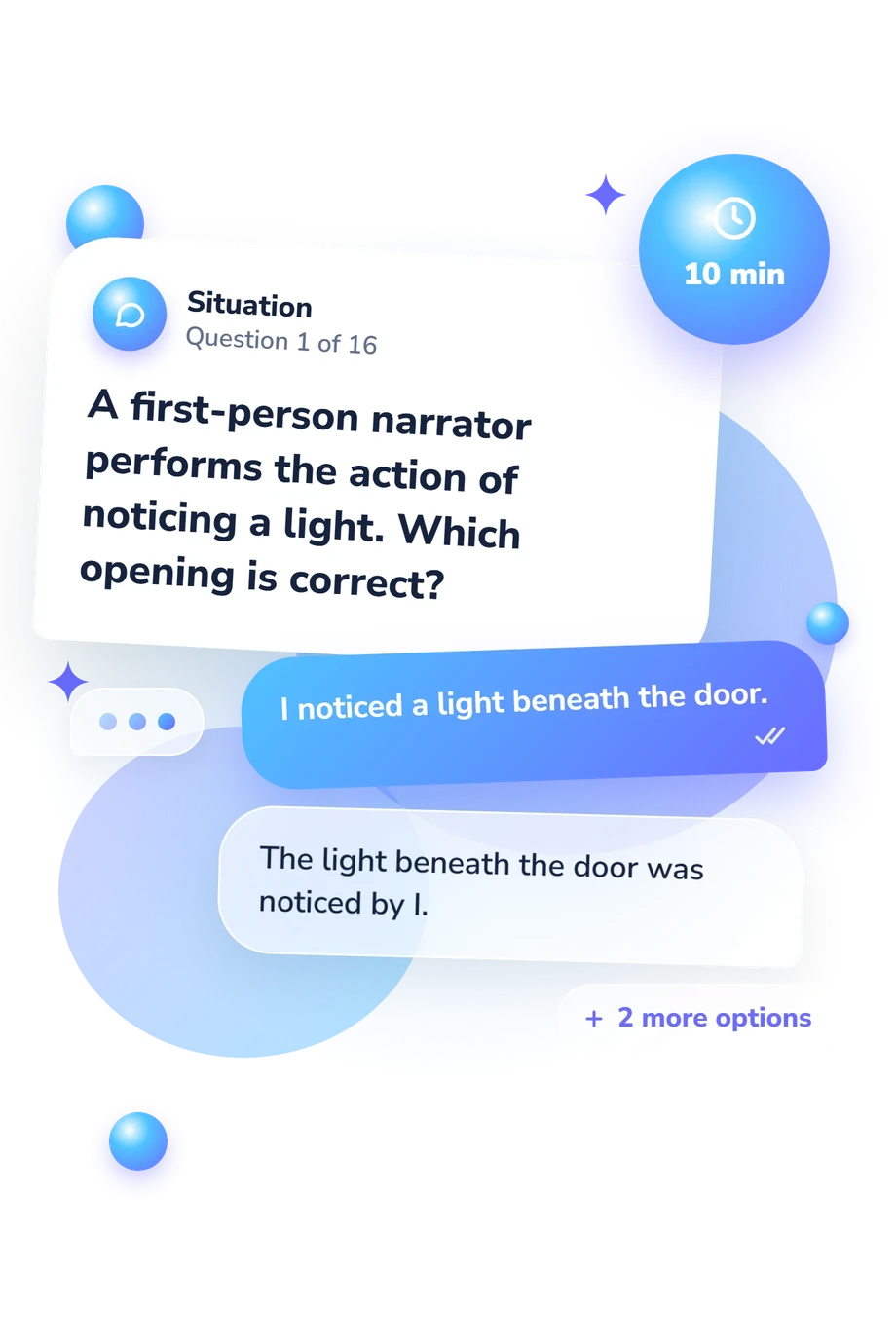
- I noticed a light beneath the door.
- The light beneath the door was noticed by I.
- Myself noticed a light beneath the door.
- Me noticed a light beneath the door.
- Nina finished the puzzle earlier than I did.
- Nina finished the puzzle earlier than me did.
- Nina finished the puzzle earlier than myself did.
- Nina finished the puzzle earlier than I done.
- Me with Talia interviewed the witness.
- Talia and I interviewed the witness.
- I and Talia interviewed the witness.
- Talia and me interviewed the witness.
I vs Me Quiz - Description and methodology of the test
People who want to write standard English more confidently can use the I vs Me Quiz to check a specific grammar distinction without working through a broad language assessment. This quiz about I and me is intended for learners, writers, and speakers who want practical subject and object pronoun practice, especially when a sentence contains another person, a preposition, or a comparison. The result identifies current command and useful review needs.
What This Assessment Measures
At the center of this assessment is grammatical function: this i vs me grammar quiz asks whether "I" normally serves as the subject, while "me" serves as an object or follows a preposition. The questions use ordinary sentence contexts.
The item themes fall into three areas:
- Subject position shows whether you choose "I" when the pronoun performs the action, including in a compound subject.
- Object position shows whether you choose "me" after a verb or preposition, including beside another name.
- Coordination and comparison show whether you preserve the distinction in phrases such as "than I did" and "you and me."
Together, these areas produce the I vs Me Knowledge result on a 0-16 scale. The bands are Foundations to build (0-6), Developing control (7-12), and Strong command (13-16). Higher bands indicate more consistent command, while lower bands identify forms to review.
Methodology and Evidence Base
Each item presents a short situation or sentence with four answer choices. Selecting the form that fits standard English checks recognition of grammatical function in context, not extended writing. The result is reported on one knowledge scale that combines performance across the item groups rather than producing separate subject and object subscores.
Content is conceptually consistent with Kirner-Ludwig, Oberhofer, and Heiss (2023), whose corpus-pragmatic study examines hypercorrect subject pronouns in object position. It also aligns with Angermeyer and Singler (2003) on pronoun variation in coordinated noun phrases, while Huddleston and Pullum (2002) provides the broader grammatical account of subject and object functions. These works explain its rationale, not its provenance as an adaptation.
The assessment supplies I vs me grammar practice for targeted review, but it is presented with practical interpretation bands rather than independently established population norms. Results may reflect prior schooling, familiarity with formal written English, attention, and answer context. Interpret the band as current performance on these patterns, using mistakes to guide practice rather than treating one score as a complete measure of English ability.
- Kirner-Ludwig, Monika, Kathrin Oberhofer, and Julia Heiss. "Between You and I: A Methodological, Mixed-method Corpus-pragmatic Approach to Hypercorrect Uses of Subject Pronouns in Object Position." Corpus Pragmatics, 7(4), 377-399, 2023. 10.1007/s41701-023-00152-z
- Angermeyer, Philipp S., and John Victor Singler. "The Case for Politeness: Pronoun Variation in Co-ordinate NPs in Object Position in English." Language Variation and Change, 15(2), 171-209, 2003. 10.1017/S0954394503152027
- Huddleston, Rodney, and Geoffrey K. Pullum. The Cambridge Grammar of the English Language. Cambridge University Press, 2002. 10.1017/9781316423530
Updated: