
How Many States Have I Been To Quiz
How the Scales are Structured
Who Usually Takes This Test?
See How You Compare
Below is a preview of how scores are typically distributed across each scale.
Example Questions From the Test
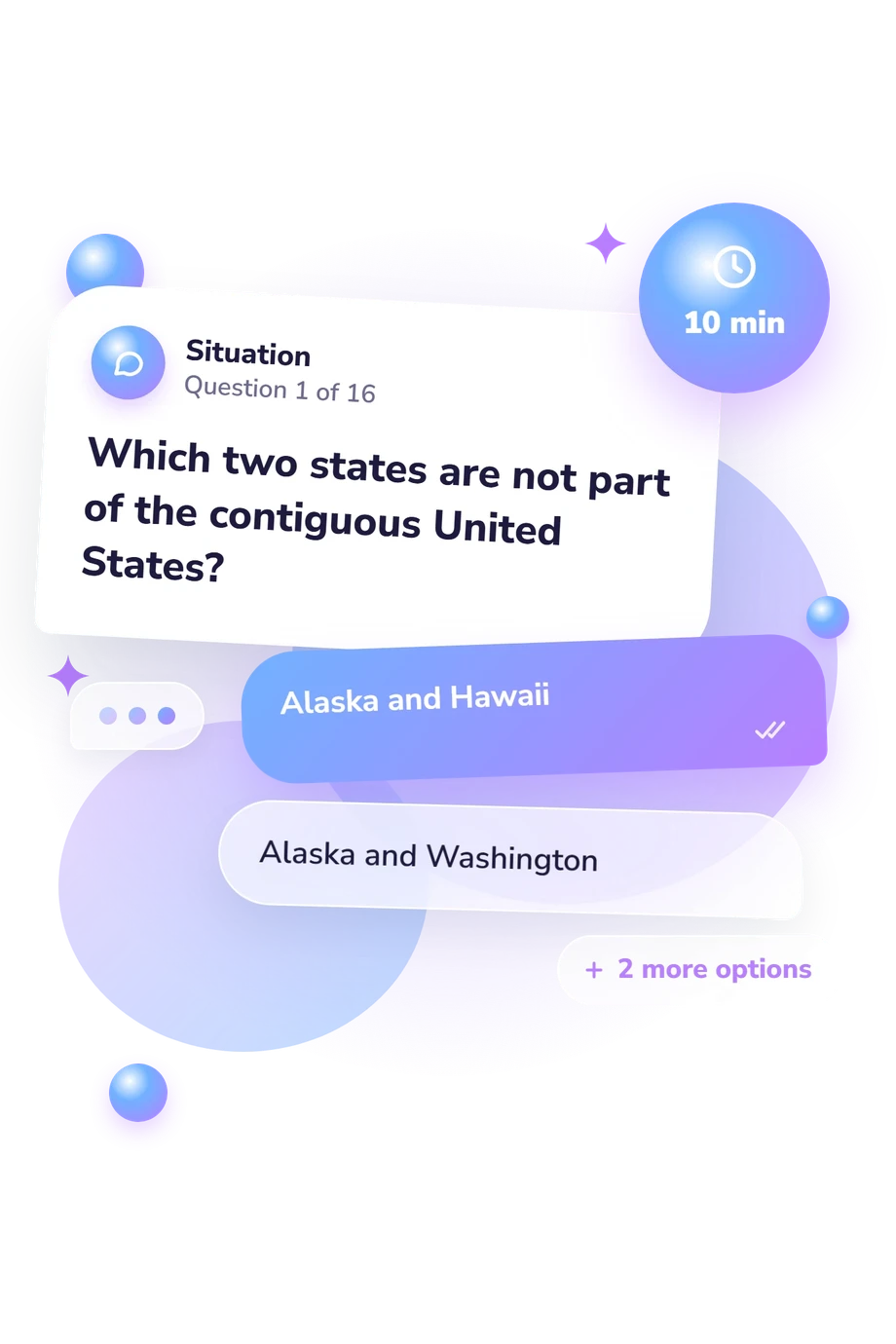
- Alaska and Hawaii
- Alaska and Washington
- Florida and Hawaii
- California and Hawaii
- Arizona, Nevada, Utah, and Colorado
- Arizona, New Mexico, Colorado, and Utah
- California, Arizona, Nevada, and Utah
- Arizona, New Mexico, Texas, and Colorado
- 3
- 5
- 4
- 6
How Many States Have I Been To Quiz - Description and methodology of the test
Travelers who want to check the geography behind a state total can use the How Many States Have I Been To Quiz as a practical knowledge check. It works as a how many states have you been to quiz for travelers. This assessment addresses the question of how many states you have been to by testing the rules needed to count them, rather than calculating a personal travel total.
What This Assessment Explores
Questions focus on geography for counting unique U.S. states, not recall destination names. They cover boundaries, regional groupings, state status, and the rule that repeat stops in one state remain one state. The test suits anyone checking travel geography or organizing a travel log.
The result draws on four practical areas:
- State status shows whether you separate states from territories and federal districts.
- Regional knowledge checks New England, the Four Corners, and the contiguous United States.
- Route reasoning tests whether a journey adds each distinct state only once.
- U.S. States Travel Knowledge (0-16) reports correct answers and reflects knowledge useful for counting visited states, not personal travel totals. Starting Map (0-6), Developing Tracker (7-12), and Confident Counter (13-16) describe the displayed result.
In this states visited quiz, your result shows how well you apply rules to a unique-state total.
Methodology and Scientific Basis
Items use four-option multiple choice. Prompts require factual recognition or short counting judgments: identifying Alaska and Hawaii, locating the Four Corners, separating a territory from a state, or removing duplicates from a travel log. The displayed score is the number of correct answers; interpretation concerns knowledge useful for counting states.
The questionnaire also serves as a how many states have i visited quiz by applying geographic rules. It is conceptually consistent with Kozak et al.'s 2015 survey of geographic knowledge, but is not an adaptation. U.S. Census Bureau state codes and federal Four Corners legislation support the factual distinctions in its items.
The displayed bands are descriptive ranges for this questionnaire. The result reflects performance on the included knowledge task rather than a personal travel total, with no separate subscores for geographic knowledge and counting performance. Memory, attention, and familiarity with U.S. geography may affect answers: someone can know the rules yet misread a route, while a frequent traveler may miss a boundary. Interpret the outcome alongside a travel log.
- Kozak, Stephanie L., Jerome E. Dobson, and Joseph S. Wood. "Geography's American Constituency: Results from the AGS Geographic Knowledge and Values Survey." International Research in Geographical and Environmental Education, vol. 24, no. 3, 2015, pp. 201-222. 10.1080/10382046.2015.1034457
- Orth, Taylor, Carl Bialik, and Linley Sanders. "Which States Have Americans Visited, and Which Are Their Favorites?" YouGov, September 22, 2022.
- U.S. Census Bureau. "American National Standards Institute (ANSI) Codes for States." Page last revised October 8, 2021.
- U.S. Congress. "Four Corners Interpretive Center Act." Public Law 106-143, 113 Stat. 1703, December 7, 1999.
Updated: