
Horse Riding Quiz
How the Scales are Structured
Who Usually Takes This Test?
See How You Compare
Below is a preview of how scores are typically distributed across each scale.
Example Questions From the Test
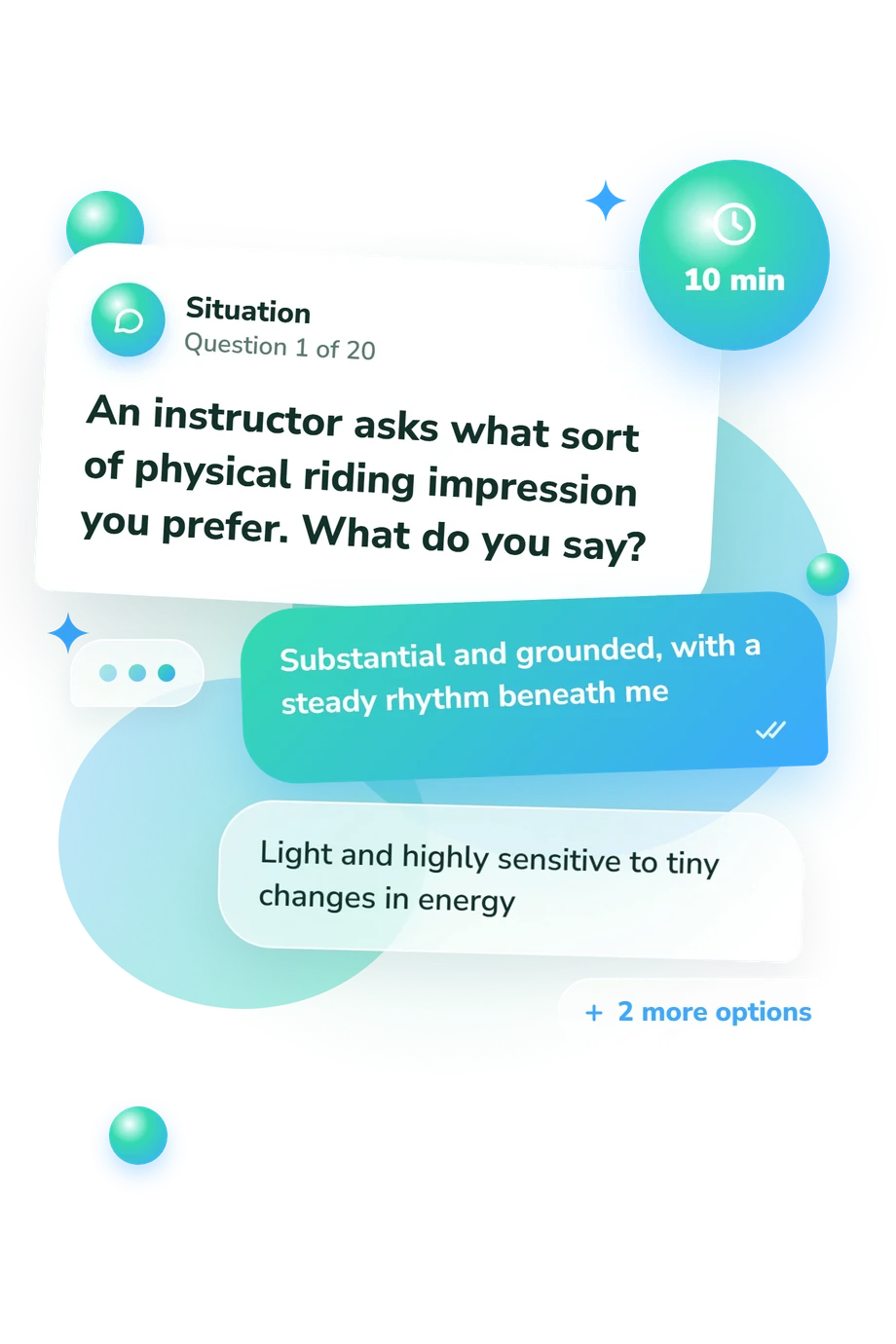
- Substantial and grounded, with a steady rhythm beneath me
- Light and highly sensitive to tiny changes in energy
- Large-moving and expressive during technical arena work
- Very forward, with speed readily available
- Not very; I already want one narrowly defined discipline
- Somewhat; variety is useful, but secondary to my main goal
- A little; I would occasionally try something different
- Very; broad versatility is central to the experience I want
- Calm persistence and efficient energy over changing terrain
- A large, expressive stride for arena work
- Short bursts of acceleration with frequent rests
- An unhurried pace with little interest in the surroundings
Horse Riding Quiz - Description and methodology of the test
For riders deciding what kind of partnership they want with a horse, this horse riding quiz offers a structured way to compare preferences rather than rely on a breed stereotype. This horse rider quiz gives riders language for discussing movement, responsiveness, stamina, versatility, and care routines with an instructor. It turns broad interests into a profile that can guide further reflection.
What This Assessment Explores
The questionnaire explores a rider's preferred partnership qualities: movement, forwardness, sensitivity, endurance, versatility, technical work, retraining, and grooming. As a horse breed quiz, it shows which associated riding qualities match those choices without treating breed as destiny. Its dimensions are:
- American Quarter Horse Affinity (0-12) reads preference for grounded versatility: Different Direction (0-4), Some Common Ground (5-8), Strong Affinity (9-12).
- Arabian Affinity (0-12) reads preference for attentive communication and endurance: Different Direction (0-4), Emerging Connection (5-8), Strong Affinity (9-12).
- Irish Cob Affinity (0-12) reads preference for steadiness and leisure connection: Different Direction (0-4), Comfortable Possibility (5-8), Strong Affinity (9-12).
- Thoroughbred Affinity (0-12) reads preference for forward athleticism: Different Direction (0-4), Conditional Match (5-8), Strong Affinity (9-12).
- Warmblood Affinity (0-12) reads preference for structured training and expressive arena work: Different Direction (0-4), Partial Alignment (5-8), Strong Affinity (9-12).
Methodology and Scientific Basis
Each of the scenarios presents four choices contrasting movement, energy, communication, goals, and care. Selecting the closest statement produces a comparative profile across the affinity scales, not one overall score. Scoring is unspecified in this horse riding preferences quiz, so the result indicates stated preferences and cannot predict the suitability of an individual horse.
Evidence is conceptually consistent with E-BARQ (McGreevy et al., 2025), which examines owner-reported behaviour in ridden horses. It also aligns with research by Suwała et al. (2016), Lloyd et al. (2008), and Sackman and Houpt (2019) on equine temperament, personality, breed, use, and management. This questionnaire is not presented as an adaptation of those published instruments.
The profile helps turn stated preferences into practical questions about sensitivity, stamina, forwardness, arena training, or versatility for an instructor-led assessment and supervised trial. Responses can shift with mood, experience, self-awareness, and limited exposure. It is an online self-reflection tool without displayed standardized norms, so treat a high affinity as a reason to arrange instructor-led assessment, supervised riding, and properly fitted safety equipment for the individual horse.
- McGreevy, Paul, Imke Tammen, Peter Thomson, and Kate Fenner. “Owner-reported breed differences in the behaviour of ridden horses.” Applied Animal Behaviour Science 284 (2025): 106556. 10.1016/j.applanim.2025.106556
- Suwała, Mira, Aleksandra Górecka-Bruzda, Marta Walczak, John Ensminger, and Tadeusz Jezierski. “A desired profile of horse personality - A survey study of Polish equestrians based on a new approach to equine temperament and character.” Applied Animal Behaviour Science 180 (2016): 65-77. 10.1016/j.applanim.2016.04.011
- Lloyd, Adele Sian, Joanne Elizabeth Martin, Hannah Louise Imogen Bornett-Gauci, and Robert George Wilkinson. “Horse personality: Variation between breeds.” Applied Animal Behaviour Science 112 (2008): 369-383. 10.1016/j.applanim.2007.08.010
- Sackman, Jill E., and Katherine A. Houpt. “Equine Personality: Association With Breed, Use, and Husbandry Factors.” Journal of Equine Veterinary Science 72 (2019): 47-55. 10.1016/j.jevs.2018.10.018
Updated: