
Highly Sensitive Child Test
How the Scales are Structured
Who Usually Takes This Test?
See How You Compare
Below is a preview of how scores are typically distributed across each scale.
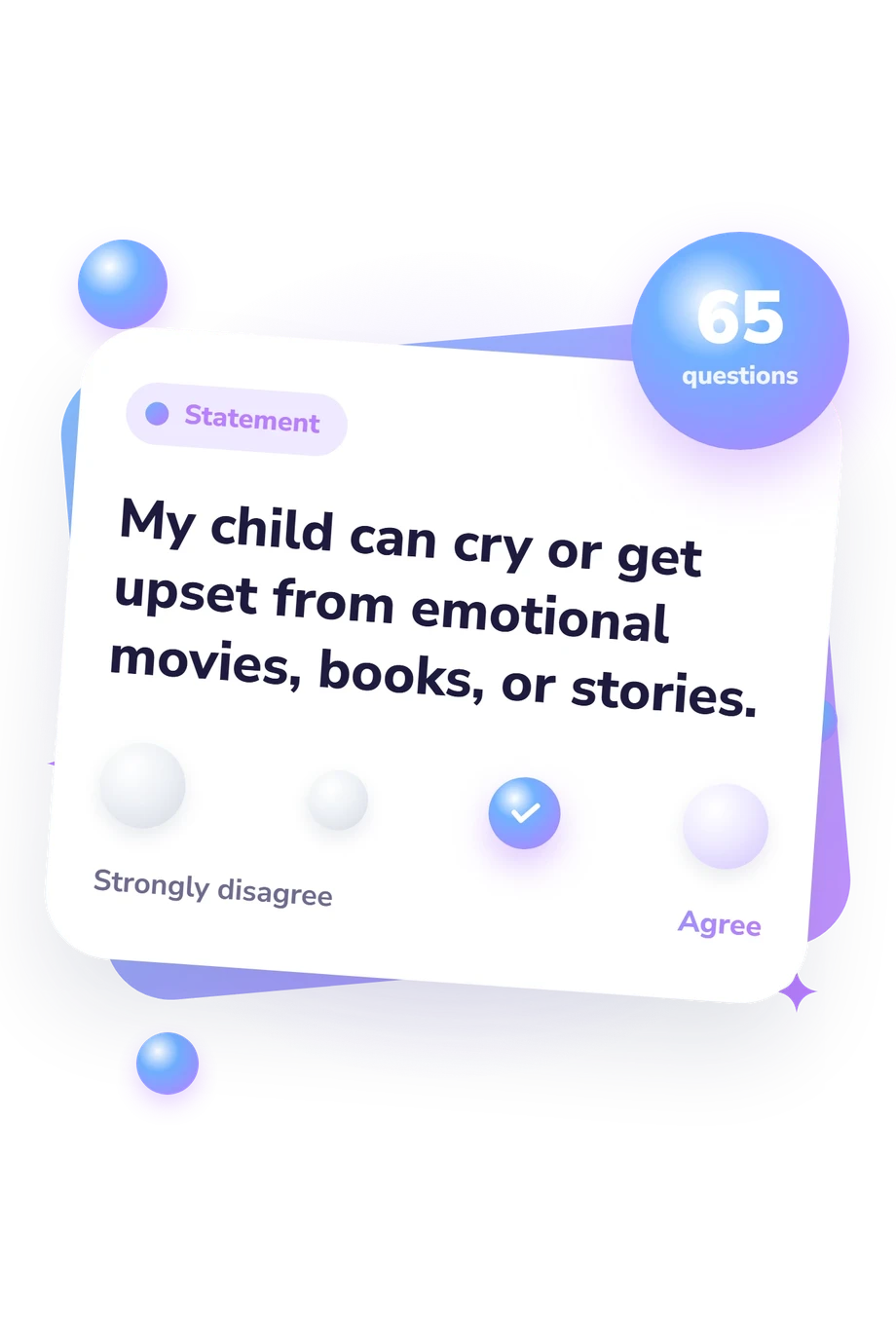
Example Questions From the Test
- Strongly disagree
- Disagree
- Not sure
- Agree
- Strongly disagree
- Disagree
- Not sure
- Agree
- Strongly disagree
- Disagree
- Not sure
- Agree
Highly Sensitive Child Test - Description and methodology of the test
For parents and caregivers considering whether a child may be unusually responsive to emotional, sensory, or social cues, the Highly Sensitive Child Quiz offers a focused way to organize everyday observations. A highly sensitive child assessment can help identify recurring patterns rather than overinterpreting one difficult moment. The resulting profile gives language for reflection and for discussing practical support around the child’s daily experiences.
What This Assessment Explores
Questions focus on how a child processes experiences, responds to other people’s emotions, and reacts to sensory input. They cover subtle social cues, reflection, empathy, strong or lingering feelings, noise and touch discomfort, and recovery after stimulation. The parent or caregiver answers about recurring everyday behavior.
The three result dimensions are:
- Depth of Processing (0-30) indicates reflection, attention to nuances, and careful consideration; bands: Lower depth (0-10), Moderate depth (11-20), Higher depth (21-30).
- Emotional Reactivity & Empathy (0-30) indicates intense feelings and sensitivity to others; bands: Lower (0-10), Moderate (11-20), Higher (21-30).
- Sensory Sensitivity (0-30) indicates stronger reactions to noise, light, touch, textures, or crowds; bands: Low (0-10), Moderate (11-20), High (21-30).
As a highly sensitive child test, it describes tendencies rather than defining the child, so the profile is best read across contexts.
Methodology and Scientific Basis
The questionnaire uses parent- or caregiver-report statements about familiar situations, including reactions to conflict, subtle sensory changes, other people’s feelings, and the need for recovery after stimulation. Four response options-Strongly disagree, Disagree, Not sure, and Agree-show how closely each statement fits the child.
Responses are presented as three dimension scores. Because the point assigned to each option is not specified, the numerical formula should not be inferred from the ranges. The displayed bands are descriptive categories for this online profile, not established clinical cutoffs or population norms.
Its closest evidence connection is HSC-PR (Sperati et al., 2024), a parent-report validation study of the Highly Sensitive Child construct. The content is conceptually consistent with the HSC scale developed by Pluess et al. (2018) and with sensory-processing sensitivity described by Aron and Aron (1997), but this questionnaire is not presented as a direct reproduction or validated adaptation of those instruments.
Interpretation should account for current circumstances, observer perspective, and recall. A highly sensitive child questionnaire can organize patterns across home, school, relationships, and sensory settings, while leaving open why they occur and what support may help.
- Sperati, Alessandra, Spinelli, Maria, Fasolo, Mirco, Pastore, Massimiliano, Pluess, Michael, and Lionetti, Francesca. (2024). Investigating sensitivity through the lens of parents: validation of the parent-report version of the Highly Sensitive Child scale. Development and Psychopathology, 36(1), 415-428. 10.1017/S0954579422001298
- Pluess, Michael, Assary, Elham, Lionetti, Francesca, Lester, Kathryn J., Krapohl, Eva, Aron, Elaine N., and Aron, Arthur. (2018). Environmental sensitivity in children: Development of the Highly Sensitive Child Scale and identification of sensitivity groups. Developmental Psychology, 54(1), 51-70. 10.1037/dev0000406
- Aron, Elaine N., and Aron, Arthur. (1997). Sensory-processing sensitivity and its relation to introversion and emotionality. Journal of Personality and Social Psychology, 73(2), 345-368. 10.1037/0022-3514.73.2.345
Updated: