
Healing Quiz
How the Scales are Structured
Who Usually Takes This Test?
See How You Compare
Below is a preview of how scores are typically distributed across each scale.
Example Questions From the Test
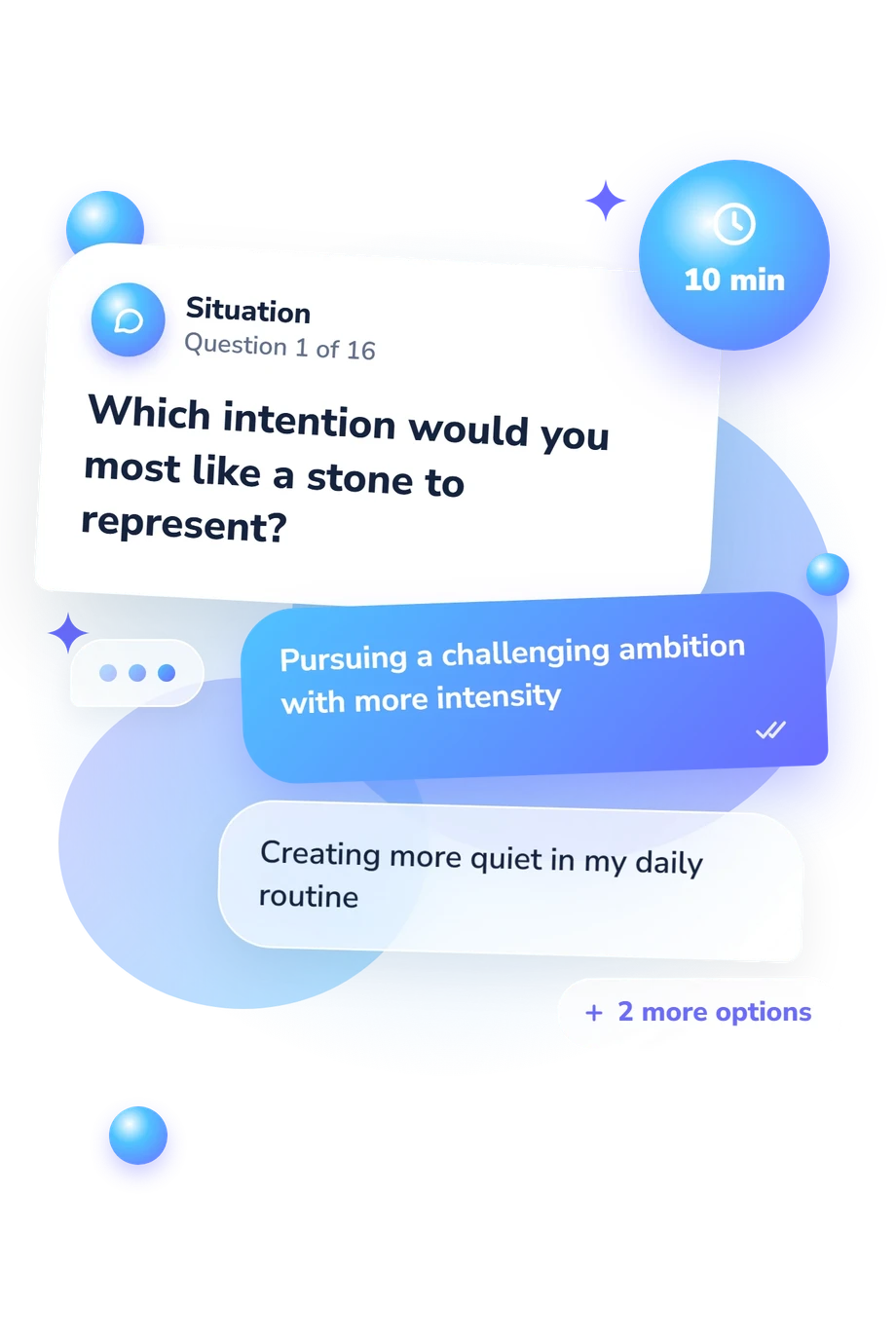
- Pursuing a challenging ambition with more intensity
- Creating more quiet in my daily routine
- Speaking to myself with greater patience and warmth
- Giving steady attention to the relationships I value
- Removing distractions and defining a clear zone for focus
- Adding photos that make the space feel affectionate and familiar
- Introducing more sunlight or an encouraging phrase
- Placing one solid, weighty object where I can see or touch it
- Trying one small but bold experiment today
- Organizing the materials before deciding what comes next
- Waiting until I feel completely calm and certain
- Telling someone my goal so it feels more real
Healing Quiz - Description and methodology of the test
People curious about the meanings they attach to recovery, rest, or personal change can use this healing quiz as a structured pause rather than a verdict. Someone wondering whether they feel healed can use this quiz for healing self-reflection, considering current symbolic preferences and intentions instead. It suits anyone drawn to symbolic objects and practical self-reflection.
What This Assessment Explores
Questions ask which qualities feel most restorative. As a healing test, it suits people who want reflective language for present priorities rather than a fixed personality label. Four symbolic dimensions are:
- Amethyst (0-12) shows affinity for quiet reflection and mental spaciousness; Light affinity: 0-4, Meaningful affinity: 5-8, Strong affinity: 9-12.
- Black Tourmaline (0-12) shows affinity for grounding, structure, and clearer limits; Light affinity: 0-4, Meaningful affinity: 5-8, Strong affinity: 9-12.
- Citrine (0-12) shows affinity for optimism, expression, and forward movement; Light affinity: 0-4, Meaningful affinity: 5-8, Strong affinity: 9-12.
- Rose Quartz (0-12) shows affinity for self-kindness, compassion, and heartfelt connection; Light affinity: 0-4, Meaningful affinity: 5-8, Strong affinity: 9-12.
The highest total is the strongest affinity; totals within one point create a blended result.
Methodology and Evidence Base
Each question presents four answer choices. Across the set, options repeatedly point toward action and confidence, quiet reflection, compassion and connection, or grounding and boundaries. Choosing one indicates the quality that feels most relevant now; it does not rate symptoms or assign a clinical category.
The score display compares four totals, identifies the strongest affinity, and shows close results as blended. The bands organize symbolic preference; they do not establish a universal point value for each response.
A 2025 study by Escolà-Gascón and colleagues on placebo responses, a 2018 survey by Kutlu and colleagues on healing-stone beliefs, and Kaptchuk’s 2011 work on ritual and meaning offer conceptual context, not evidence validating this quiz’s four scales, scoring, or bands. The questionnaire is not an adaptation of those studies.
As a healing stone quiz, it is a reflective exercise. Self-report can shift with mood, circumstances, and self-awareness; symbolic associations do not show that a stone treats illness or guarantees protection. The questionnaire has no documented standardized scoring, norms, reliability, or validity evidence; its bands are descriptive, not clinical cutoffs.
- Escolà-Gascón Á, Dagnall N, Drinkwater K, Denovan A, Benito-León J. Placebo effects in alternative medical treatments for anxiety: false hope or healing potential? CNS Spectrums. 2025;30(1):e70, 1-15. 10.1017/S1092852925100515
- Kutlu YA, Çalık A, Ulugergerli EU. A Survey Study on the Placebo Effect of Healing Stones. Journal of Awareness. 2018;3(Special Issue):199-208. 10.26809/joa.2018548630
- Kaptchuk TJ. Placebo studies and ritual theory: a comparative analysis of Navajo healing ceremonials, acupuncture and biomedical healing. Philosophical Transactions of the Royal Society B: Biological Sciences. 2011;366(1572):1849-1858. 10.1098/rstb.2010.0385
Updated: