
Hate Values Test
How the Scales are Structured
Who Usually Takes This Test?
See How You Compare
Below is a preview of how scores are typically distributed across each scale.
Example Questions From the Test
- Strongly disagree
- Disagree
- Not sure
- Agree
- Strongly disagree
- Disagree
- Not sure
- Agree
- Strongly disagree
- Disagree
- Not sure
- Agree
Hate Values Test - Description and methodology of the test
For readers examining their own reactions to moral conflict, the hate values test offers a structured way to notice when judgments about groups move toward certainty, contempt, or exclusion. The hate test focuses on value-based reactions and helps people examine polarized responses without reducing themselves to a fixed label. The result describes patterns in their answers and can support more deliberate choices during disagreement.
What This Assessment Explores
These items examine how moral disagreement can become judgments about a whole group’s character, status, or belonging. They cover absolute right-wrong framing, demeaning language, bad-faith assumptions, reduced compassion, retaliation, punishment, separation, and unequal power. Viewed as a hate values assessment, the profile shows which tendencies are more pronounced in the respondent’s answers, not whether the person belongs to a moral category.
The displayed dimensions are:
- Black-and-White Thinking (0-40) measures all-or-nothing interpretations; Low rigidity (0-13), Moderate rigidity (14-26), and High rigidity (27-40) show increasing inflexibility.
- Dehumanization & Contempt (0-40) measures reducing others to stereotypes or lesser personhood; Low (0-13), Moderate (14-26), and High (27-40) show increasing devaluation.
- Exclusion & Dominance Orientation (0-40) measures support for hierarchy, retaliation, or removing others from shared spaces; Inclusion-oriented (0-13), Mixed/conditional (14-26), and Dominance/exclusion-oriented (27-40) mark the displayed pattern.
Item Themes and Evidence Base
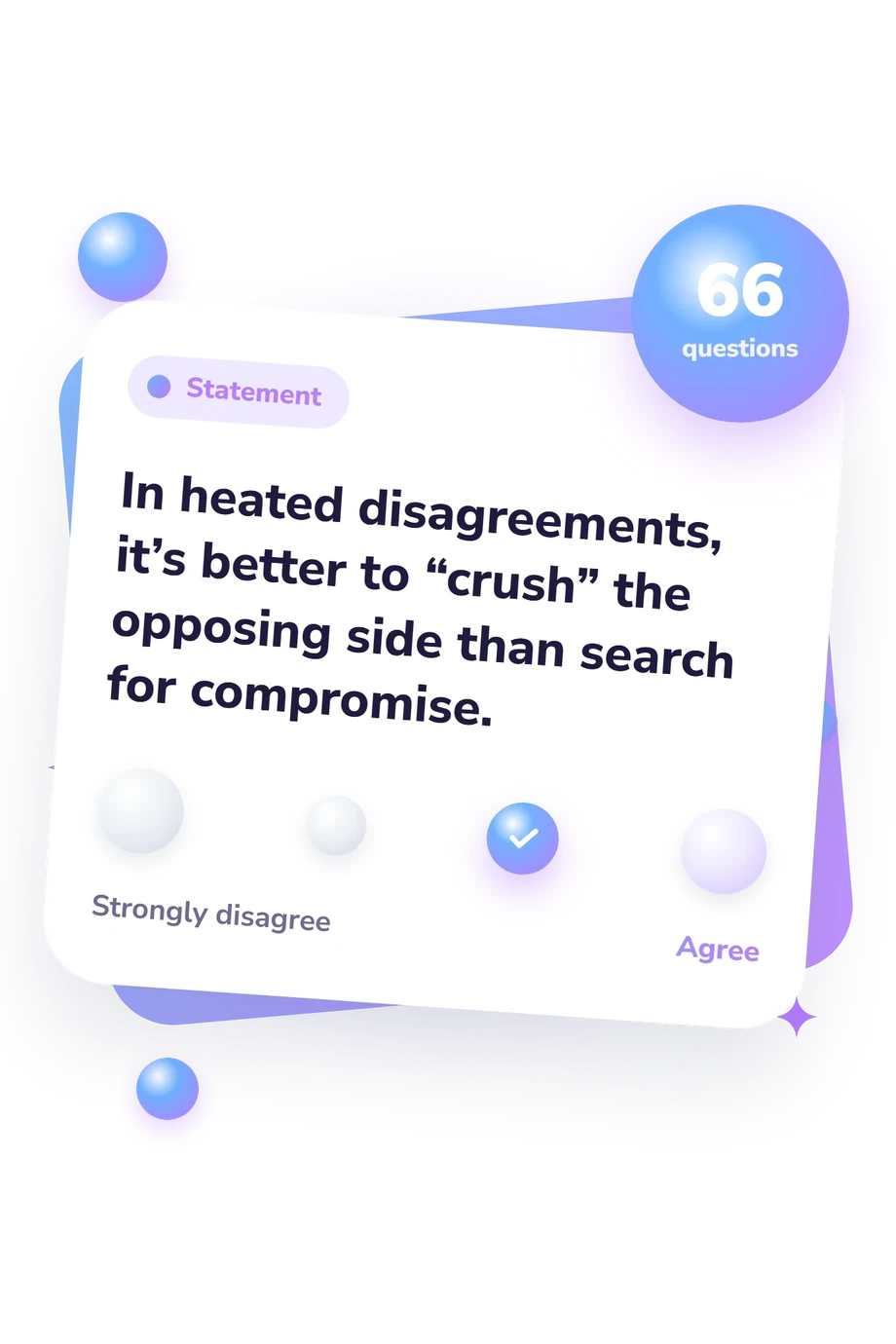
The questions are presented as first-person statements with options ranging from Strongly disagree to Agree. Statements address polarized judgments, demeaning labels, exclusion, punishment, hierarchy, and assumptions about whole groups. The result presents three dimension scores within the displayed ranges, but individual response weights are not specified.
The hate values questionnaire is conceptually consistent with the Hate Behaviours Scale (Vergani et al., 2025) and related work on dehumanization, social dominance, and dichotomous thinking, but it is not a direct adaptation or validated administration of those instruments. Related examples include Kteily et al.’s work on blatant dehumanization, Ho et al.’s SDO7 model of social dominance orientation, and Oshio’s Dichotomous Thinking Inventory. Together, these sources identify content areas represented by the statements: rigid categorization, devaluation, and support for unequal treatment.
Results are best read as a profile of response tendencies. They may show whether rigid, dehumanizing, or exclusionary patterns are more prominent, but they do not explain their causes or predict conduct in every setting. The displayed bands are not population norms or clinical thresholds; self-report can reflect current mood, self-presentation, and limited self-awareness.
- Vergani, M., Diallo, T., & O'Brien, K. (2025). Measuring the potential for hateful behaviours: Development and validation of the Hate Behaviours Scale (HBS). Terrorism and Political Violence, 37(2), 205-222. 10.1080/09546553.2023.2283565
- Kteily, N., Bruneau, E., Waytz, A., & Cotterill, S. (2015). The ascent of man: Theoretical and empirical evidence for blatant dehumanization. Journal of Personality and Social Psychology, 109(5), 901-931. 10.1037/pspp0000048
- Ho, A. K., Sidanius, J., Kteily, N., Sheehy-Skeffington, J., Pratto, F., Henkel, K. E., Foels, R., & Stewart, A. L. (2015). The nature of social dominance orientation: Theorizing and measuring preferences for intergroup inequality using the new SDO7 scale. Journal of Personality and Social Psychology, 109(6), 1003-1028. 10.1037/pspi0000033
- Oshio, A. (2009). Development and validation of the Dichotomous Thinking Inventory. Social Behavior and Personality: An International Journal, 37(6), 729-742. 10.2224/sbp.2009.37.6.729
Updated: