
Great Gatsby Chapter 8 Quiz
How the Scales are Structured
Who Usually Takes This Test?
See How You Compare
Below is a preview of how scores are typically distributed across each scale.
Example Questions From the Test
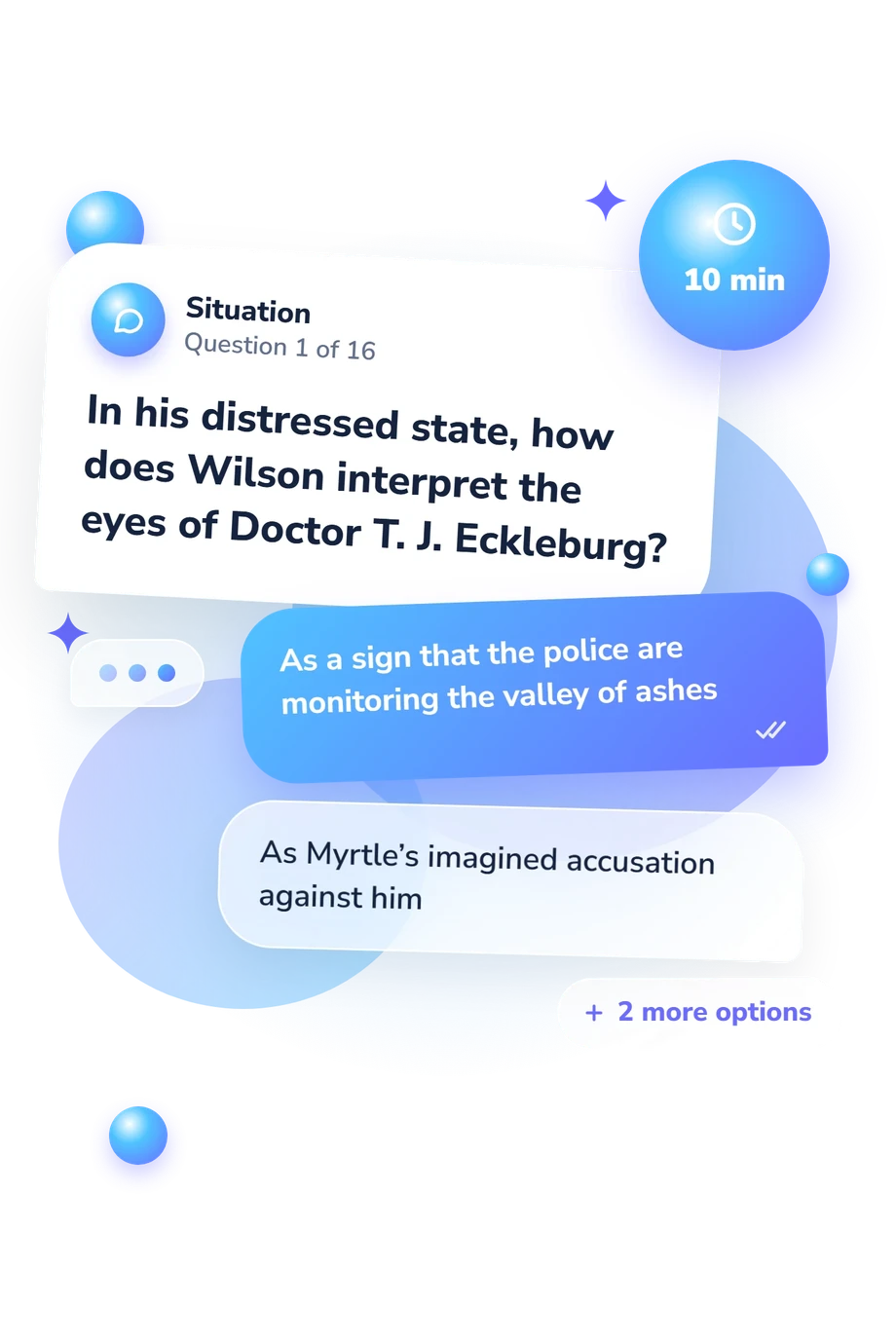
- As a sign that the police are monitoring the valley of ashes
- As Myrtle’s imagined accusation against him
- As the eyes of God watching human actions
- As a coded advertisement for Gatsby’s business
- Tell the police that Daisy was driving.
- Ask Jordan to provide an alibi.
- Hide the car at Wolfsheim’s office.
- Leave Long Island for a while.
- Daisy’s
- Wolfsheim’s
- Nick’s
- The police commissioner’s
Great Gatsby Chapter 8 Quiz - Description and methodology of the test
Readers checking Fitzgerald’s penultimate chapter can use the Great Gatsby Chapter 8 Quiz as a focused chapter review. It suits students, book-club members, and anyone preparing to discuss the ending. The result indicates current knowledge of Chapter 8 and command of its events, motives, imagery, and themes, while the review can build confidence for discussion. Chapter 8 quiz questions connect details with its emotional and moral turning points.
What This Assessment Explores
Chapter 8 follows Gatsby’s vigil, Wilson’s pursuit, the deaths at Gatsby’s estate, and Gatsby’s memories of Daisy. The prompts connect chronology, motive, setting, imagery, and Nick’s changing judgment, so the quiz asks for recall and supported interpretation of Great Gatsby Chapter 8 themes.
The questions bring together four thematic areas:
- Events and chronology show whether you place the pursuit, phone call, war memories, and deaths correctly.
- Character motives show how you read Gatsby’s hope and Wilson’s fixation; separate choices, absences, and Nick’s judgment also shape interpretation.
- Symbolic details test your understanding of Eckleburg’s eyes, the yellow car, pool, and valley of ashes.
- Themes connect desire, illusion, violence, class, and moral carelessness.
Great Gatsby Chapter 8 Knowledge is the single scale, ranging from 0-16: Foundations to Revisit (0-6), Developing Knowledge (7-12), and Strong Knowledge (13-16).
Methodology and Evidence Base
Each item presents an event- or passage-based prompt with four answer choices. You select the detail or interpretation best supported by the chapter, so performance depends on recognizing both what happens and how the text frames it. The output is one aggregate knowledge result; no additional weighting or item-level formula is stated.
Conceptually, the questionnaire follows Chapter 8 of Fitzgerald’s primary text, which supplies its events, conversations, and images. Gross and Gross add contextual discussion of the novel’s issues and historical background, while Ghiotto and Wijanarka support attention to color symbolism, including the yellow car and valley of ashes. Together, these sources support the questionnaire’s focus on Chapter 8’s events, conversations, images, and interpretive context.
As a Great Gatsby Chapter 8 study guide, the questionnaire offers an informal indication of current chapter knowledge through one displayed knowledge scale. Familiarity with the novel, recent memory, and care with close-reading questions can affect performance. Reviewing the chapter can prepare you for a later attempt; a retake then reflects both chapter knowledge and prior review.
- Fitzgerald, F. Scott. The Great Gatsby. New York: Charles Scribner's Sons, 1925.
- Gross, Dalton, and MaryJean Gross. Understanding The Great Gatsby: A Student Casebook to Issues, Sources, and Historical Documents. Westport, CT: Greenwood Press, 1998.
- Ghiotto, Monica Federica, and Hirmawan Wijanarka. "American Dreams Represented through the Color in Fitzgerald's The Great Gatsby." Journal of Language and Literature 16, no. 1 (2016): 55-62. 10.24071/joll.v16i1.151
Updated: