
Financial Health Quiz
How the Scales are Structured
Who Usually Takes This Test?
See How You Compare
Below is a preview of how scores are typically distributed across each scale.
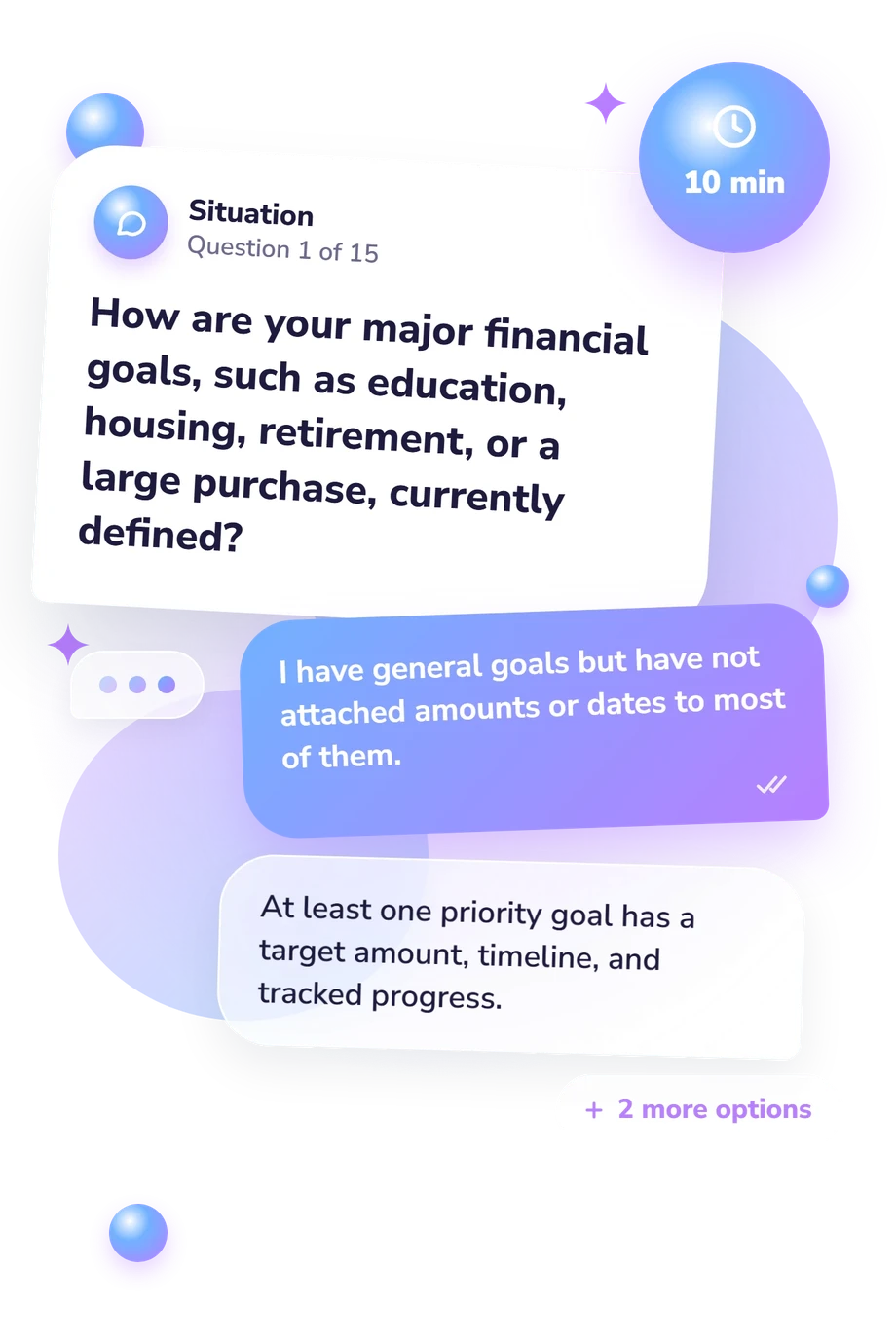
Example Questions From the Test
- I have general goals but have not attached amounts or dates to most of them.
- At least one priority goal has a target amount, timeline, and tracked progress.
- I mostly respond to financial needs as they arise rather than setting longer-term targets.
- I have estimated amounts or timelines for some goals, but progress is reviewed irregularly.
- I know the lenders and approximate balances but not most rates or payoff details.
- I maintain current balances, rates, minimums, and due dates, or I have no outstanding debt.
- I can identify most balances and payment amounts, though some terms would require checking.
- I would need to gather statements before I could list several of the debts or amounts.
- About one to four weeks.
- Three months or longer.
- Less than one week.
- About one to two months.
Financial Health Quiz - Description and methodology of the test
People who want a clearer picture of everyday money decisions can use this assessment to organize the evidence already visible in their routines. The Financial Health Quiz is intended for anyone reviewing household cash flow, borrowing, reserves, and longer-term choices. It can help answer whether your finances are stable by acting as a financial stability assessment: the profile shows which everyday habits make a financial system more resilient.
What This Assessment Explores
Rather than judging income alone, the questionnaire examines how a person manages obligations, absorbs disruption, controls borrowing, and advances future goals. Its situations cover bill timing, reserves, debt visibility, payment history, essential borrowing, large purchases, saving, protection arrangements, and longer-term reviews. As a financial security assessment, it locates pressure in cash flow, debt, or planning.
The result is organized into three dimensions:
- Cash-Flow Resilience (0-15) shows whether cash, buffers, and spending routines protect essentials; Strained (0-5), Building (6-10), and Established (11-15) mark increasing stability.
- Debt and Credit Control (0-15) reflects balance awareness, payment reliability, and deliberate credit use; Pressured (0-5), Managing (6-10), and Controlled (11-15) mark increasing control.
- Future Financial Planning (0-15) captures defined goals, progress, protection reviews, and considered tradeoffs; Unstructured (0-5), Taking Shape (6-10), and Purposeful (11-15) mark increasing direction.
Methodology and Evidence Base
Each item offers several descriptions of a financial situation, and the respondent chooses the option closest to their circumstances. Scenarios address income disruption, repairs, purchases, bills, debt payments, reserves, and longer-term decisions. Responses are combined into the displayed scales and bands; the result reports totals for those scales, while the conversion of individual answers into points is not stated.
Conceptually, the structure is consistent with the FinHealth Score, which views financial health as multidimensional, combining day-to-day management, resilience, and progress toward goals. It also aligns with the CFPB Financial Well-Being Scale and the perceived financial well-being model of Netemeyer, Warmath, Fernandes, and Lynch (2018). The questionnaire is not presented as an adaptation of those instruments, so their reliability, norms, and validation should not be attributed to this scoring.
As a financial health assessment, its bands are educational summaries rather than population norms. Debt categories are not creditworthiness judgments, and planning categories are not individualized investment, insurance, tax, or retirement advice. Self-report results can shift with stress, events, memory, and candor; use the profile to identify the next habit or information gap to examine.
- Financial Health Network. (2021). FinHealth Score® Toolkit. Chicago, IL: Financial Health Network.
- Consumer Financial Protection Bureau. (2017). CFPB Financial Well-Being Scale: Scale Development Technical Report. Washington, DC: Consumer Financial Protection Bureau.
- Netemeyer, Richard G., Dee Warmath, Daniel Fernandes, and John G. Lynch, Jr. (2018). How Am I Doing? Perceived Financial Well-Being, Its Potential Antecedents, and Its Relation to Overall Well-Being. Journal of Consumer Research, 45(1), 68-89. 10.1093/jcr/ucx109
Updated: